Afghan Diaspora Rallies Mark Five Years Under Taliban
“Afghanistan should not be forgotten, and Afghan women should not be left alone.”
Five years after the Taliban seized Kabul on 15 August 2021, ending the internationally recognized republic and prompting a chaotic foreign troop withdrawal, Afghan diaspora communities worldwide turned grief into public defiance.
While the Taliban held victory celebrations in Kabul, Afghan diaspora groups organized protests, discussions, music, and statements across Europe, North America, South America, Australia, and South Asia. Their common message was clear: Afghanistan must not be forgotten, gender apartheid must end, and the Taliban should not gain legitimacy.
In at least 24 cities, from Munich and Düsseldorf to Geneva, Malmö, Washington, São Paulo, Tehran and Islamabad, Afghans and supporters gathered.
Inside Afghanistan itself, where open street protests face severe risks, a spontaneous women’s movement in Badakhshan issued a public declaration. It described 15 August as one of the bitterest days in recent history and vowed to continue civil resistance until justice, freedom and equal rights are restored. The statement rejected the systematic exclusion of women and girls from education, work, and public life as a direct attack on human dignity.
Voices from Europe and Beyond
In Düsseldorf, protesters stood outside the office of the North Rhine-Westphalia state premier near the state parliament. Speakers including former higher education minister Abbas Basir, women’s rights activists and Amnesty International members condemned ongoing human rights violations, ethnic and religious discrimination, and the risk of forced returns of Afghan refugees. They urged Germany not to normalize relations with the Taliban and to uphold the principle of non-refoulement.
Munich hosted a gathering of Afghan activists, academics, and German supporters that focused on the same themes. Participants stressed that half the population’s exclusion from education and work damages the entire country’s future.
In Malmö, Sweden, demonstrators outside a church near Triangeln station declared that being a woman in Afghanistan has effectively become a crime and rejected gender apartheid.
Geneva saw a prominent rally outside the United Nations. Singer Aryana Sayeed and former health minister Suraya Dalil joined others to demand that the UN hold the Taliban accountable and recognize gender apartheid as a crime.
Sayeed said the objective of the demonstration was “to stand for the rights of Afghan women and girls.” She added that the world has forgotten Afghan women and no longer hears about them.
“It seems to the world that not going to school or not going to work for women is something very simple. We are here to bring the voices of Afghan women to the world and stand for them and also want gender apartheid to be recognized as a criminal act.”
Saeed called the travel of Taliban officials to the European Union unacceptable for every Afghan and expressed hope that the world would not recognize the group until the human rights of Afghan women are restored.
“It was surreal to see the Taliban were invited to Europe, and this should not have taken place.”
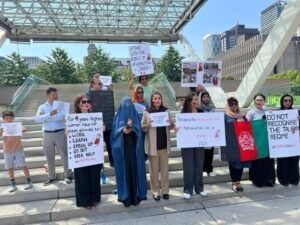
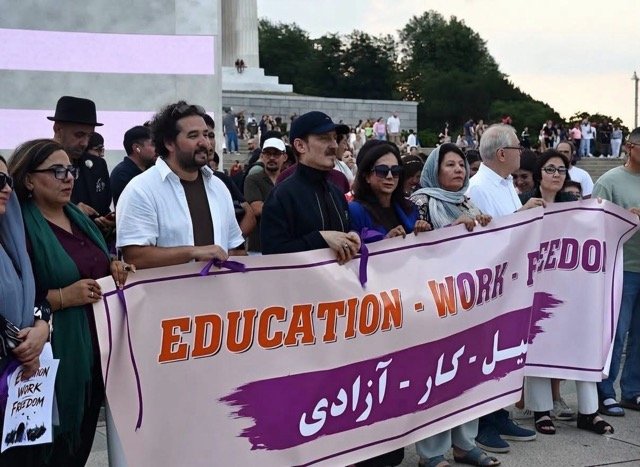
Similar events took place in Spanish cities and London, where participants discussed poverty, hunger, and the erasure of women from public life. Across the gatherings, slogans echoed repeatedly: “Do not recognize the Taliban,” “Education, work, freedom,” “No to the Taliban,” and “Stop gender apartheid in Afghanistan.”
In Washington, singer and songwriter Farhad Darya took part in a protest organized in support of Afghan women. He later reflected that the true value of such gatherings lies not only in numbers but in refusing to let Afghanistan fade into memory.
Darya stressed personal responsibility, saying that if people do not participate in these demonstrations, they should not expect the international community to act. On education, he urged that if Afghan girls cannot access schools and universities, they should turn to online education and free media, which young people can use to learn many times more than in traditional classrooms.
“Afghanistan should not be forgotten, and Afghan women should not be left alone,” he later wrote on his Facebook page.
In Brazil, the group Voice for Women’s Rights and the Afghan Refugee Rescue Organization held a program titled “15 August: Narrative of a Nation, Voice of Afghan Women and Girls.” Speakers, a documentary, and personal testimonies highlighted the political and social consequences of the takeover and the continuing responsibility of the international community.
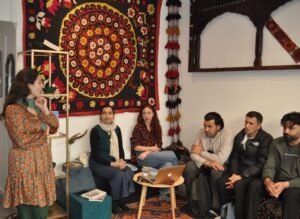
A women’s discourse held shortly before the anniversary brought together several Afghan women’s movements. Participants examined five years of deprivation, resistance, and demands for justice. They argued that excluding women is not merely a “women’s issue” but a threat to Afghanistan’s development, economy, and political future. Speakers warned against the normalization of these restrictions and stressed the need for solidarity, transparency, and continued documentation of rights violations.
Resistance Continues Despite Risks
Across these events, the same demands repeated: restore education and work for women and girls, protect refugees, reject recognition of the Taliban, and keep pressure on the international community.
Activists pointed out that protests inside Afghanistan are routinely suppressed, making diaspora voices essential. Women in Afghanistan’s northeastern Badakhshan province and elsewhere have continued quieter forms of resistance through education networks, documentation, and civil advocacy.
Analysts note that the anniversary highlights a growing gap. In Kabul, the Taliban staged parades and claimed restored security. Outside the country, diaspora communities, artists, former officials, and ordinary citizens insisted that control of territory does not equal legitimacy. They argued that any engagement with the Taliban must center on human rights and an inclusive political process involving women and civil society.
Five years on, the protests show that memory and mobilization have not faded. From Badakhshan’s declaration to rallies in European capitals, Washington, Islamabad, and São Paulo, the message remains consistent: the systematic removal of half the population from public life cannot become permanent, and the world must not look away.
The Afghan diaspora has made clear that as long as Afghan women and girls remain silenced at home, their voices will continue to be raised abroad.