Five Years of Taliban Rule: Munich Voices Demand Action for Afghan Women
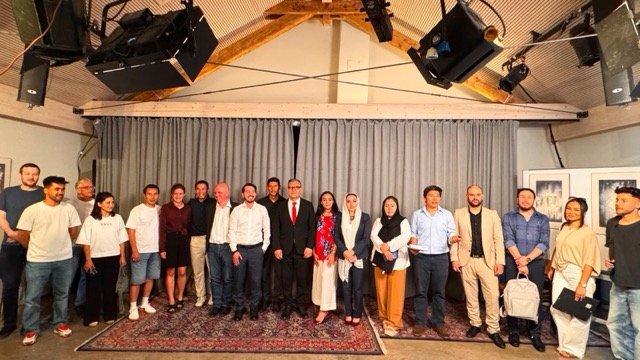
The participants of the Munich event on August 15 gathered to commemorate the fall of Afghanistan and the loss of Afghan women’s rights. Photo: @Organizers to ADN
Any engagement with the Taliban must take human rights seriously and must not normalize or legitimize the ongoing violations.
Five years after the Taliban returned to power, the situation in Afghanistan remains one of the world’s most urgent human rights crises. On 15 August 2026, activists, academics, human rights defenders, artists, political figures and Afghan community members gathered at Bellevue di Monaco in Munich to reflect on what these five years have meant — and what responsibilities the international community must not ignore.
The event brought together voices from inside Afghanistan and Pakistan. Women joined live to describe their daily reality: restrictions on movement, fear of arrest, loss of education, and the disappearance of basic freedoms. Their testimonies were not abstract political statements; they were lived experiences of a society where half the population has been pushed out of public life.
Speakers and panelists discussed key issues shaping Afghanistan today: human rights, the situation of women and girls, the collapse of education, economic hardship, migration, asylum, and the role of Germany and the European Union. The message was clear — Afghanistan is not only facing a political crisis, but a deep social and humanitarian one.
The final declaration of the event emphasized several core principles. First, human rights are not privileges. The right to education, work, freedom and dignity belongs to every human being, regardless of geography or political context.
In Afghanistan today, these rights are systematically denied to women and girls. Their exclusion from schools, universities, workplaces and public spaces is not only a violation of their rights — it is a direct threat to the future of the entire country.
Participants stressed that Afghan women and girls must not become bargaining chips in political negotiations. Any engagement with the Taliban must take human rights seriously and must not normalize or legitimize the ongoing violations.
The international community cannot afford to treat Afghanistan as a forgotten crisis.
Germany, the EU and global institutions were urged to take responsibility for protecting those most at risk: women, civil society activists, journalists, artists and minorities. Many of these individuals continue to face persecution, violence and discrimination. Their safety cannot depend on political convenience.
Another central message was the importance of Afghan voices in shaping the country’s future. Decisions about Afghanistan cannot be made without women, youth and civil society. Their participation is not symbolic — it is essential for any meaningful path forward.
Speakers also warned against the growing global silence surrounding Afghanistan. Media attention has faded, political priorities have shifted, and humanitarian resources have declined. But the crisis has not ended. The restrictions on women, the suppression of free expression, the targeting of minorities, and the shrinking space for civil society continue every day.
The declaration ended with a powerful reminder:
Education is not a privilege. Work is not a privilege. Women’s rights are not a privilege. Freedom is not a privilege. These are human rights.
Human rights know no borders. And Afghanistan must not be forgotten.
The organizers — Afghan activists in Munich, supported—called on journalists, civil society, policymakers and ordinary citizens to continue amplifying the voices of Afghan women and girls. Their struggle is not only a national issue; it is a global responsibility.