“Education Is Resistance”: Former Child of Taliban Rule Warns of a New Lost Generation
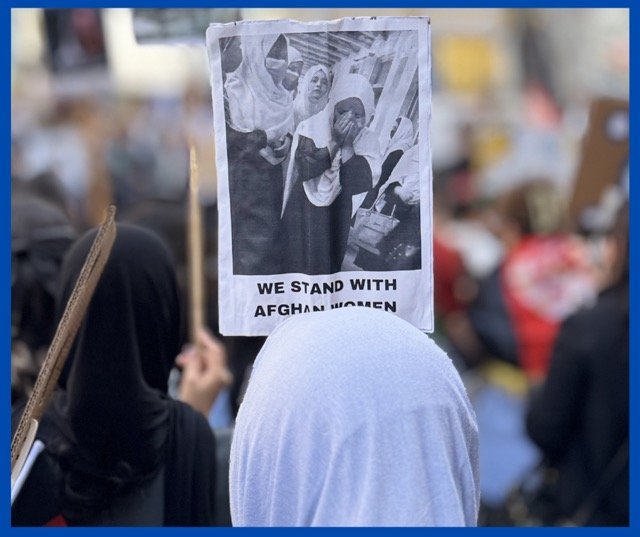
An Afghan girls holding a picture of a girl during a demonstration in Vienna. The placards reads: "We stand with Afghan women." Photo: @Ali Ahmad
By Kazim Jafari
When Afghan activist Zuhal Salim shared a video on Instagram this week, it quickly drew attention—not only for its emotional force but also for the painful history behind it. While the video focused on the Taliban’s current repression of women, Salim’s deeper reflections on her childhood under the Taliban in the late 1990s—which she has previously written about on X—give her message a haunting weight.
Salim was five years old when the Taliban captured Kabul in 1996. She spent the next five years of her childhood under a regime responsible for severe human rights violations, including the systematic erasure of women and girls from public life. On X, she has described witnessing acts of brutality no child should ever see. Those memories, she says, have never left her.
Now, watching history repeat itself, she calls it “horrifying.” A new generation of Afghan children—especially girls—is growing up under the same darkness she once lived through.
In her Instagram video, Salim explains why the Taliban fear women’s education so intensely. Their fear, she argues, is not of women themselves, but of educated women—women who can think critically, organize, document abuses, lead, work, and make independent decisions. These are precisely the qualities that authoritarian systems find threatening.
This, she says, is why girls are banned from secondary school and university, why women are pushed out of offices, media, and public life, and why even basic forms of participation are treated as subversive. Education gives women independence—and independent women are harder to control.
Her analysis reflects a broader truth long recognized by Afghan women’s rights advocates: education is not merely a pathway to opportunity; it is a direct challenge to systems built on silence and obedience.
Yet Salim also highlights a quieter, more defiant reality inside Afghanistan. Despite the bans, women and girls continue to seek knowledge through underground schools, secret study circles, and informal networks of learning. These acts, she says, are not just attempts to study — they are acts of resistance.
Her message is ultimately a warning and a call to attention. The world may debate diplomatic strategies, but Afghan women are already engaged in a daily struggle for survival and dignity. Their determination to learn—even in secret—exposes the fragility of a regime built on fear.
Salim’s testimony makes one thing clear: a society that fears educated women is a society afraid of its own future.
Kazim Jafari is a political science student at the University of Heidelberg in Germany.
Note: The contents of the article are the sole responsibility of the author. Afghan Diaspora Network will not be responsible for any incorrect statements in the articles.