Rebuilding Heritage Online: The Afghan Diaspora’s Push to Digitize Pashto Language
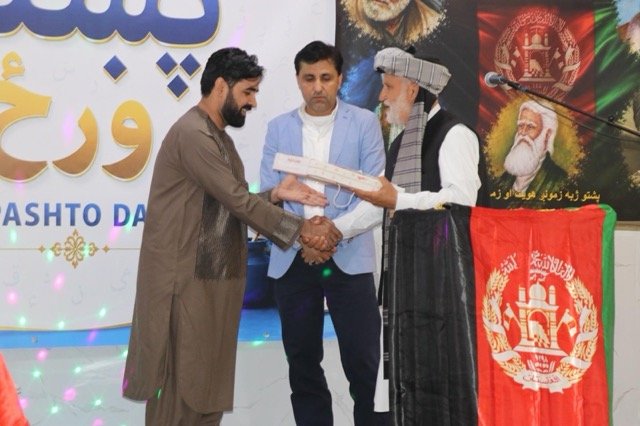
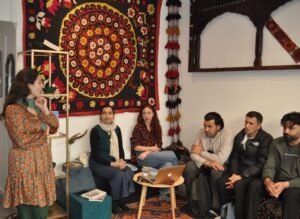
On June 14, the Afghan Social Progress Association in the Netherlands held an event to mark International Pashto Day. Toryalai Wesa, an education activist (left), receives an appreciation letter from the organizers. Photo: @Social Progress Association in the Netherlands
“If Pashto does not enter the digital world, it will struggle to survive among future generations.”
By Abdul Wakeel Attock
In the Netherlands, far from the landscapes of Kabul and Kandahar, a quiet but determined movement is reshaping the future of the Pashto language. At the center of this effort is Khyber Wisaal, a social activist who has lived in the country for more than three decades. Although his professional life is rooted in engineering, his deeper mission lies elsewhere: safeguarding the cultural and linguistic heritage of his community through digital innovation.
Wisaal began his education in Kabul but completed his secondary and higher studies in the Netherlands. His personal journey mirrors that of many Afghans who left home but continue to carry its cultural weight. For him, language is not simply a means of communication; it is the backbone of identity, a vessel of memory, and a bridge between generations. In an era defined by rapid technological change, he believes Pashto must evolve or risk fading from daily use.
“Languages survive when they adapt,” he says. “If Pashto does not enter the digital world, it will struggle to survive among future generations.”
Three Innovators Building the Digital Foundations of Pashto
On June 14, the Afghan Social Progress Association in the Netherlands held a public event to mark International Pashto Day. The gathering honored three young innovators whose work has laid the digital foundations for Pashto in the age of artificial intelligence. Their achievements, carried out independently and often without institutional support, represent a milestone for Afghan communities abroad.
The first innovator was Ahmad Wali Achakzai, based in Germany. He is widely regarded as a pioneer of Pashto digitalization. His website, qamosona.com is the largest Pashto dictionary database in existence. Over the past twenty‑five years, he has catalogued hundreds of thousands of words and preserved more than 200,000 poems and couplets. Students, researchers, and AI developers rely on his work daily. In effect, he has built the linguistic backbone that any language needs to thrive in the digital era.
The second innovator, Hanif Rahman, lives in London and holds a master’s degree in computer science. Rahman leads the Pashto component of Mozilla Common Voice, a global project that collects voice data to train speech‑recognition systems. His contribution is extraordinary: he has built a Pashto linguistic corpus containing 1.25 billion words. Without such corpora, computers cannot learn to recognize a language, distinguish dialects, or process speech accurately. Rahman’s work has placed Pashto firmly on the map of global AI development.
The third innovator, Jandad Jahani, also based in Germany, transformed Rahman’s technical foundation into a community movement. He organized volunteer teams to record voices, gather dialect samples, and encourage women to contribute their speech as well. His efforts resulted in 5,500 hours of recorded Pashto audio, making Pashto one of the top languages in the entire Common Voice project—surpassing global giants like English, Arabic, and Spanish in voice contributions.
“These three young men have done work that normally requires governments and academic institutions,” Wisaal said. “They achieved it with nothing but dedication.”
Digitalization as Cultural Preservation for the Afghan Diaspora
The digitalization of Pashto is more than a technological achievement; it is a cultural lifeline for Afghans living abroad. For diaspora communities, language is the most fragile link to heritage. Children born in Europe or North America often grow up speaking the dominant language of their environment, while Pashto becomes confined to the home—or lost altogether. Without digital tools, the transmission of language across generations becomes increasingly difficult.
Digitalization changes that dynamic. When a language exists in mobile apps, online dictionaries, AI systems, and digital learning platforms, it becomes accessible to young people who navigate the world through screens. It becomes part of their daily digital ecosystem rather than a distant cultural obligation.
The work of Achakzai, Rahman, and Jahani provides exactly that:
- A vast dictionary that makes Pashto searchable and learnable.
- A massive linguistic corpus that allows AI systems to process Pashto text.
- Thousands of hours of voice recordings that enable speech recognition and dialect preservation.
For the Afghan diaspora, these tools are not luxuries—they are essential mechanisms for cultural continuity. They allow families to teach their children their mother tongue, enable communities to maintain cultural cohesion, and ensure that the language remains alive in the digital spaces where younger generations spend most of their time.
Digitalization also democratizes cultural preservation. In the past, safeguarding a language required institutions, funding, and government support. Today, diaspora communities can contribute directly—recording their voices, sharing dialects, building databases, and creating online learning platforms. This participatory model strengthens community bonds and reinforces a shared sense of responsibility.
The Afghan Social Progress Association embodies this ethos. Beyond celebrating International Pashto Day, the organization hosts cultural events, teaches language classes in local community centers, and offers online courses. Through digital communication tools, they maintain ties with Afghanistan, support local initiatives, and help create opportunities for people back home. Jahani’s voice‑recording teams, for example, allowed participants in Afghanistan to earn small payments for contributing their voices—an innovative blend of cultural preservation and economic support.
In this way, digitalization becomes a form of empowerment. It allows diaspora communities to preserve their heritage while actively shaping the future of their language. It transforms cultural nostalgia into practical action. And it ensures that Pashto, like other global languages, will not be left behind as technology continues to redefine how communities communicate, learn, and remember.
Afghan poet Abdul Wakeel Attock previously served as the director of culture for the eastern provinces of Laghman and Nooristan.
Note: The contents of the article are the sole responsibility of the author. Afghan Diaspora Network will not be responsible for any incorrect statements in the articles.