Afghan Refugees Fear Arrest and Deportation in Khyber Pakhtunkhwa
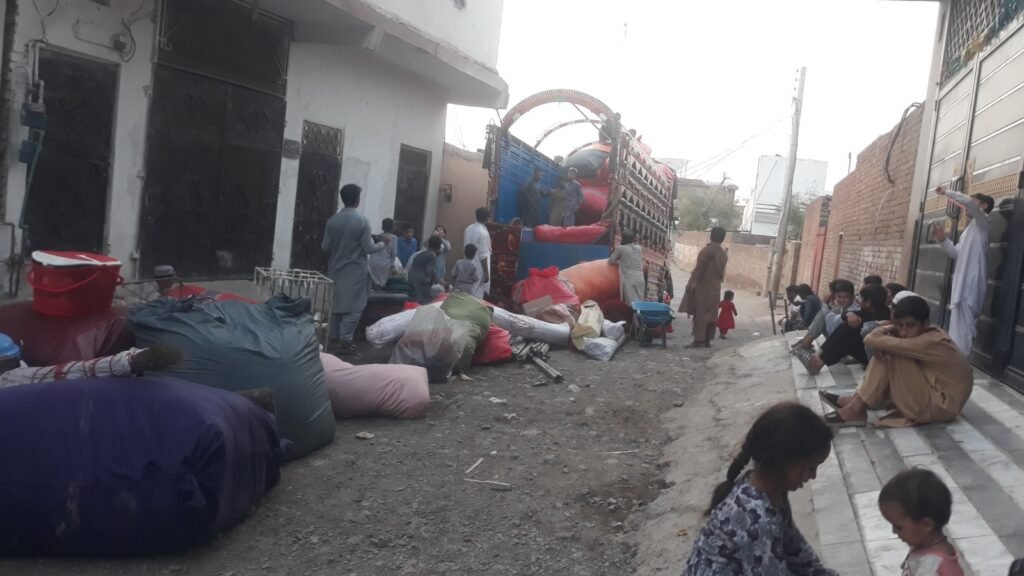
Peshawar, on the Pakistani side of the Durand Line. Photo: @Dawood Jabarkhail
By Dawood Jabarkhail
As Pakistan’s federal government tightens its grip on Khyber Pakhtunkhwa following the imposition of emergency rule and a governor’s administration, a familiar group is once again bearing the consequences: Afghan refugees.
Reports from the province indicate that the detention and deportation of Afghans have accelerated since the political changes took effect. Refugee advocates and community members say Afghan migrants are being arrested, held for unspecified periods, and eventually deported to Afghanistan, despite concerns about their safety and prospects upon return.
The development reflects a pattern that has become increasingly common in Pakistan’s approach to migration. Whenever security challenges, political crises, or economic pressures intensify, Afghan refugees often become convenient targets of state policy.
Many of those now at risk are not recent arrivals. According to reports from Khyber Pakhtunkhwa, many Afghans who had previously been forced to leave other Pakistani provinces moved to the Pashtun-majority province, where they settled with relatives and found accommodation in rented homes. For years, Khyber Pakhtunkhwa served as a relatively more tolerant environment for Afghan refugees compared to some other parts of Pakistan.
Analysts note that the previous provincial government led by Pakistan Tehreek-e-Insaf (PTI) maintained a comparatively softer approach toward Afghan refugees. While refugees still faced challenges, many were able to work, run small businesses, and sustain social networks built over decades.
That situation appears to be changing rapidly.
With the implementation of governor’s rule, federal policies are now being enforced more aggressively in the province. Refugees report restricting their daily activities out of fear of arrest. Some avoid markets, workplaces, and public spaces where police operations are likely to occur. Families already struggling with rising rents, unemployment, and documentation issues now face the additional anxiety of possible detention and deportation.
The human consequences of these policies extend far beyond administrative measures.
Many Afghan families have spent years, and in some cases decades, building lives in Pakistan. Their children were born there, attended local schools, and became integrated into local communities. Yet despite these realities, Pakistani authorities continue to view large segments of the Afghan population primarily through the lens of security and border control.
The contradiction is difficult to ignore.
Pakistan has for decades played a central role in Afghanistan’s modern history. Successive Pakistani governments positioned themselves as key actors in Afghan affairs while simultaneously hosting millions of Afghan refugees who fled wars, instability, and economic collapse. Today, however, many of those same refugees face uncertainty and expulsion at a time when Afghanistan remains gripped by economic hardship, widespread unemployment, and severe humanitarian challenges.
Refugee rights advocates argue that any return process should comply with legal and humanitarian standards. Families facing potential persecution, security risks, or humanitarian hardship should have their cases assessed individually rather than being subjected to blanket deportation measures.
Yet such concerns are increasingly overshadowed by domestic politics.
The timing of the intensified deportation campaign raises important questions. As Pakistan grapples with growing political tensions, rising militancy and economic difficulties, tougher measures against Afghan refugees may serve political purposes by demonstrating state authority and shifting public attention toward migration and security issues.
The policy may also prove shortsighted.
Afghan communities have long been woven into the social and economic fabric of Khyber Pakhtunkhwa. Thousands of small businesses, labor networks, and local markets depend on their participation. Analysts warn that large-scale deportations could have social and economic repercussions for the province itself.
More importantly, the campaign risks further damaging Pakistan’s image at a time when international scrutiny of refugee rights is intensifying.
For Afghan families living in Khyber Pakhtunkhwa, however, the debate is not about geopolitics or public policy. It is about survival. Many are now living in fear, uncertain whether their next trip to work, school, or the market could result in detention and removal from the only home they have known for years.
As Pakistan deepens its emergency measures in Khyber Pakhtunkhwa, Afghan refugees appear to be among the first casualties of a policy that prioritizes security optics over human realities. The question is not only how many people will be deported but also whether Pakistan is once again using one of the world’s most vulnerable refugee populations to manage a crisis of its own making.