A Language Beyond Borders: From Rabia Balkhi to Afghan Women Today
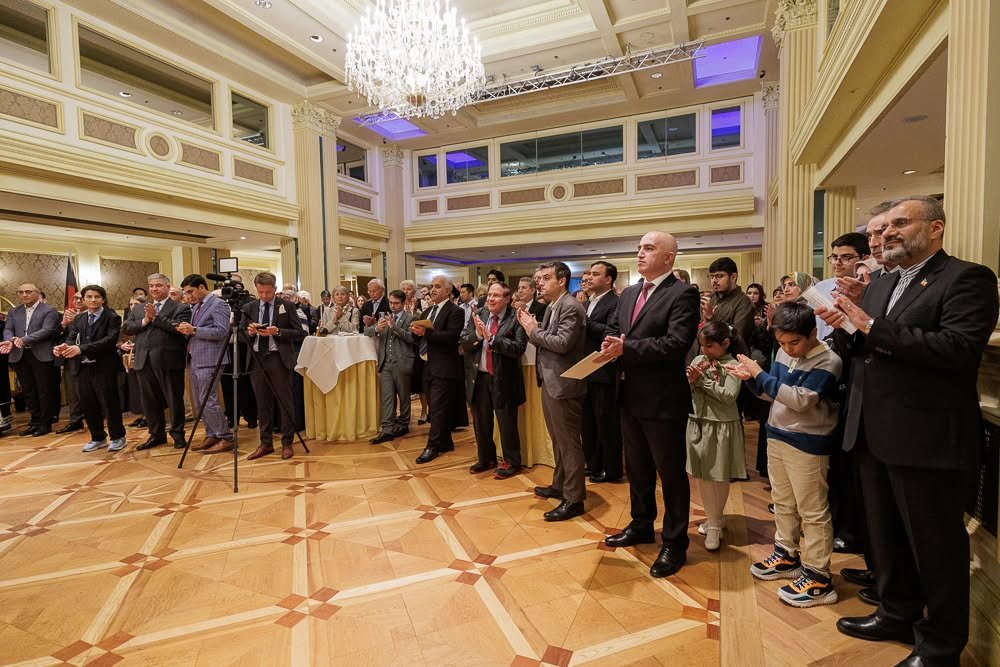
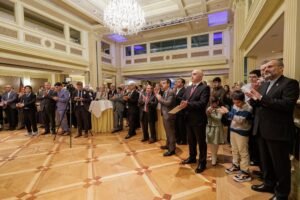
Guests applaud during the “Cultural Heritage of the Persian-Speaking Countries: From Rabia Balkhi to Hafez Shirazi” event in Vienna on October 12. Photo: @Society Magazine
Persian is more than a language. It is a living cultural space that continues to connect people across borders and generations.
On 12 October, in a chandelier-lit ballroom in Vienna, diplomats, scholars, artists, and guests from across Europe gathered to celebrate a language that has traveled across mountains, empires, and centuries. The event, titled “Cultural Heritage of the Persian-Speaking Countries: From Rabia Balkhi to Hafez Shirazi,” brought together representatives of Afghanistan, Iran, and Tajikistan for an evening dedicated to a shared literary tradition that continues to shape the cultural identity of millions.
Organized by Gertrud Tauchhammer and the Diplomatic Society in cooperation with the embassies of Afghanistan, Iran, and Tajikistan, the gathering was more than a tribute to poets of the past. It became a reflection on identity, memory, cultural diplomacy, and, for some speakers, the struggle for freedom in the present.
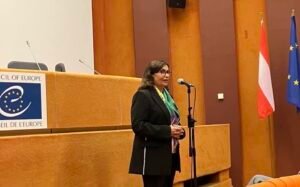
Among the evening’s speakers was Manizha Bakhtari, Afghanistan’s ambassador in Vienna, who described Persian, or Dari, as more than a language.
“Persian is not simply a language through which we communicate,” she told the audience. “It is a home in which our collective memory lives.”
For Bakhtari, the language serves as a bridge connecting Afghanistan, Iran, and Tajikistan through a shared cultural inheritance that transcends modern political boundaries. It is the language of lullabies sung by mothers, poems recited in homes and schools, and philosophical reflections passed from one generation to the next.
Her message echoed themes raised also by Iran’s ambassador Asadollah Eshragh Jahromi, who described Persian as a “living bridge” connecting peoples across West Asia, Central Asia, and beyond. He argued that Persian literature remains one of the region’s most powerful forms of cultural diplomacy, linking communities from Balkh, Herat, and Kabul to Dushanbe, Samarkand, Bukhara, Shiraz, and Isfahan.
“We speak in a voice that resonates simultaneously across Iran, Afghanistan, and Tajikistan,” he said, describing Persian poetry as a common cultural home shared across borders.
The two ambassadors spoke of a literary tradition that includes towering figures such as Ferdowsi, Rudaki, Nizami, Saadi, Attar, Omar Khayyam, Jalaluddin Balkhi (Rumi), and Hafez Shirazi. Their works, they argued, belong not to one nation but to an entire civilizational space shaped by a common language and cultural memory.
Yet among all the celebrated names mentioned throughout the evening, one figure stood apart.
For Bakhtari, the story of Rabia Balkhi carried particular significance.
Widely regarded as one of the earliest female poets in Persian literature, Rabia was born more than a thousand years ago in the ancient city of Balkh, in present-day Afghanistan. Historical and literary accounts portray her as an educated, talented, and independent woman at a time when opportunities for women were severely limited.
According to legend, she fell in love with a man named Baktash, crossing rigid social boundaries that defined her era. When their relationship was discovered, she was imprisoned and ultimately killed. Literature tells us that, as she lay dying, she wrote her final verses on the walls with her own blood.
Whether every detail of the story is historically accurate remains a matter of debate. But for generations of readers, Rabia has endured as a symbol of courage, artistic freedom, and resistance.
“She refused to surrender her love, her voice, or her freedom, even in the face of death,” Bakhtari said.
The story resonated deeply because it connected the past to a painful reality in Afghanistan today.
More than a millennium after Rabia’s lifetime, Afghan women once again face severe restrictions on education, employment, and participation in public life. Girls remain barred from secondary and higher education, while many female writers, scholars, and artists have been pushed to the margins of society.
“As a woman and a writer of this literary tradition, I find this contradiction heartbreaking,” Bakhtari said.
The contrast is striking. Afghanistan proudly celebrates Rabia Balkhi as a literary icon, yet many contemporary Afghan women are denied the very freedoms that allowed her voice to emerge and survive through history.
The Iranian ambassador also linked literature to broader questions of human dignity and justice. From the epic verses of Ferdowsi to the mystical poetry of Hafez, he argued, Persian literature consistently defended values such as freedom, dignity, and resistance against oppression.
“Hafez rejected hypocrisy and violence and called for compassion and humanity,” he said, describing the poet’s message as surprisingly relevant in today’s polarized world.
The evening also highlighted Vienna’s own place in the history of Persian literature. Speakers noted the role of Austrian orientalist Joseph von Hammer-Purgstall, whose early nineteenth-century German translation of Hafez introduced Persian poetry to Europe and inspired Johann Wolfgang von Goethe’s famous West–Eastern Divan. The story served as a reminder that cultural exchange between Europe and the Persian-speaking world has deep roots.
As the speeches concluded and musicians from Afghanistan, Iran, and Tajikistan took the stage, the atmosphere shifted from reflection to celebration.
Yet the central message of the evening remained clear.
Persian is more than a language. It is a living cultural space that continues to connect people across borders and generations. And for Afghanistan, whose cultural heritage often disappears behind headlines about conflict and crisis, it remains a powerful reminder that the country’s story is not only one of war but also of poetry, scholarship, and intellectual achievement.
More than a thousand years after Rabia Balkhi’s death, her voice still echoes across that shared cultural landscape. For Bakhtari, that persistence offers hope.
If a poet from ancient Balkh could survive in memory for eleven centuries, perhaps the voices of Afghanistan’s women today can survive as well, until they are once again free to become poets, scholars, thinkers, and dreamers in their own right.