The Body and the Pen Under the Black Turban: Pragmatics, Neuro-Aesthetics, and Biopolitics in the Writing of Homeira Qaderi
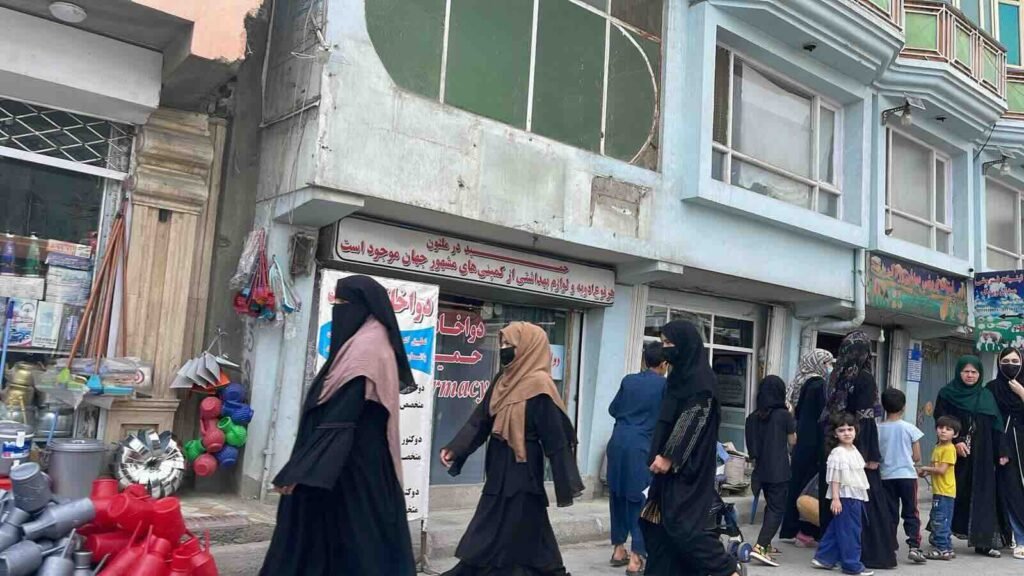
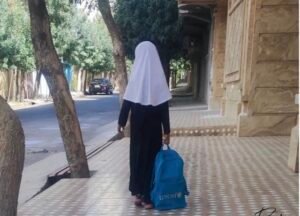
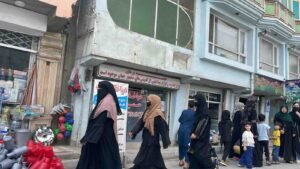
Afghan women in Kabul in 2025. Photo: @AADIL for ADN
Exile does not represent the end of Afghan writing; it is the transition of testimony from the national territory to the diasporic space.
By Ivan Pozzoni
The Performativity of Testimony and the Deixis of Grief
The production of Homeira Qaderi, particularly her epistolic memoir Dancing in the Mosque: An Afghan Mother’s Letter to Her Son (2020) and her novel Noqra: The Daughter of Kabul River (2009), must be read as a practice of narrative resistance against patriarchal subordination and politico-religious violence. Qaderi does not limit herself to recording trauma: through the first person, she transforms private experience into public testimony. Dancing in the Mosque arises, in part, from the necessity to leave her son Siawash a trace of her own story and of the battle fought to maintain his custody. Particularly significant is the sentence recalled by the writer regarding her own childhood: «My grandmother believed that one of the most difficult tasks that the Almighty can assign anyone is being a girl in Afghanistan.» It is accompanied by the recollection: «As a child, I didn’t want to be a girl. I didn’t want my dolls to be women». Female identity appears to be early perceived not as a simple biological datum, but as a social position subjected to a specific distribution of vulnerability.
Fear, Memory, and the Narrative Body
Trauma in Qaderi is not represented as a psychological category but as an embodied experience. Fear alters the perception of space, the relationship with movement, and the elementary possibilities of learning. During the first Taliban regime, Qaderi organized clandestine classes for girls and taught the children of displaced persons, transforming education into a practice of resistance. Testimonies regarding her experience in the underground school also document the episode of the lesson hosted in the structure called the ‘mosque’, where a young Qaderi taught boys and girls under the surveillance of the Taliban. The narrative of fear must be interpreted, with due caution, through neuro-aesthetics as a device of perceptual simulation: the reader does not merely receive information about terror but reconstructs through the text sequences of threat, anticipation, and relief. It is incorrect to identify such a process with a direct physiological reproduction of the author’s trauma: literature should foster empathy and simulation, but it does not automatically allow for the deduction of a deterministic neurobiological response. Furthermore, the episode of the ‘mosque’ assumes a symbolic value: a space subjected to religious control is temporarily transformed into a site of literacy. The female body, rather than being disciplined through prohibition, becomes a vehicle for the transmission of knowledge.
The Pen as Counter-Power
Qaderi explicitly defines her literary activity as a form of combat. In an interview with the Afghanistan Women’s News Agency, she declares: «در تمام این سالها از راه قلمم مبارزه کردهام» («In all these years, I have fought through my pen»). This phrase is important because it does not constitute a critical interpretation applied externally to her work: it is the author herself who defines writing as a practice of resistance. Qaderi connects this struggle to the years under the Taliban regime and to the subsequent democratic phase, identifying literary production as the primary instrument through which she sought to counter oppression. The pen must be interpreted as an epistemic counter-device: not because it literally replaces material force, but because it restores to the female subject the capacity to name that which the patriarchal system tends to render invisible. Writing thus produces cognitive and political agency.
Patriarchal Law and Expropriated Motherhood
One of the most powerful thematic cores of Dancing in the Mosque is the experience of motherhood and the custody battle over Siawash. Qaderi recounts her fight against a legal system in which the custody of a male child passed, after a certain age, from the mother to the father. Her private experience immediately becomes political: the maternal body is subjected to a legal regulation that claims to establish the temporal limit of the relationship between mother and child. Qaderi herself describes motherhood as the sudden opening of a “window” onto a world of «خشم و ستم و زنستیزی», that is, of anger, oppression, and misogyny («anger, oppression, and misogyny»). Motherhood, initially perceived as a natural right, reveals itself to be a politically vulnerable condition. The motif of the dolls – «I didn’t want my dolls to be women»- acquires, within this framework, a particular retrospective force: as a child, she intuits in the transformation of the doll into a woman the entrance into a social order marked by subordination.
Education and Disobedience
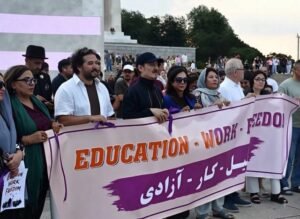
One of the most explicit passages of the memoir concerns the right to education. Qaderi writes: «من میدانم که در بعضی از کشورها آموزش و تحصیل یک حق برای زنان است اما در کشور من چنین نیست» («I know that in some countries education and study are a right for women, but in my country, it is not so»). This passage, referenced from page 124 of Dancing in the Mosque, continues by describing the condition of the Afghan woman as a subject exposed to beatings, humiliation, and blame. The formulation possesses a precise pragmatic force: the utterance does not limit itself to noting the absence of a right; it constructs a contrast between two normative regimes, the one in which education is recognized as a right, and the one in which it is denied. This comparison highlights the arbitrariness of the prohibition and transforms autobiographical recollection into political indictment. Clandestine education becomes an elementary form of civil disobedience: teaching how to read means wresting a portion of power from a system that claims to control who may access knowledge.
Literature as Survival
The function of writing is articulated by Qaderi in a second, particularly significant statement: «ادبیات برای من نجات دهنده بوده است» («Literature for me has been a savior»). This assertion acquires its full meaning within the context of her lived experience. Qaderi recounts that, during the Taliban rule, several of her female friends died by suicide due to despair, and that writing offered her a means of escaping depression. Literature thus becomes a technique of symbolic survival rather than a mere representation of trauma. Writing effects a decisive transformation: that which appears in reality as helplessness is converted into narrative, and narrative enables the subject to regain an enunciative position. The pain does not disappear, but it becomes speakable.
Exile and the Deixis of Distance
Exile constitutes a second form of bodily dislocation. The loss of territory does not coincide with the erasure of memory: the homeland continues to exist in language, in memories, and in the relationship with her son. In the memoir, the following formula appears: «مادر گفت مهاجرت یعنی بیگانه شدن در کشور دیگری و مردن در تنهایی» («Mother said: emigrating means becoming a stranger in another country and dying in solitude»). This passage is cited from page 21 of Dancing in the Mosque. Emigration thus acquires a double semantics: it is simultaneously an escape from violence and a loss of the spatial continuity of identity. The physical safety of exile does not erase the affective cost of displacement. Today, Qaderi lives in the United States and conducts academic research at the Yale MacMillan Center. Exile does not represent the end of Afghan writing; it is the transition of testimony from the national territory to the diasporic space.
Motherhood as a Counter-Act
The epistolary form of Dancing in the Mosque transforms physical absence into textual presence. The letter addressed to her son is not merely an autobiographical document: it is the device through which the mother reasserts a relationship that the law and geographical separation may limit but cannot symbolically erase. The text produces an institutional counter-act: where the norm dictates who is fit to exercise motherhood, the narrative constructs a different form of legitimacy based on memory, care, and affective continuity.
Noqra and the Female Genealogy of Memory
The discourse on resistance must not be restricted to the memoir. Noqra: The Daughter of Kabul River, published in 2009, constructs a narrative genealogy centered on women, traversing different moments in Afghan history. The novel allows Qaderi to shift resistance from the testimonial self to the construction of a plural female memory. The difference between the two works is significant: in the memoir, resistance stems from the first-person testimonial voice; in Noqra, it is entrusted to the narrative construction of a plurality of female experiences. In both cases, however, Qaderi rescues the experience of women from documentary marginality and transforms it into literary material.
Conclusions
The writing of Homeira Qaderi demonstrates how literature can become a device of resistance without devolving into propaganda. Clandestine education, fear, bodily control, legal subjection of motherhood, and exile are transformed into narrative forms capable of restoring agency to a female subject that the patriarchal system continuously seeks to define from the outside. As Faridullah Bezhan observes in his study of Afghan women’s literature, «women’s connectedness to revolution and jihad» must be considered alongside the structures of violence and resistance that shape Afghan women’s experience (Women, War and Islamic Radicalization in Maryam Mahboob’s Afghanistan, Monash University Publishing, 2016). The author’s three explicit declarations: «در تمام این سالها از راه قلمم مبارزه کردهام» («I have fought through my pen all these years»), «ادبیات برای من نجات دهنده بوده است» («Literature for me has been a savior»), and «من میدانم که در بعضی از کشورها آموزش و تحصیل یک حق برای زنان است اما در کشور من چنین نیست» («I know that in some countries education and study are a right for women, but in my country, it is not so») allow us to condense the political core of her work without resorting to apocryphal citations. The child who refuses to imagine her dolls as women, the adolescent who teaches clandestinely, the mother who fights for her son, and the writer who transforms exile into memory belong to different moments of a single trajectory: the conquest of the ability to name one’s own body, experience, and destiny. From this perspective, body and pen are not separate dimensions. The body is that which power attempts to discipline; writing is the space in which that body speaks once more. As Judith Butler argues in What World Is This?: A Pandemic Phenomenology, what may appear to be a «harmonious embrace» between the world and the subject can become «a chokehold that deals pain rather than joy» (Columbia University Press, 2022).
About the author: Ivan Pozzoni was born in Monza in 1976. He introduced Law and Literature in Italy and the publication of essays on Italian philosophers and on the ethics and juridical theory of the ancient world; he collaborated with several Italian and international magazines. He wrote 152 volumes, wrote 1000 essays. His verses/essays are translated into 30 languages.
Note: The contents of the article are the sole responsibility of the author. Afghan Diaspora Network will not be responsible for any incorrect statements in the articles.