The Drug Trade’s New Geography: A Shift to Pakistan
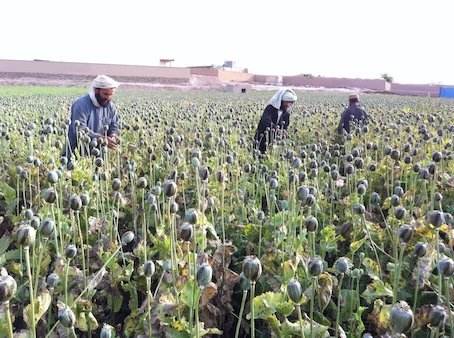
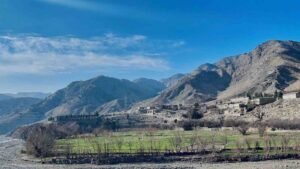
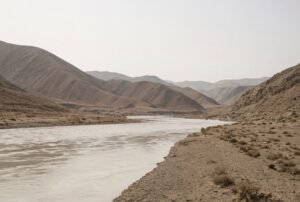
Southern Uruzgan province, Afghanistan.
As Afghanistan’s opium production plummets under the Taliban’s drug ban, new evidence suggests that cultivation is increasingly moving across the country’s borders, raising questions about whether the regional narcotics economy is shrinking or simply relocating.
By Rahmatullah Achakzai
The Taliban administration has launched a fresh diplomatic and media campaign to highlight what it portrays as a major success in the fight against narcotics. Yet rather than focusing solely on declining drug production inside Afghanistan, Taliban officials are increasingly directing attention toward neighboring Pakistan, which they accuse of becoming a new center for cultivation, processing, and trafficking.
In recent remarks, Abdul Mateen Qani, spokesperson for the Taliban’s Interior Ministry, claimed that most narcotics entering Afghanistan, including traditional and synthetic drugs, are now being smuggled from Pakistan. He urged Islamabad to fulfill its responsibilities in preventing drug trafficking and called on the international community, particularly the United Nations, to pressure Pakistan to curb drug cultivation, production, and cross-border smuggling.
Speaking to TOLOnews, Qani went further, alleging that narcotics are being cultivated and processed in Pakistan’s Balochistan province before being trafficked into Afghanistan and onward to other countries in the region. He argued that while neighboring countries’ drug industries have received little international scrutiny, Afghanistan has faced sustained pressure despite what the Taliban describe as significant progress in eradicating cultivation. He urged the UN and other international actors to investigate and condemn drug production in Pakistan and Iran.
The statements reflect an emerging narrative from Kabul: that Afghanistan’s notorious opium economy has been dramatically reduced, while cultivation has increasingly shifted beyond its borders.
There is evidence supporting at least part of this claim. According to a July 2026 report by the United Nations Office on Drugs and Crime (UNODC), Afghanistan experienced a 95 percent decline in opium production after the Taliban imposed a nationwide ban on poppy cultivation in 2022. The area under cultivation fell from approximately 232,000 hectares in 2022 to around 10,200 hectares in 2025, while opium production dropped from roughly 6,200 tonnes to 296 tonnes. Afghanistan, which once supplied around 80 percent of the world’s illicit opium, has seen one of the most significant reductions in narcotics production ever recorded in the country.
For the Taliban, those figures have become a key source of political legitimacy, particularly at a time when the movement continues to seek greater international recognition. The anti-drug campaign is one of the few policy areas where international institutions have acknowledged measurable results.
Yet the broader regional picture suggests the story may be less about elimination than displacement.
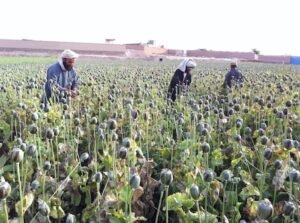
A recent investigation by Radio Free Europe/Radio Liberty found growing evidence that opium production is expanding in border regions of Pakistan and Iran. According to satellite imagery and field research cited by the report, Pakistan’s Balochistan province has emerged as a significant center of poppy cultivation. David Mansfield, one of the leading experts on Afghanistan’s illicit drug economy, described the Afghanistan-Pakistan-Iran borderlands as an emerging global center for opium production following the Taliban ban. Satellite assessments identified more than 9,000 hectares of poppy cultivation in Balochistan alone.
The findings have been echoed by analysts cited in regional reporting. According to research referenced by TOLOnews, poppy cultivation has expanded in Balochistan as well as Iran’s Sistan-Baluchistan province since the Taliban’s ban took effect. Experts argue that Afghan farmers and traders have increasingly transferred cultivation expertise, investment, and supply networks across the border, creating new production hubs outside Afghanistan.
Economic incentives appear to be driving the shift. Farmers interviewed by RFE/RL pointed to drought, insecurity, and declining returns from traditional agriculture as reasons for turning to poppy cultivation. Afghan growers from former production centers such as Helmand and Kandahar have reportedly crossed into Pakistan to lease land and establish new farming operations.
Pakistan has consistently denied widespread opium cultivation and maintains that any discovered poppy fields are eradicated. At the time of reporting, Pakistani authorities had not publicly responded to the Taliban’s latest accusations.
Meanwhile, Pakistan faces growing domestic concerns related to narcotics. A recent report highlighted how Karachi’s drug crisis has become increasingly visible through theft linked to addiction, including stolen electrical cables, damaged infrastructure, missing railings, and disruptions to public services. While separate from the issue of poppy cultivation, the report underscored the broader challenge drugs pose to governance and public security in Pakistan.
Still, Afghanistan’s role in the narcotics trade should not be understated. UN officials note that substantial opium stockpiles accumulated before the Taliban ban are expected to last through at least the end of 2026. RFE/RL also reported evidence of continued, albeit limited, cultivation in parts of Afghanistan, particularly in Badakhshan and some southwestern provinces.
The emerging debate is therefore not simply about whether Afghanistan has reduced opium production. It is about what comes next. If cultivation is indeed moving into Pakistan and Iran, the Taliban’s drug ban may be reshaping the geography of the regional narcotics economy rather than ending it. The result could be a new phase in the decades-long drug trade: one in which the center of production shifts across borders, while the underlying drivers of the industry remain largely unchanged.
About the author: Rahmatullah Achakzai is a journalist based in Balochistan, covering human rights, regional politics, and cross-border issues.
Note: The contents of the article are the sole responsibility of the author. Afghan Diaspora Network will not be responsible for any inaccurate statements in the articles.