From Bookshelves to Community: An Afghan Activist’s Mission in Vienna
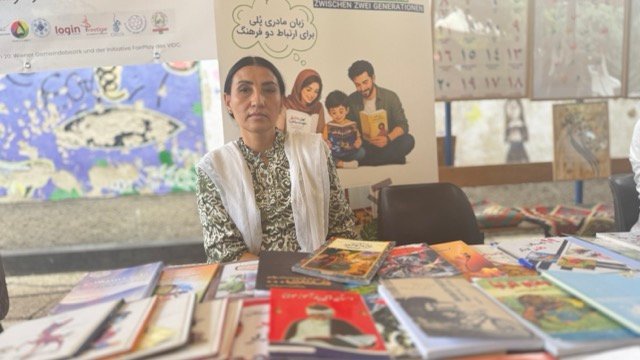
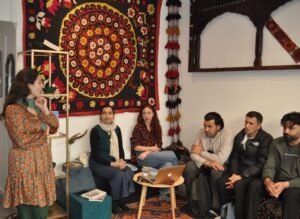
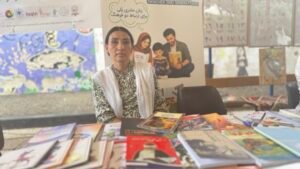
Shaima Khudayar, initiator of the Farhangsara Online Library in Vienna, works to promote reading, preserve Persian language and culture, and strengthen connections within the Afghan diaspora. Photo: @Ali Ahmad
“Many Afghans remain psychologically tied to Afghanistan long after migration.”
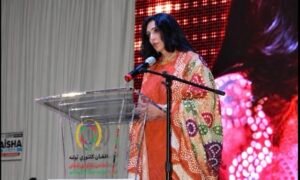
At the 13th From Kabul to Vienna integration festival held this July in Vienna, visitors moved between cultural exhibitions, music performances, and community initiatives showcasing Afghan life in Austria. Among the participants was Shaima Khudayar, coordinator of the Farhangsara Online Library and a cultural activist with the New Beginning Association (Aghaz-e Nawin).
While many discussions at the festival focused on integration, identity, and migration, Khudayar spoke about something simpler but equally important: books, language, and community.
Through the cultural section of the Aghaz-e Nawin, she helps oversee two initiatives designed to preserve Afghan culture while supporting life in Austria: the Farhangsara Online Library and a Persian-language school for Afghan children.
“We established an online Persian-language library that includes literary, historical, and cultural books,” she said. “Alongside that, for almost two years now, we have operated the Farhangsara Persian School, where Afghan migrant children learn their mother tongue.”
For Khudayar, language is more than a tool of communication. It is a connection between generations.
Many Afghan children growing up in Austria speak Persian or Dari at home but cannot read or write in their native language. The school aims to close that gap by helping children maintain a connection to their cultural heritage as they grow up in a European society.
“Our goal is for children to be able to read and write their mother tongue, remain connected to their culture, and use language as a bridge between parents and children,” she said.
The same philosophy guides the Farhangsara Online Library, a project that emerged from an observation she made within the Afghan diaspora.
Visiting Afghan families and community members over the years, she noticed a common pattern. Many households owned small collections of books, sometimes including valuable works of literature, history, and poetry. Yet many of those books remained untouched on shelves for years.
“I started thinking about how these books could be reused,” Khudayar said. “Some of them were very good books, but nobody was reading them.”
Rather than creating a traditional library, she helped develop a system that connects readers directly with people who own books.
The process is simple. Books are photographed and listed online through the Farhangsara platform. Anyone interested in reading a particular title can contact the association. The reader is then connected with the owner of the book, allowing them to arrange a meeting and exchange the book directly.
But the initiative soon produced unexpected benefits.
People who previously did not know one another suddenly found themselves meeting over shared literary interests. Book exchanges often turned into conversations, friendships, and community connections.
“They meet each other, exchange books, and sometimes sit together for tea or coffee at our association,” Khudayar said.
What began as a book-sharing project gradually evolved into a community-building initiative.
For Khudayar, that social dimension is just as important as promoting reading.
“My main objective was to bring people back from the virtual world,” she said. “I saw that many people in our community spend so much time on social media. I wanted Afghans in the diaspora to return to the real world and to reading books.”
She believes reading not only increases knowledge but also encourages deeper reflection and healthier forms of social interaction.
“As a cultural person, my goal has always been that people read books,” she said.
Khudayar’s own life story reflects many of the challenges faced by Afghan migrants.
She studied law and diplomacy in Afghanistan, completing part of her education in Kabul and part in Mazar-e Sharif. Like many Afghans of her generation, however, conflict disrupted her academic plans before she could complete her degree.
After arriving in Austria 26 years ago, she resumed her education but chose a different path, focusing on German language studies and teacher training.
Living between two cultures has shaped her perspective on migration, integration, and identity.
Today, she believes one of the greatest challenges facing the Afghan diaspora is adapting to the realities of life in a new country while maintaining a sense of cultural belonging.
“Afghan diaspora communities need solidarity, cooperation, and people who genuinely care about their community and their country,” she said.
At the same time, she argues that many Afghans remain psychologically tied to Afghanistan long after migration.
“If I could solve one problem, it would be for my people to accept that they are no longer living in Afghanistan,” she said.
In her view, many diaspora continue to focus on Afghanistan’s problems and the possibility of eventual return, while paying less attention to building stable lives in the countries where they now reside.
“They should not only think about rebuilding Afghanistan,” she said. “They should think about rebuilding their lives in their new country.”
The statement is not a call to abandon cultural roots. Rather, Khudayar sees cultural preservation and integration as complementary goals.
The Farhangsara school helps children maintain their language and identity. The online library encourages reading, personal interaction, and community engagement. Together, the projects seek to strengthen the Afghan community while helping its members navigate life in Austria.
For Khudayar, successful integration does not require forgetting where one comes from. It requires using that heritage as a foundation for moving forward.
In an age dominated by screens, algorithms, and social media feeds, her work offers a different vision of community, one built through books, conversation, and human connection.
Every borrowed book, she believes, is about more than reading.
It is an opportunity to learn, to connect and, perhaps most importantly, to build a stronger sense of belonging far from home.