Durand Line Restrictions Push Afghanistan to Diversify Trade
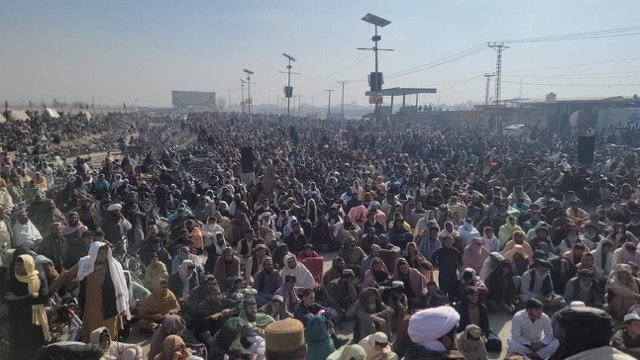
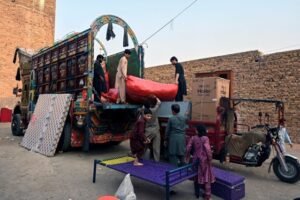
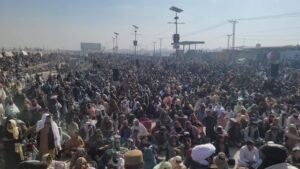
Crowds gather at a Durand Line crossing, highlighting the human and economic costs of recurring transit restrictions between Afghanistan and Pakistan.
By Dawood Jabarkhail
For decades, Pakistan served as Afghanistan’s primary gateway to international markets. Through transit crossings along the Durand Line and access to the ports of Karachi, Afghan traders moved a substantial share of the country’s imports and exports via Pakistani territory. Yet repeated closures of crossings and recurring restrictions on transit have exposed the risks of relying too heavily on a single commercial corridor, forcing Afghanistan to rethink long-standing assumptions about trade and regional connectivity.
The immediate consequences have been significant. Afghan businesses have faced delays in shipments, rising transportation costs, disruptions to supply chains, and, in many cases, increased prices for consumers. For traders dealing in perishable goods or operating on narrow margins, even a short interruption can result in substantial losses.
These disruptions have also highlighted a deeper structural problem. Afghanistan’s dependence on Pakistani transit routes was built on convenience, geography, and historical trading patterns. For years, Karachi offered the shortest and most accessible route to international markets, making Pakistan an essential transit partner. However, every closure along the Durand Line has demonstrated how quickly political or security tensions can affect economic activity.
As a result, Afghan traders and policymakers have accelerated efforts to diversify the country’s trade routes and reduce dependence on any single neighbor.
Iran’s Chabahar Port has emerged as one of the most important alternatives, providing Afghanistan with a direct connection to maritime trade beyond Pakistan. At the same time, northern corridors linking Afghanistan with Uzbekistan, Turkmenistan, and Tajikistan have become increasingly important. The Hairatan crossing has gained strategic value, while growing commercial engagement with China and participation in regional infrastructure projects reflect a broader effort to strengthen economic links across multiple directions.
This is not merely a logistical adjustment. It represents an attempt to make Afghanistan’s trade more resilient. By connecting to multiple transit routes, markets and partners, the country can reduce its exposure to sudden disruptions and improve its bargaining position within the region.
Consequently, investment in roads, railways, border infrastructure, regional transport corridors, and energy projects has taken on greater importance. Improved connectivity with Central Asia and expanded access to regional markets are increasingly viewed as necessities for long-term economic stability rather than simply opportunities for growth.
The transition, however, remains challenging. Alternative routes often involve higher transportation costs and require infrastructure that is still being developed. Building new commercial networks takes time, investment, and regional cooperation. In the short term, Afghan businesses continue to shoulder much of the economic burden created by uncertainty along traditional transit corridors.
Beyond commerce, the issue also reflects broader geopolitical dynamics that have shaped the region for decades. Pakistan’s role in Afghanistan has long been a subject of debate among policymakers, researchers, and regional observers. Critics have argued that Islamabad’s security establishment pursued influence in Afghanistan through various proxy forces over several decades, contributing to instability that repeatedly undermined both economic development and regional integration. Analysts have frequently linked Pakistan’s support networks and sanctuary for the Taliban to the movement’s ability to survive and eventually return to power after two decades of war.
Today, an irony has emerged in regional politics. Pakistan’s relationship with the Taliban government has become increasingly strained, even though the Taliban’s return to power was once widely viewed as serving Islamabad’s strategic interests. At the same time, Afghan political circles increasingly speculate that former officials and security figures from the previous republic who seek to challenge Taliban rule have found varying degrees of space and accommodation in Pakistan’s Islamabad. These claims reinforce a persistent Afghan perception that the country continues to be affected by competing regional power struggles and proxy politics.
From an economic perspective, these dynamics carry important consequences. Trade, investment, and regional connectivity depend on predictability and trust. When relations are repeatedly shaped by security competition and political leverage, commercial ties inevitably suffer. The frequent disruption of transit routes encourages traders to seek alternatives and accelerates the search for new economic partnerships.
The situation raises important questions for Pakistan as well. Geography provides a natural advantage in regional trade, but geography alone cannot sustain long-term economic influence. Transit hubs remain relevant when they offer reliability, predictability, and confidence to businesses. If traders repeatedly experience disruptions, they eventually adapt, and alternative routes that once appeared secondary can become permanent features of regional commerce.
As Afghanistan expands its economic links with Iran, Central Asia, China, and other regional partners, the country’s trade map is gradually changing. What began as a response to restrictions along the Durand Line is increasingly becoming a broader strategy aimed at reducing vulnerability and expanding economic options. In that sense, the recurring disruption of traditional transit routes may ultimately have an unintended consequence: accelerating Afghanistan’s shift toward a more diversified regional trading network and diminishing its dependence on any single corridor.
Note: The contents of the article are the sole responsibility of the author. Afghan Diaspora Network will not be responsible for any inaccurate statements in the articles.