The Poisonous Snake on the Tongue: Pragmatics, Neuro-Politics, and Subversive Morphometry of the Afghan Landay in the Mirman Baheer Circle

By Ivan Pozzoni
The repression exercised by theocratic regimes concerns the control of bodies, spaces, and speech. In the Afghan context, the progressive exclusion of women from the public sphere has transformed the voice into a contested political territory. Enforced silence becomes a form of erasure of subjectivity. Against such marginalization, the Pashtun oral tradition continues to offer tools for expression and resistance. Within this framework, the landay assumes particular significance: a short Pashto poetic composition, traditionally oral and often anonymous, consisting of two lines totaling twenty-two syllables- nine in the first line and thirteen in the second. Its essential structure facilitates memorization and transmission. Themes range from love to separation, from marriage to war, from death to the female condition. The landay thus constitutes a micro-structure capable of converting individual experience into collective discourse. Anonymity reinforces this function. The poem is meant to be remembered, modified, and transmitted without relying on an authorial signature. Poetry thereby becomes a form of memory that is exceptionally difficult for authority to control.
The Landay and Mirman Baheer
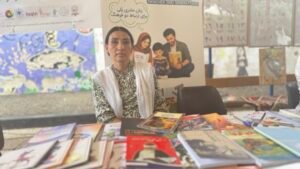
This function emerges with particular clarity in the female poetry circle Mirman Baheer (مېرمن بهير), active in Kabul and connected to women in the provinces through telephonic communications. The circle constitutes a network of poetic sharing in which oral tradition converges with contemporary communication technologies. Women from diverse social backgrounds can participate, directly or remotely, in a literary community founded on speech and listening. Orality assumes a precise political function in this context: a written text risks confiscation or destruction, whereas a memorized line is capable of continued circulation. The brevity of the landay, alongside its rhythmic cadence, promotes interpersonal transmission and transforms poetry into a shared heritage. The force of this form is exemplified in the first distich:
تاليبان وژني افغانان
خدای دي برباد کړي تاليبان
“The Taliban kill Afghans / May God destroy the Taliban”.
The composition is constructed as an accusation followed by an invocation. The first line names the violence; the second symbolically reverses the balance of power, entrusting the destruction of the oppressor to divine justice. The poetic word thus performs an action: it denounces, accuses, and curses. In pragmatic terms, the speech act becomes a vehicle for political subjectification.
Knowledge, the Body, and the Female Condition
The resistance embedded in the landay also confronts the intersection of power, knowledge, and the body:
مي ويلي نه شي لوستل پوهېدنه
کله چې ناروغ شې زما به در يادېږي
“You forbid me to study and acquire knowledge / When you fall ill, you will remember me”.
The prohibition of education is converted into an ironic prophecy. The knowledge denied to women returns as a future necessity. When the oppressor requires medical care, he will be forced to reckon with the consequences of the knowledge he prevented them from acquiring. The poem transforms subordination into a paradox: those who control knowledge engineer their own vulnerability. The landay therefore becomes a space in which women reassert their right to speech and their epistemic agency. In this perspective, the body constitutes the exact locus where knowledge and power collide.
War, Technology, and the Body
The traditional form also incorporates the conflicts of modernity:
بې پيلوټه الوتکه شوه راپیدا
زما جانان يې په وینو ولړلو
“An unmanned aircraft [a drone] appeared / and covered my beloved in blood”.
The reference to the drone introduces a contemporary warfare technology into poetic diction. The machine is described through its physical impact on the body of the beloved. Global technological violence is thus reduced to the tangible dimension of grief, and geopolitical conflict is refracted through individual trauma. This capacity to absorb novel elements within an ancient architecture ensures that the landay remains a living poetic form. The tradition records historical change through a concise, rhythmic, and easily transmissible vehicle.
Patriarchy and Forced Marriage
The critique of female subordination emerges with sharp intensity in the fourth composition:
خدای دي په زوړ سړي کړه واده
چې په زوانۍ کې درنه پاتې شي کونډتون
“May God marry you to an old man / so that you may become a widow while still young”.
Irony subverts the fate imposed by forced marriage. The marital state, traditionally represented as the fulfillment of patriarchal order, becomes the object of a curse. Paradoxically, the desire for youthful widowhood assumes the meaning of a liberation. Poetry permits the pronunciation of that which social reality attempts to render unutterable. Sarcasm operates as a mode of resistance; while language does not materially sever the bond, it disarticulates its symbolic prestige.
Historical Memory and Honor
The fifth landay invokes the memory of the Battle of Maiwand in 1880:
کـه په ميـوند کـې شـهيد نـه شـوې
خـدايجـو لالیـه بې ننګـۍ تـه دي سـاتينـه
“If you do not fall as a martyr at Maiwand / my dear, God will save you only to live in shame”.
Historical memory is mobilized to interrogate the concept of honor (nang). The value of the combatant is submitted to the moral judgment of the poetic voice. Cowardice is transformed into public shame, and the memory of war is repurposed as an instrument of ethical evaluation. The poetic tradition thus fulfills an archival function: through the landay, collective events survive within oral memory and are continuously reinterpreted in light of the present.
A Prudent Neuro-Aesthetic Perspective
The rhythmic and participatory structure of the landay warrants comparison with contemporary research on embodied cognition, prosodic processing, and interpersonal synchronization. However, deterministic neuroscientific explanations must be avoided. There is no empirical evidence proving that the 9+13 metric pattern directly triggers specific secretions of dopamine or endorphins, nor that it causes a precise modulation of the amygdala. It is methodologically sound to observe that rhythm, repetition, memory, and collective participation contribute to structuring a shared experience. The neuro-aesthetic value of the landay lies in its capacity to demonstrate how a rhythmic and oral pattern converts an individual experience into a collective act of attention, memory, and mutual recognition. The neuro-political dimension should be understood in the same manner: it does not denote a biological determinism of poetry, but rather describes the interplay between the body, perception, memory, emotion, and the social organization of listening.
Scott, Rancière, Butler, and Mbembe
This phenomenon can be interpreted through the concept of the hidden transcript developed by James C. Scott. When public discourse is monopolized by power, subordinate groups construct alternative discursive spaces to express what cannot be voiced openly. Similarly, Jacques Rancière’s concept of the “distribution of the sensible” (partage du sensible) offers a productive lens: power dictates what may be seen, heard, and spoken. The landay intervenes directly upon this boundary, rendering perceptible a subjectivity that the political order attempts to marginalize. A comparative reading with Judith Butler allows us to understand language as a site of vulnerability and re-appropriation. Categories such as honor, martyrdom, and divine retribution are wrested from authority’s ideological monopoly and weaponized against it. Finally, from a perspective aligned with Achille Mbembe, poetry must be read as a symbolic response to a power that organizes hierarchies of life, death, and exposure to violence. The wounded body, the excluded body, and the desiring body become the sites where sovereignty is contested through the spoken word.
Conclusion
The landay demonstrates that brevity is capable of wielding significant political power. Its 9+13 structure, orality, anonymity, and capacity to assimilate contemporary events render it a formidable instrument of memory and resistance. In the Mirman Baheer circle, poetic tradition intersects with communication technologies to construct an alternative network of listening. The political value of the landay resides in its transformation of vulnerability into speech. Where power attempts to produce silence, the verse restores a voice. Where the individual faces isolation, the poetic form builds collective memory. Its efficacy depends on its ability to condense experience, denunciation, irony, and memory into a few metric feet. The “poisonous snake” of the Pashtun tradition operates through the persistence of the word: concise, anonymous, memorable, and capable of traversing the boundaries erected by power.
About the author: Ivan Pozzoni was born in Monza in 1976. He introduced Law and Literature in Italy and the publication of essays on Italian philosophers and on the ethics and juridical theory of the ancient world; he collaborated with several Italian and international magazines. He wrote 152 volumes, wrote 1000 essays. His verses/essays are translated into 30 languages.
Note: The contents of the article are the sole responsibility of the author. Afghan Diaspora Network will not be responsible for any incorrect statements in the articles.