Afghanistan Ambassador’s Independence Day Warning
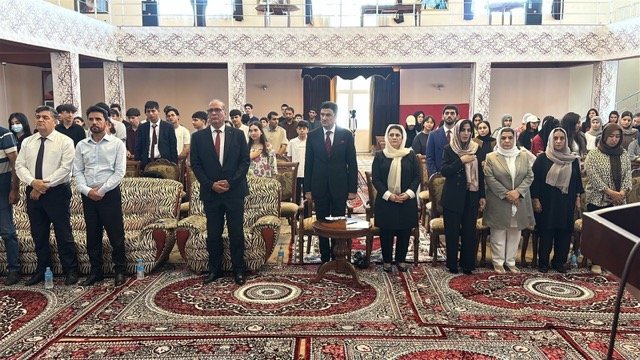
Ambassador Mohammad Zahir Aghbar with Afghan participants at the Dushanbe embassy during the 107th Independence Day ceremony. Photo: @Aghbar X
“Our success and victory lie in national unity.”
At the Afghan Embassy in Dushanbe—known as “Little Afghanistan” because it still represents the republic rather than the Taliban—Ambassador Mohammad Zahir Aghbar addressed a hall filled with Afghan men and women gathered to mark the 107th anniversary of Afghanistan’s independence. What unfolded was not a ceremonial speech, but a sharp political message aimed at redefining freedom, legitimacy, and responsibility at a moment when Afghanistan remains under Taliban rule, a group responsible for severe human rights violations.
Aghbar began by dismantling the Taliban’s central slogan that they “liberated” Afghanistan. “Freedom does not happen simply because foreign troops leave,” he said, arguing that the withdrawal of NATO and U.S. forces was “based on international decisions,” not on Taliban military success. He insisted that the Taliban’s takeover was “the result of a handover by former political leaders,” adding that “there is not a single commander in any province who can claim a real military victory.” This line directly confronts the Taliban’s attempt to build a heroic narrative around August 2021.
He then turned to the Taliban’s definition of freedom, calling it a distortion of the concept itself. “For the Taliban, real freedom means eliminating women from political and social life,” he said. “It means closing the doors of schools and issuing daily decrees against a respected part of our society.” By framing these policies as the Taliban’s “achievements,” Aghbar exposed the contradiction between their rhetoric of liberation and their systematic repression of women and girls.
Aghbar also challenged the Taliban’s claim to legitimacy. “They say they defeated America,” he noted, “but they beg America to reopen its embassy and recognize them.” He emphasized that “no country in the world recognizes the Taliban,” and pointed out that even the one state that once supported them “did not congratulate them on August 15.” His argument was clear: a regime that lacks both domestic consent and international recognition cannot claim to be a legitimate government.
One of the most provocative parts of his speech was directed at the Afghan diaspora. “Those who live abroad with foreign passports, financial security, and safety have no right to dictate solutions to people inside Afghanistan,” he said. He described Afghans living under Taliban rule as breathing “out of compulsion,” deprived of basic rights such as expression, protest, and choice. His message was not an attack on the diaspora but a call for responsibility: external voices must avoid imposing agendas that ignore the realities of life under Taliban repression.
Aghbar’s speech also carried a broader national warning: division is the real danger. Quoting Afghanistan’s former anti-Soviet military commander, Ahmad Shah Massoud, he reminded the audience that “no military power can conquer Afghanistan,” but “the enemy wins when we are divided into small ethnic and sectarian tents.” He urged Afghans to “put down the rifles of division” and stand together against “ignorance, darkness, barbarism, extremism, and misogynistic groups.”
He honored the historical figures who fought for independence—Amanullah Khan, Mir Masjidi Khan, Aminullah Khan Logari, Mullah Mushk Alam—and reminded the audience that independence was “the blood-price of hundreds of motivated Afghans.” This historical grounding served as a contrast to the Taliban’s attempt to claim ownership of Afghanistan’s sovereignty.
Aghbar also addressed former soldiers of the republic with unusual empathy. “You are not guilty,” he told them. “Your leaders abandoned you.” He acknowledged the suffering of ordinary Afghans who remain in the country, living in poverty and fear, and urged political figures to avoid “irresponsible statements” that deepen divisions.
His critique of the Taliban’s leadership structure was particularly sharp. “They say their Amir is worthy of unconditional obedience,” he said, “but even the Taliban do not know who he is or where he is. Is he a code or a person?” This line captured the opacity and secrecy that define the Taliban’s governance.
Aghbar closed with a message of unity: “Our success and victory lie in national unity.” In “Little Afghanistan,” far from Kabul but still carrying the flag of the republic, his speech served as a reminder that independence is not just a historical event—it is a set of values: rights, legitimacy, unity, and resistance to authoritarianism.