One Flag, Many Fault Lines: Aisha Wahab and the Diaspora’s Battle Over Identity
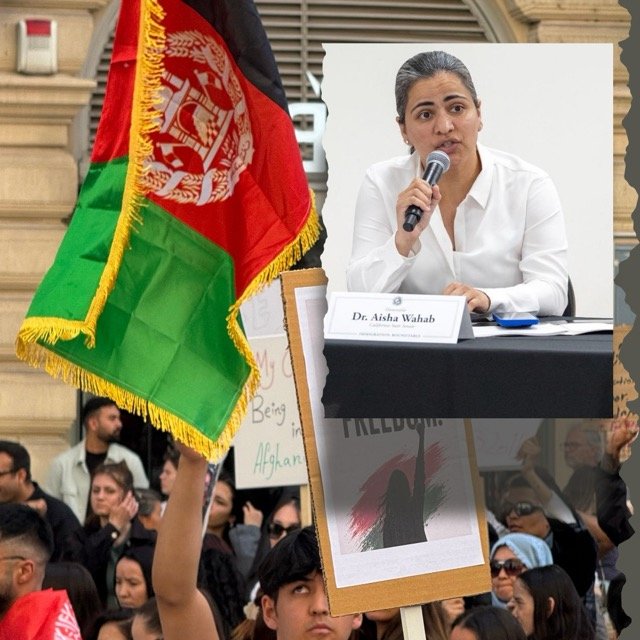
Photo: @Aisha Wahab X account
“We are one people… it does not matter if you’re Hazara, Pashtun, Shia, Sunni, American‑born or European‑born.”
By Kazim Jafari
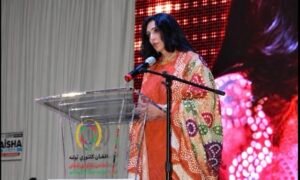
In a small park surrounded by apartment blocks and storefronts, Aisha Wahab stepped onto a makeshift stage and delivered a message that instantly rippled across the Afghan diaspora. The first Afghan‑American ever elected to the U.S. Congress, she spoke with conviction: “We are one people… it does not matter if you’re Hazara, Pashtun, Shia, Sunni, American‑born or European‑born.” The crowd responded with cheers, flags raised high.
Then came the line that ignited a political storm: “This is the only flag that we are to recognize. There will be no warlord flag. There will be no Taliban flag.” She tied her stance to the future of Afghan girls:
“We want our young daughters to have a future… when we say equality and opportunity, we mean it.”
For many in the park, her words were a declaration of unity and a rejection of symbols tied to violence and extremism. But online, the reaction was immediate — and deeply divided.
A Rally Becomes a Flashpoint
The video of Wahab’s speech spread quickly across social media, where Afghanistan’s diaspora politics often play out with raw intensity. Supporters praised her courage, calling her message overdue. Critics accused her of erasing history, inflaming ethnic tensions, or misunderstanding Afghanistan’s political landscape.
Maisam Nazari, spokesperson for the National Resistance Front (NRF), led the charge. He accused Wahab of “exploiting divisions within the diaspora” and using “the ethnic card.” For Nazari, the resistance flag she dismissed as a “warlord flag” represents sacrifice:
“Tens of thousands fought under that flag for freedom and democracy… dismissing it shows complete disregard for those who died under it.”
His statement framed Wahab’s words as an insult to a generation of fighters who resisted the Taliban in the 1990s and again after 2021. But the backlash to Nazari was equally fierce. One user wrote: “You speak for the son of a warlord who killed thousands of civilians.” Another mocked him: “This kid is trying to be seen by attacking Aisha Wahab…”
The ethnic undertones were unmistakable—and familiar to anyone who has followed Afghan diaspora debates.
Old Wounds, New Platforms
Activists linked to former jihadi networks also weighed in. Natiq Malikzada called Wahab’s stance “Pashtun supremacist politics,” arguing that her rejection of the resistance flag echoed the same mindset that empowered the Taliban. Barmak Hamdard warned that Wahab already faces political pressure in California and should avoid “aligning herself with ethnocentric Pashtun groups.” He argued that as a social worker, she should uphold principles of dignity and fairness, not take sides in Afghanistan’s ethnic politics.
But another voice offered a sharply different interpretation. Khalid Wardag wrote: “There’s something almost poetic about architects of Afghanistan’s failed republic, now comfortably abroad, lecturing Dr. Aisha Wahab on how to ‘be American.’ She didn’t inherit foreign intelligence funds, a militia, a title, or a seat at a foreign‑appointed table. She earned it by campaigning and earning votes.” His conclusion was blunt: “Perhaps that’s what really stings: an Afghan-American woman saying Afghanistan belongs neither to the Taliban nor to yesterday’s warlords. One country. One national flag.”
Wardag’s comment captured a sentiment shared by many younger diaspora members: that Wahab represents a break from the old political class—a generation shaped not by militias or foreign patronage, but by civic participation.
A Symbol Larger Than the Moment
The controversy around Wahab’s speech is not simply about a flag. It is about who gets to define Afghan identity in exile. For some, the tricolor flag represents the republic, democracy, and a modern Afghanistan. For others, the resistance flag symbolizes sacrifice against tyranny. For many, the Taliban flag represents oppression.
Wahab’s insistence on “one flag” was meant as a call for unity. But unity is difficult in a diaspora shaped by war, displacement, and competing historical narratives. Her critics fear erasure of their own struggles. Her supporters see her stance as a necessary break from warlordism and extremism.
What happened in that park—a woman standing before a crowd, declaring, “We are one people”—was more than a rally. It was a reminder that Afghanistan’s political battles did not end in 2021. They simply moved to new places: parks in California, community centers in Europe, and the digital battlegrounds of social media.
Whether Wahab’s message becomes a bridge or another fault line remains to be seen. But one thing is clear: the diaspora is still searching for a shared story—and a shared symbol—that can hold its fractured history together.
Kazim Jafari is a political science student at the University of Heidelberg in Germany.
Note: The contents of the article are the sole responsibility of the author. Afghan Diaspora Network will not be responsible for any incorrect statements in the articles.