Poetry, Knowledge, Historical Memory, and Taliban Violence in Abdullah Atefi
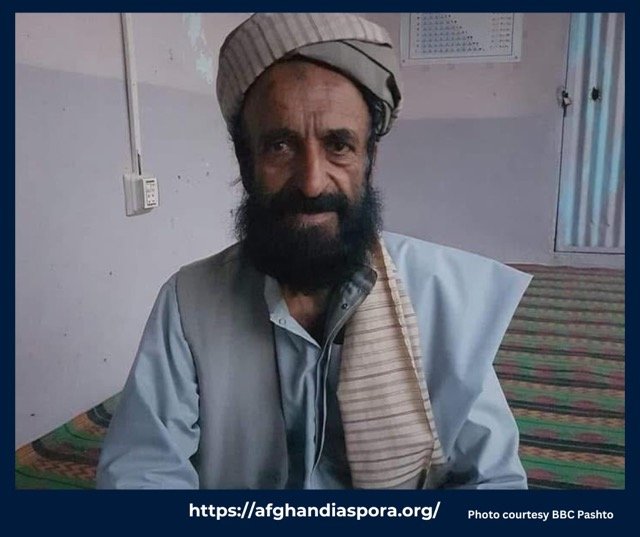
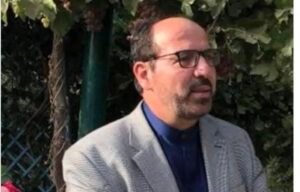
Abdullah Atefi, a historian, writer, and poet, was a public figure whose extensive body of work focused on Pashtun culture and literature and was regularly featured in regional publications.
The Poem as a Site of Cultural Survival
By Ivan Pozzoni
Abdullah Atefi occupies a particularly revealing position in contemporary Afghan intellectual history because his literary identity cannot be separated from his historical and cultural labor. Poet, historian, teacher, and member of Afghanistan PEN since 2008, Atefi devoted his writing to Pashtun history, literature, and collective identity; he published the poetry collection Yūn, founded the periodical Ebrat, and worked on a large historical reconstruction of Pashtun antiquity. PEN International records that several of his writings remained unpublished because of financial difficulties, while later documentation identifies his murder on 4 August 2021 as part of the wider destruction of Afghanistan’s independent intellectual sphere. Atefi’s work therefore becomes particularly productive when approached through pragmatics. Poetry here is not merely an aesthetic object. It is an utterance situated in a social field, an act whose meaning depends upon speaker, addressee, presupposition, shared cultural knowledge, and anticipated response. The repeated first-person plural of the poem Da Khpəlwākۍ Ghag (“The Voice of Independence”) constructs a collective deictic center: the pronoun موږ(“we”) continuously transforms individual poetic speech into communal enunciation. One of the surviving textual fragments reads: «موږ د خپلواکۍ غورځنګ». The utterance does not simply describe independence; through its performative force, it constitutes a speaking collective. The same mechanism appears in «موږ د ورورګلوۍ غورځنګ», where the lexical movement from خپلواکۍ (“independence”) to ورورګلوۍ (“brotherhood”) establishes a political semantics founded on collective belonging. A third fragment, «علم او عرفان غواړو», places knowledge and spiritual/intellectual cultivation inside the same desiderative structure. The verb غواړو (“we want”) is pragmatically decisive: it expresses collective volition while projecting a future social order. Poetry consequently becomes a form of speech act, capable of producing solidarity through linguistic repetition. The available online reproductions must nevertheless be handled cautiously. They reproduce fragments attributed to Atefi’s poetic corpus rather than providing a critical edition of Yūn. For this reason, the quotations are treated here as documented textual fragments, not as reconstructed lines from an inaccessible primary edition. This distinction is essential for a rigorous literary methodology.
From Desire to Collective Memory
Atefi’s poetic language operates through a characteristic transformation: the individual voice is repeatedly absorbed into a collective subject. «ملي وحدت غواړو» (“we want national unity”) condenses this process into a minimal syntactic structure. The adjective ملي (“national”) modifies وحدت (“unity”), while the first-person plural verb converts an abstract political concept into a collectively articulated desire. In pragmatic terms, the proposition possesses a strong illocutionary force: it does not merely represent a political ideal; it publicly performs adherence to that ideal. This linguistic architecture is closely connected with Atefi’s historical writing. His historical project, reported under the title سلطانان شرق لرغوني پښتانه عبریان, sought to reconstruct long-term Pashtun historical identity, while Yūn represented its poetic dimension. The coexistence of poetry and historiography is significant. Poetry compresses memory into rhythm, repetition, and affect; historiography organizes memory through genealogy, chronology, and explanatory narrative. Their intersection produces what may be called mnemonic sovereignty: the capacity of a community to narrate its own continuity rather than receiving its historical identity from an external authority. This dimension places Atefi in productive dialogue with contemporary theories of memory, cultural identity, and political aesthetics. Jan Assmann’s distinction between communicative and cultural memory remains useful here, while more recent memory studies emphasize the material, embodied, and mediated dimensions through which communities preserve narratives of the past. Atefi’s writing participates in precisely such a process: the archive is not confined to the institutional document. It is distributed among poems, history books, periodicals, teaching, and oral transmission. The political significance becomes clearer when the poetic we is contrasted with the logic of authoritarian control. Political violence frequently begins by controlling the legitimate forms of collective speech: who may name the past, who may define the community, which cultural symbols may circulate, and which narratives are permitted to become public memory. The suppression of literary production therefore affects a society at the level of symbolic reproduction. Pierre Bourdieu’s concept of the cultural field remains relevant, while contemporary political-aesthetic approaches allow us to understand literature as a struggle over visibility, legitimacy, and the distribution of interpretive authority. Atefi’s final historical project thus acquires an additional significance after his death. His writing becomes an archive whose physical vulnerability mirrors the vulnerability of the society represented within it. The destruction of books is never only the destruction of paper. It interrupts the transmission chain through which a community recognizes itself as historically continuous.
Knowledge, Violence and the Pragmatics of Threat
The most disturbing dimension of Atefi’s case emerges when literary production is placed beside the reported circumstances of his death. According to PEN International, Atefi was taken from his home in Chora district on the night of 4 August 2021 and killed; Afghan officials attributed the murder to Taliban forces, while the Taliban denied responsibility. PEN America likewise records the killing and the conflicting attribution. More recent PEN documentation states explicitly that Atefi was shot outside his home and situates his death within the broader destruction of Afghanistan’s independent cultural and intellectual life. A particularly revealing reported utterance attributed to Atefi immediately before his removal is: «زه درسره ځم، خو کتابونو ته مې لاس مه وروړئ» The sentence may be translated as: “I will go with you, but do not touch my books.” Its pragmatic structure is extraordinary. The first clause accepts physical coercion; the second establishes a boundary around the symbolic world represented by the books. The conjunction خو(“but”) creates a semantic reversal: bodily vulnerability is acknowledged, while textual property is defended as something requiring protection. The sentence can be read through Austin’s theory of speech acts and Searle’s distinction between illocutionary force and propositional content. Its apparent simplicity conceals several pragmatic operations. Atefi identifies an addressee capable of destroying the material archive; he anticipates the destruction of books; he formulates a prohibition; and he implicitly establishes the books as entities possessing value beyond their materiality. The utterance therefore converts a moment of extreme asymmetry into a final act of symbolic agency. This is precisely where violence and literature intersect. The persecutor acts upon the body, while the writer’s final linguistic act attempts to protect the archive. The contrast produces a form of semiotic resistance: violence seeks immediate control over the person; language projects meaning beyond the immediate encounter. The books become metonyms for historical memory, cultural identity, and intellectual autonomy. The political anthropology of art helps clarify why such an archive can become threatening. Art and literature produce what Alfred Gell conceptualized as forms of social agency distributed through objects and networks. A book participates in social relations: it stores statements, preserves identities, creates future readers, and enables transmission across generations. From this perspective, the threat posed by the destruction of Atefi’s books is precisely their capacity to survive the moment of coercion.
Neuroaesthetics, Trauma and the Embodied Archive
The neuroaesthetic dimension strengthens this interpretation without reducing poetry to biology. Contemporary research in neurocognitive poetics demonstrates that poetic language engages cognitive and emotional systems in complex ways. Cartocci and colleagues, in a 2021 study of poetry reception, found differentiated neurophysiological responses between literature and non-literature students and connected poetic engagement with processes involving cerebral effort, affective response, and content recognition. Such findings are particularly relevant to Atefi because his poetry repeatedly combines semantic compression, rhythmic recurrence, and collective pronouns. A further conceptual bridge is provided by predictive processing. Contemporary accounts describe perception and cognition as involving continuous interaction between incoming signals and internally generated predictions. In aesthetic experience, ambiguity, expectation, and prediction error can become productive components of interpretation. This framework offers a useful model for understanding cultural memory: the reader approaches a poem with prior narratives, cultural schemas, and embodied expectations, while the poem modifies or reorganizes those predictions. Trauma complicates this process. Experimental research has shown that traumatic exposure can rapidly modify functional connectivity involving the amygdala, hippocampus, and memory-related cortical regions. The implication for literary analysis should remain cautious: one cannot infer a specific neural state from a poem. One can, however, examine how poetic form organizes representations of threat, belonging, loss, and future possibility. Atefi’s collective we can therefore be understood as an embodied mnemonic operator. It repeatedly reconstructs a social body through language. The body represented in the poem is simultaneously political, historical, and affective. Its continuity depends on repetition. The phrase «موږ ملي وحدت غواړو» does not merely describe unity; through repeated first-person plural address, it rehearses unity as a communicative possibility. The relationship between memory and embodied cognition is equally important. Contemporary enactive approaches emphasize that cognition emerges through interactions among the brain, body, environment, and social world. Vaisvaser, for instance, connects embodied creative expression with predictive processing, memory, and meaning-making. In Atefi’s case, poetry can consequently be regarded as a materialized cognitive environment: words preserve cultural categories, activate memories, organize collective attention, and transmit forms of belonging. This is why the destruction of books acquires such a powerful symbolic meaning. The archive functions as an external memory system. Its destruction attacks a community’s capacity to reactivate representations of its own past. Violence consequently reaches beyond the individual writer and enters the ecology of cultural memory.
Contemporary Comparisons and the Political Life of Literature
Atefi’s position becomes even clearer when placed beside contemporary writers who have transformed literature into a technology of memory under conditions of coercion. Svetlana Alexievich, whose polyphonic documentary writing reconstructs historical trauma through testimony, provides one important comparison: her texts distribute memory across multiple voices, producing a collective archive from individual speech. In a different linguistic and geopolitical environment, Adonis has repeatedly treated cultural memory as a field of conflict in which inherited symbolic systems are continuously reconstructed. Mahmoud Darwish offers another productive comparison because his poetry transforms displacement, territory, and collective identity into linguistic structures through which political existence can be imagined.The comparison with Afghan and diasporic writers is even more direct. Writers such as Homeira Qaderi and Atiq Rahimi demonstrate how literary production can preserve forms of subjectivity under conditions in which political institutions attempt to regulate the body, education, language, and public visibility. Their works show that literary resistance frequently operates through rearticulation: the oppressed subject acquires agency by modifying the terms through which existence can be narrated. Atefi’s particular contribution lies in the convergence of poetry and historiography. His literary practice constructs a bridge between aesthetic memory and historical knowledge. The poem condenses collective aspiration; historiography extends the temporal horizon; teaching converts knowledge into transmission. The three dimensions form a single cultural circuit. The Taliban context gives this circuit its violent political significance. PEN International’s contemporary assessments describe the post-2021 Afghan cultural sphere as subjected to systematic pressure, including the closure of independent media, destruction of books, exile of writers, and widespread self-censorship. Atefi’s murder therefore belongs to a broader epistemic conflict over who may speak, write, teach, and preserve cultural memory. The central question is consequently not simply why a poet was killed. The deeper question concerns what kind of social power literature acquires when historical memory itself becomes politically contested. Atefi demonstrates that poetry can function as a cultural infrastructure. Its political effectiveness does not require direct propaganda. It can reside in pronouns, repetitions, desires, historical references, and the simple persistence of a linguistic community. His poem’s repeated غواړو (“we want”) is especially revealing. Desire becomes collective grammar. Grammar becomes political imagination. Political imagination becomes memory. Memory becomes an object of struggle. Atefi’s work thus belongs to a broader contemporary constellation in which literature operates simultaneously as an archive, testimony, identity-making practice, and anticipatory model of social life. The book becomes a portable institution; the poem becomes a compressed archive; the reader becomes the site where cultural memory is reactivated. The ultimate force of Atefi’s literary corpus lies precisely in this transformation of language into continuity. His historical writing attempted to reconstruct a past; his poetry articulated a desired collective future; his death exposed the violence directed against the cultural mechanisms connecting those temporal dimensions. The result is a striking paradox of literary history: the physical archive can be destroyed, while the communicative act can continue through quotation, translation, teaching, and remembrance. Atefi therefore survives in the most concrete sense available to literature: through transmission. His texts continue to generate readers, interpretations, and political questions. The act of reading becomes a small counter-operation against cultural erasure.
Conclusion
Abdullah Atefi’s work can be understood through a simple sequence: poetry creates a collective voice, history gives that voice a past, memory carries it forward, and political violence attempts to interrupt the transmission. His poetry is important because its language is direct, collective, and future-oriented. The repeated موږ (“we”) constructs a community; غواړو (“we want”) gives that community a future; references to knowledge, unity, and independence transform poetry into a public act. His historical writing extends the same project into the longue durée of Pashtun cultural memory.
The reported final defence of his books makes the relationship between literature and violence unmistakable. The body could be taken away. The books represented something more difficult to control: the possibility that knowledge would remain available to others. This is ultimately the clearest way to read Atefi. He was a poet and historian working inside a society in which cultural memory had become politically dangerous. His literature preserved a collective vocabulary of knowledge, independence, unity, and historical continuity. His death demonstrates the brutality of the forces that sought to control that vocabulary. His surviving texts demonstrate the opposite possibility: language can outlive the coercive situation in which it was produced. In Atefi, poetry and history therefore meet at a single point: the struggle over who has the right to remember, to speak, and to imagine a future.
About the author: Ivan Pozzoni was born in Monza in 1976. He introduced Law and Literature in Italy and the publication of essays on Italian philosophers and on the ethics and juridical theory of the ancient world; he collaborated with several Italian and international magazines. He wrote 152 volumes, wrote 1000 essays. His verses/essays are translated into 30 languages.
Note: The contents of the article are the sole responsibility of the author. Afghan Diaspora Network will not be responsible for any incorrect statements in the articles.