Emergency Rule in Khyber Pakhtunkhwa: Security Measure or a New Chapter in Pakistan’s Political Crisis?
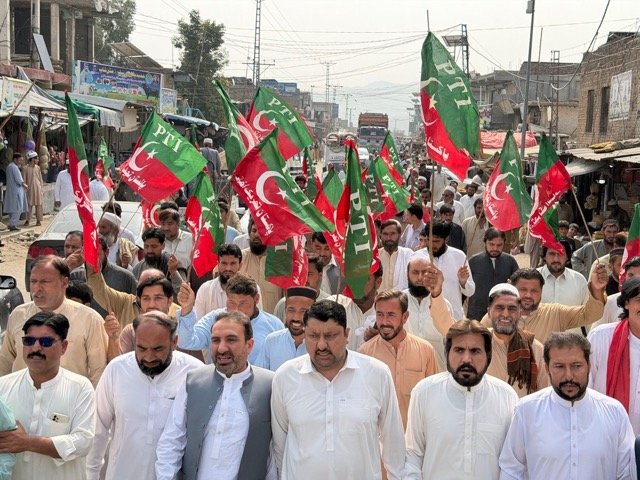
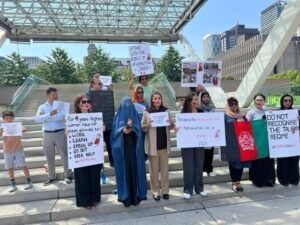
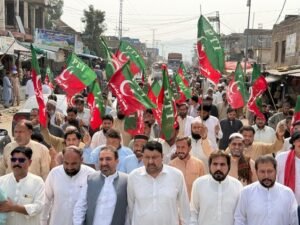
Residents of Pakistan's Mohmand district gather to reject the imposition of Governor's Rule and emergency measures in Khyber Pakhtunkhwa, pledging support for former Prime Minister Imran Khan and his movement for what supporters call "true freedom."
Imposing emergency rule on a province already scarred by decades of conflict amounted to another experiment in authoritarian governance.
By A. Shafaq
Pakistan’s decision to impose emergency rule in Khyber Pakhtunkhwa has intensified an already volatile political confrontation between the federal government and the opposition while reopening longstanding debates about governance, security, and the state’s relationship with its Pashtun-majority frontier region. The move, which effectively removed a provincial government controlled by supporters of imprisoned former Prime Minister Imran Khan, is being portrayed by Islamabad as a necessary response to militancy. Critics, however, see it as a political intervention disguised as a security measure.
On October 11, President Asif Ali Zardari approved emergency measures under Articles 232 and 234 of Pakistan’s constitution following recommendations from Prime Minister Shehbaz Sharif’s cabinet. The decision suspended the provincial administration led by the Pakistan Tehreek-e-Insaf (PTI) and transferred authority to a governor supported by an advisory council. The federal government also announced the deployment of troops to the province.
In a statement, the president’s office said the decision was based on reports regarding the law-and-order situation and the failure of negotiations with government delegations. Federal authorities argued that the provincial government had failed to adequately address rising militancy and terrorism in the province along the Durand Line with Afghanistan.
The government is acting against a backdrop of worsening insecurity. Khyber Pakhtunkhwa has witnessed a surge in militant attacks in recent years, with Pakistani authorities repeatedly accusing armed groups operating from Afghan territory of carrying out attacks inside Pakistan. Islamabad has also accused PTI leaders of failing to effectively confront the security threat.
Yet the emergency declaration arrives at a politically sensitive moment.
PTI has been preparing major demonstrations demanding the release of Imran Khan, who remains one of Pakistan’s most influential political figures despite years in prison. According to Reuters, hundreds of PTI activists and several of Khan’s relatives and associates were detained ahead of planned protests, fueling allegations that security concerns are being used to suppress political opposition.
The opposition has responded furiously.
PTI spokesman Zulfikar Bukhari described the move as a “coup disguised as emergency,” arguing that it would lead to further instability and bloodshed rather than restore order. The party insists that Islamabad is exploiting security concerns to remove an elected provincial administration and weaken a region that has remained one of PTI’s strongest political bases.
Among the most outspoken critics is former parliamentarian Mohsin Dawar, who accused the federal government of pursuing “colonial” policies toward Khyber Pakhtunkhwa. Dawar said decisions affecting the province are once again being imposed without a democratic mandate and warned that emergency rule could push the region “into further darkness.” He also criticized proposals reportedly linked to administrative restructuring, arguing that such measures risk isolating the province and echoing controversial policies historically associated with the former Federally Administered Tribal Areas.
Veteran Pashtun nationalist leader Afrasiab Khattak offered an equally blunt assessment. Writing on social media, he argued that imposing emergency rule on a province already scarred by decades of conflict amounted to another experiment in authoritarian governance. Khattak questioned whether Pashtuns should view the measure as evidence that they continue to be treated as subjects of a colony rather than equal citizens within the federation.
The debate has also attracted attention across the border in Afghanistan.
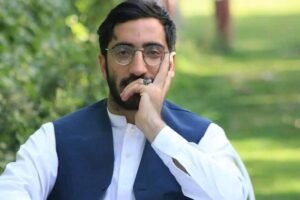
Former Afghan ambassador to Pakistan Atif Mashal argued that the emergency cannot be understood solely through the lens of domestic politics. According to Mashal, PTI protests may provide a convenient public justification, but broader regional calculations could be driving the decision. He suggested that elements within Pakistan’s security establishment may be seeking greater militarization of the frontier region to advance wider strategic objectives.
Mashal also warned that any attempt to revive the proxy-war dynamics that have shaped regional politics for decades would face a far more complicated environment than in the past. Pakistan, he noted, is confronting a multidimensional internal crisis, while regional powers including China, Russia, Iran and Central Asian states have their own security concerns and may be less willing to tolerate prolonged instability.
Former Afghan deputy defense minister Shah Mahmood Miakhel offered an even sharper critique. Referring to Pakistani accusations that political actors have supported militancy, Miakhel argued that successive Pakistani governments and security institutions have for decades cultivated and used extremist groups for strategic purposes. In his view, Pakistan is now confronting the consequences of policies that encouraged militancy as an instrument of statecraft.
Whether one accepts these arguments or not, they reflect a broader perception found among many critics of Pakistan’s security policies: that the country’s current security challenges cannot be separated from decisions made over several decades.
The emergency declaration therefore represents more than an administrative measure. It sits at the intersection of three overlapping crises: rising militancy, deep political polarization, and unresolved questions about the governance of Pakistan’s Pashtun borderlands. Supporters see decisive action against a deteriorating security situation. Opponents see a dangerous precedent in which elected governments can be sidelined under the banner of counterterrorism.
As troops move into Khyber Pakhtunkhwa and federal authorities assume greater control, the province has once again become the focal point of Pakistan’s most important national debate: whether security and democracy can coexist or whether one will continue to be used to justify curtailing the other.
A. Shafaq (pseudonym) is a researcher and lecturer at one of the private universities in Kabul.
Note: The contents of the article are the sole responsibility of the author. Afghan Diaspora Network will not be responsible for any incorrect statements in the articles.