Growing Punjabi Domination is Leading to a Federal Crisis
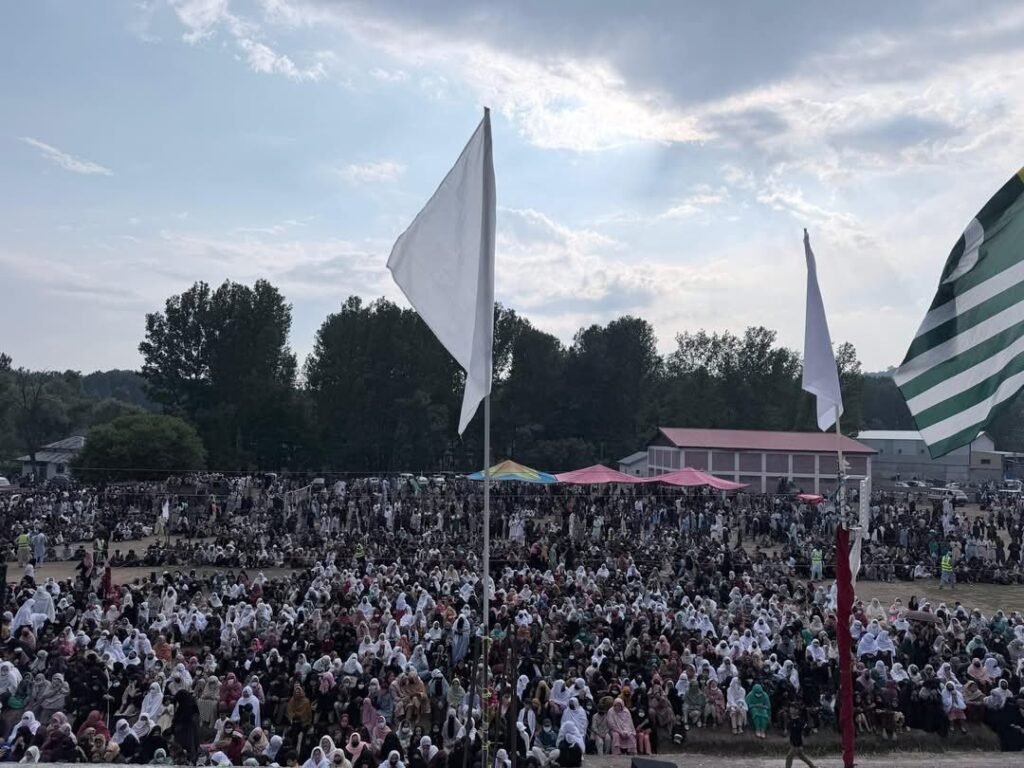
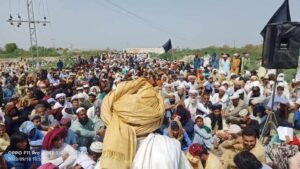
AJK’s spirit on full display. A historic gathering standing united for basic rights. Photo: @Khawaja Faizan Wani.
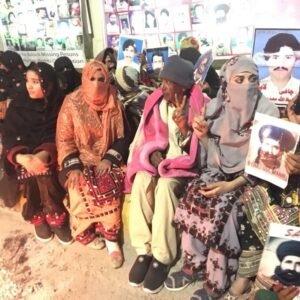
Baloch activists have repeatedly accused the state of enforced disappearances, extrajudicial killings, resource extraction, and political exclusion.
By Fatima Chaudhary
The latest violence in Pakistan-occupied Jammu and Kashmir is not an isolated law-and-order episode. It is another warning that Pakistan’s centralized state is losing legitimacy in its own peripheries. The crackdown on peaceful protestors associated with the Jammu Kashmir Joint Awami Action Committee (JKJAAC) has exposed a deeper crisis: from PoJK and Pakistan Occupied Gilgit-Baltistan (PoGB) to Balochistan, Khyber Pakhtunkhwa and Sindh, more communities now openly frame their grievances through the language of Punjabi domination, military coercion, and federal exploitation.
This is not simply anti-Punjabi prejudice. It is a political reaction to the way power is organized in Pakistan. Punjab is the country’s most populous province. Its political families, military recruitment networks, bureaucratic influence, and economic weight have long shaped the federal state. Many ordinary Punjabis are themselves victims of authoritarian rule, inflation, and elite politics. But in the eyes of smaller provinces and occupied territories like PoJK and PoGB, “Punjab” has become shorthand for a ruling structure: the army high command, Islamabad’s civilian facade, and Punjab-based parties that dominate national decision-making while presenting coercion as national unity.
PoJK shows how this system operates through brute force and the suppression of basic human rights. The JK Awami Action Committee emerged from everyday grievances: electricity tariffs, flour prices, elite privileges, political representation, and the feeling that local people have little control over their own territory. Instead of treating this as a democratic mobilization, the state turned to familiar tools such as arbitrary bans, sedition cases, internet shutdowns, arrests, and the labelling of a civil protest platform as a security threat. The immediate trigger is the dispute over 12 reserved legislative seats for Kashmiri refugees living in Pakistan. For locals, these seats are not an abstract constitutional matter. They are seen as a mechanism through which non-resident voters and Pakistan-based parties influence PoJK politics.
This is why the current crackdown carries wider meaning. It tells Kashmiris that even peaceful demands for political representation will be treated as rebellion if they challenge Islamabad’s control. It also confirms a pattern seen elsewhere in Pakistan: when local movements ask for rights, the Punjabi-dominated military-security state first questions their loyalty, then criminalizes their leadership, and finally presents force as stability.
Balochistan has lived with this logic for decades. Baloch activists have repeatedly accused the state of enforced disappearances, extrajudicial killings, resource extraction, and political exclusion. The province holds strategic ports, minerals, gas, and territory central to China-Pakistan Economic Corridor projects, yet many Baloch communities remain among the poorest and most heavily securitized in Pakistan. When groups such as the Baloch Yakjehti Committee mobilize peacefully, the response is often detention, terrorism cases, and intimidation. The message is clear that Balochistan’s resources matter to the state more than Baloch political consent.
Among Pashtuns, the Pashtun Tahafuz Movement has voiced similar anger over enforced disappearances, military operations, landmines, and the heavy security footprint in former tribal areas. The Pakistani state banned PTM under terrorism laws, even though the movement’s core claim was that Pashtuns should not be treated as expendable subjects in Pakistan’s security wars. Here again, the Punjabi-dominated military establishment transformed a rights-based movement into a “security problem.”
Sindh adds a different but equally important front. The controversy over new canals on the Indus River revived an old fear that the upstream Punjab will capture water while the lower riparian Sindh bears the cost. For Sindhis, water is not just an administrative issue; it is food security, agriculture, identity, and survival. The federal government’s retreat after protests did not erase the suspicion that Punjab-first development remains the hidden logic of national planning. When Sindhi activists accuse Islamabad and Lahore of stealing water, they are speaking from a long history of mistrust.
PoGB faces its own version of the same crisis, but on a larger scale. Its people lack full constitutional rights and representation in Pakistan’s parliament, while their land, rivers, tourism routes, and strategic geography remain central to Pakistan’s state projects. Protests over wheat subsidies, electricity shortages, and taxation without representation show that the region’s anger is no longer confined to nationalist circles. It has entered everyday economic life.
The Punjabi establishment of Pakistan has failed to understand the political meaning of these province-wide protests. It still believes that subsidies can buy quiet, arrests can break movements, and security laws can erase local identity. But coercion is producing the opposite result. Every crackdown deepens the idea that Pakistan is not a federation of equal units but a Punjab-centered security state managed by generals and protected by weak civilian governments.
This is dangerous to Pakistan’s long-term stability. The anti-Punjab sentiment now visible across the country is not merely emotional resentment. It is a structural indictment. People are asking who controls land, water, minerals, budgets, jobs, elections, policing, and courts. They are asking why local leaders are delegitimized while federal parties backed by the military parachute into their regions. Another concern is why the military can speak in the name of national security while communities facing violence are denied the language of rights.
Pakistan’s tragedy is that its rulers keep mistaking centralization for cohesion. The lesson of 1971, the loss of ‘East Pakistan’, should have been that federal domination cannot hold a state together indefinitely. Yet the same instinct survives: deny the local grievance, accuse the dissenter, deploy military, and call it patriotism. In PoJK today, that old formula is being tested again.
The Pakistani state will not choose dialogue and demilitarization and provide genuine federal reform to marginalized minorities because it will degrade the control of the Punjabi elite. It can stop treating Kashmiris, Baloch, Pashtuns, Sindhis, and Gilgit-Baltistan residents as subjects to be managed. But if the military establishment and Punjab-based federal elite continue to answer political grievances with bullets and sedition cases, they will not create order. They will create a wider rebellion of trust. PoJK is not just burning because of one court ruling or one protest march. It is burning because Pakistan’s peripheries increasingly believe that the center takes their resources, manipulates their politics, and punishes their dissent. That is no longer a local crisis. It is Pakistan’s federal crisis.
Fatima Chaudhary is a lecturer at a private university in Pakistan’s Punjab province.
Note: The contents of the article are the sole responsibility of the author. Afghan Diaspora Network will not be responsible for any incorrect statements in the articles.