A Century‑Old Line, a New Digital Battlefield: Durand Line Tensions Resurface in the Afghan Diaspora

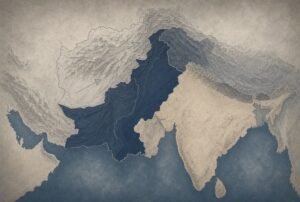
The map of Afghanistan. Photo: @AADIL for ADN
By A. Shafaq
The Afghan diaspora has once again plunged into a heated and emotionally charged debate over the Durand Line. This recurring issue has shaped Afghan political identity for more than a century. What began as a single remark by a former Afghan political figure quickly escalated into a full‑scale online confrontation, revealing deep fractures within exile communities and highlighting how unresolved historical questions continue to influence Afghan political discourse.
The immediate trigger was a statement by Mohammad Mohaqiq, a former militia leader and political figure now living in exile, who said in an interview that he recognizes the Durand Line as the official border between Afghanistan and Pakistan.
Mohaqiq’s comment broke with more than a century of Afghan political ambiguity. From the monarchy to the republics and the post‑2001 governments, Afghan leaders have historically avoided formal recognition of the line, a point highlighted in Afghanistan International’s recent background reporting.
The Durand Line, drawn in 1893 between British India and Afghanistan, has remained contested due to its colonial origins, its division of ethnic Pashtun communities, and its role in shaping regional geopolitics.
Political Faultlines
Mohaqiq’s remarks drew swift and sharp reactions. Rahmatullah Nabil, former head of Afghanistan’s intelligence service, argued that the statement appeared less like a clear legal position and more like a “questionable political shift with the scent of a deal.” Nabil suggested that if Mohaqiq had expressed such a view during his years of political influence in Kabul, it could have been interpreted as a legitimate – if controversial – political opinion. But making the statement now, after reports of his increasing proximity to Pakistani military circles, raised concerns about external influence.
Nabil warned that unilateral declarations risk deepening divisions among anti‑Taliban groups and inadvertently strengthening the Taliban’s political legitimacy.
The Taliban, for their part, have historically not recognized the Durand Line as an international border, even though their relationship with Pakistan has fluctuated over time. While some Taliban officials have made pragmatic statements about border management, the movement’s official position has remained ambiguous. Their public messaging often avoids explicit recognition, reflecting both internal divisions and the political sensitivities of their base.
The debate intensified further when Tamim Asey, former deputy defense minister, issued a strongly worded critique of Afghan political figures who he claims have aligned themselves with Pakistan’s military establishment.
Asey argued that the struggle for Afghanistan’s political future should be rooted in internal reform and engagement with Afghans inside the country – including those within the Taliban who are dissatisfied with the current situation – rather than relying on external actors. He warned that Pakistan’s intelligence services have been attempting to recruit and organize anti‑Taliban groups in a manner reminiscent of the factional conflicts of the 1990s. According to Asey, such efforts risk dragging Afghanistan back into proxy warfare.
Many Afghan commentators argue that the intensity of the current debate obscures a deeper structural reality: Pakistan’s long‑standing involvement in Afghan politics. Analysts and diaspora observers often note that, regardless of disagreements among Afghans – whether inside the country or abroad – Pakistan has historically sought to maintain influence in Kabul, sometimes through Islamist groups and at other times through anti‑Taliban factions.
Critics point out that several anti‑Taliban figures who now present themselves as defenders of sovereignty were themselves aligned with Pakistan during the 1980s and 1990s. For many Afghans, this continuity is a source of frustration, as they see political elites repeatedly entering into patron‑client relationships with Islamabad, reinforcing a cycle in which Afghan leaders become dependent on external power brokers rather than building autonomous political legitimacy.
Digital Conflict
Another influential voice in the debate was Heela Najibullah, peace researcher and daughter of former Afghan president Dr. Najibullah. She shared a video clip of her father discussing the Durand Line as a colonial imposition historically rejected by Afghans. In her accompanying message, she wrote that Afghanistan today is “in the hands of Pakistan’s proxies,” a statement that resonated strongly with segments of the diaspora who view current political dynamics through the lens of historical interference. Her intervention added emotional weight to the debate by invoking the legacy of her father, whose own political stance on the Durand Line remains a reference point for many Afghans.
The online debate also spilled into cultural expression. Artist Atiq Shahid posted a caricature on his X account depicting Mohaqiq carrying Pakistan’s flag while sitting on a donkey. Alongside the drawing, he wrote a sharply worded caption criticizing Mohaqiq’s statement and suggesting that an “imposed colonial line” cannot be redefined by an individual. Shahid’s post reflects a broader trend in diaspora political culture, where satire and visual art serve as a form of dissent and a way to challenge political figures without the constraints of formal political discourse.
These reactions – political, artistic, and historical – illustrate how the Durand Line debate is not merely a legal or geopolitical question. It is deeply tied to identity, memory, and the trauma of Afghanistan’s long history of conflict.
Afghan Diaspora Network’s earlier analyses, such as “A Fence of Fire” and “Time to Revisit British Border Legacies,” have emphasized that the Durand Line cannot be separated from the lived experiences of border communities, the militarization of the frontier, and the long‑term consequences of colonial boundary‑making.
The Afghanistan Analysts Network has similarly documented how families divided by the line continue to navigate cross‑border life despite fencing, checkpoints, and political tensions.
Yet the diaspora debate also revealed something else: the internal fragmentation of Afghan communities abroad. After a period of relative silence, Afghan social media erupted with accusations, insults, and personal attacks. Users accused one another of spying, corruption, and betrayal.
The language quickly escalated, with some resorting to terms like “country sellers” or “namos forosh,” invoking notions of honor and shame. Instead of a structured, evidence‑based debate, the conversation devolved into emotional exchanges and factional hostility.
This pattern is not new. Afghan diaspora communities often experience cycles of quiet followed by sudden eruptions of political controversy. Analysts suggest that this dynamic may be linked to the absence of political space inside Afghanistan, where public debate is restricted.
In contrast, diaspora communities enjoy the freedoms of Western democracies, where social media provides a consequence‑free arena for political expression. The result is a digital environment where long‑standing grievances, unresolved historical questions, and personal rivalries collide.
The renewed debate over the Durand Line illustrates how unresolved historical issues continue to shape Afghan political identity, especially in exile. It also reveals the extent to which Afghan political actors – whether former officials, activists, or members of the Taliban – remain entangled in regional geopolitics.
For the diaspora, the controversy underscores a deeper challenge: how to articulate a coherent political vision for Afghanistan’s future while navigating internal divisions, external pressures, and the legacy of decades of conflict.
A. Shafaq (pseudonym) is a researcher and lecturer at one of the private universities in Kabul.
Note: The contents of the article are the sole responsibility of the author. Afghan Diaspora Network will not be responsible for any incorrect statements in the articles.