“Global Terrorism Olympics: Shehbaz Sharif Competes Wearing a ‘Beggar’ Helmet at the UN”
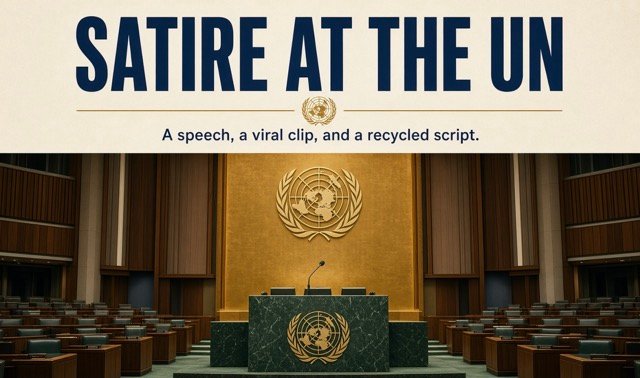
Photo: @AI generated.
By A. Shafaq
In the ever‑expanding sport of South Asian political theatrics, Pakistan’s Prime Minister Shehbaz Sharif has entered the arena with a performance so memorable that the internet immediately turned it into satire. His recent speech at the United Nations General Assembly — where he claimed Pakistan’s sacrifices had saved New York and London from roaming terrorists — inspired a viral, digitally edited video that now overshadows the speech itself.
The clip shows Sharif in torn clothing, standing at the UN podium with an upside‑down metal bowl labeled “Beggar” on his head. The costume is a direct reference to his own infamous remark, “beggars cannot be choosers,” made while discussing Pakistan’s foreign debt. Social media users decided that if he insists on calling his country a beggar, they might as well dress him like one.
The satire works because the contrast is so sharp: a leader warning the world about global terrorism while symbolically dressed as the embodiment of economic desperation. The video spread quickly, accompanied by captions like “beggars cannot be choosers,” turning Sharif’s UN appearance into a meme rather than a moment of diplomatic seriousness.
But Sharif is not the first regional leader to claim that global peace depends on his country’s suffering. Afghanistan’s former president Ashraf Ghani delivered a similar message to the UN in 2017, warning that “over 20 international terrorist groups” operated in Afghanistan and that Kabul was the frontline protecting Europe’s major cities. Ghani’s version was polished, academic, and delivered with the confidence of a man who believed he was giving a lecture at Harvard.
Sharif’s version is the budget-friendly remake. Political analyst Sangar Paykhar captured the mood perfectly: “Shehbaz Sharif is a Temu version of Ashraf Ghani. Same shit but less sophisticated.” It is difficult to improve on this comparison. Ghani was the luxury-brand storyteller; Sharif is the mass-produced knockoff.
Afghan social media users quickly joined the satire. One wrote: “Pakistan’s Prime Minister Shehbaz, the joker, is no longer just my favorite joker. Some people in the U.S also seem to enjoy his jokes.” Another asked why Sharif is so concerned about the safety of New York and London while militants continue to roam freely in Pakistan’s own cities.
Even a former Taliban spokesperson — a figure not known for subtle humor — noted the déjà vu: when Ghani’s political ground began to crumble, he too insisted that peace in Western capitals depended on Afghan sacrifices.
Other users raised sharper questions. One wrote: “The Pakistan PM admits that the terrorists being trained to create mayhem across the world come from his country.” Another asked what Pakistan means when it claims to “control” terrorists — tolerate, contain, or something more strategic?
Inside Pakistan, embarrassment was widespread. One user summed it up simply: “What an embarrassment it is to call him our PM.”
The viral “Beggar” video amplified what many already felt: Sharif’s attempt to portray Pakistan as the heroic shield protecting Western capitals sounded less like a serious policy message and more like a recycled script — one that Ghani used years earlier, and one that social media now gleefully tears apart.
And so the region continues its strange tradition: leaders competing to claim the biggest sacrifice, the greatest burden, the most dramatic role in saving the world. Ghani once held the title. Sharif now wants it. But as the memes spread, one thing becomes clear: when politicians start appearing — even digitally — at the UN wearing “Beggar” helmets, the satire writes itself.
A. Shafaq (pseudonym) is a researcher and lecturer at one of the private universities in Kabul.
Note: The contents of the article are the sole responsibility of the author. Afghan Diaspora Network will not be responsible for any incorrect statements in the articles.