The Long Beard, the Short Reason: Hasib Ahrari’s Satire Against Taliban Fundamentalism
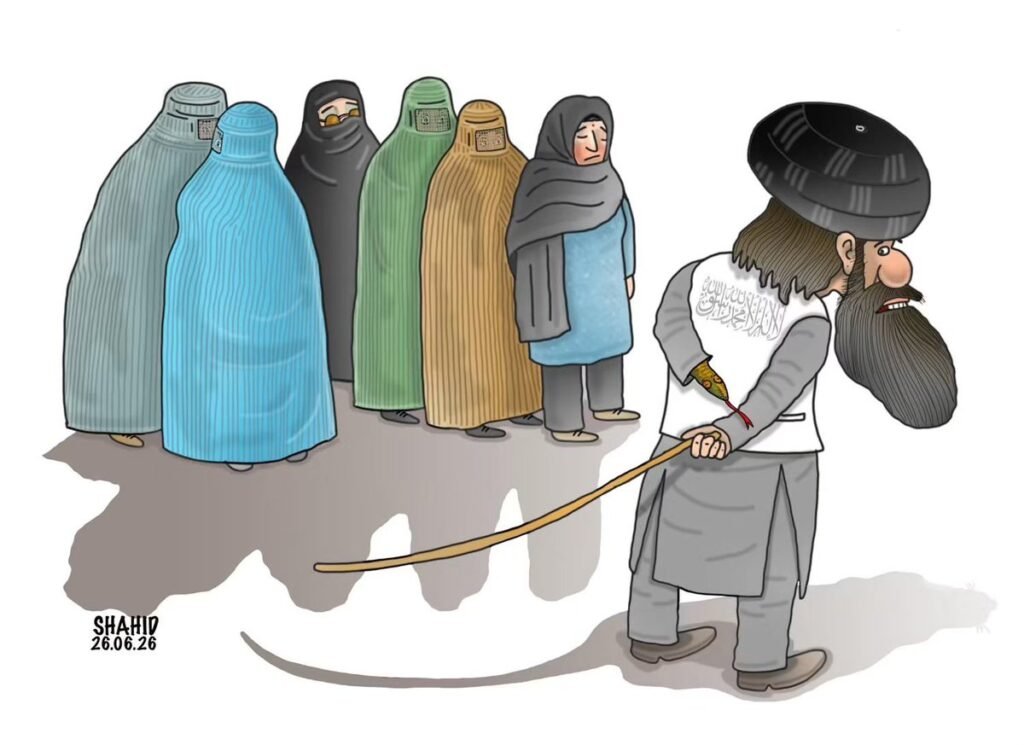
Image: @Atiq Shahid
Beard, prayer mat, rosary, sermon, clerical title and memorized Qur’anic verse are not isolated objects of ridicule. Each is a sign capable of claiming moral authority.
By Ivan Pozzoni
Satire as counter-speech
Hasib Ahrari’s Rish Daraz-e Aqel Kotah – “The Long Beard, the Short Reason”- is a powerful example of Afghan Persian satire directed against the fusion of religious authority, social discipline and political fundamentalism represented by the Taliban. Ahrari, a poet and painter from Panjshir, was arrested by the Taliban in Kabul in June 2023 and released almost two months later. His detention gives the poems a concrete political context: artistic expression, public criticism, and alternative interpretations of religious authority may become objects of repression. The title contains the collection’s central contradiction. ریشِ دراز (rish-e deraz, “long beard”) names a recognizable religious sign; عقلِ کوتاه (aql-e kutah, “short reason”) withdraws the intellectual and moral authority conventionally attached to it. Ahrari therefore opposes visible sign and ethical substance. The beard may index piety and authority; the poem asks whether the conduct of the person wearing it actually supports those meanings. The opening couplet makes the mechanism explicit: «هرچند که خدا وردزبان تو روان است», “Although God flows fluently upon your tongue”, followed by «دانم نه تو را عشق خدا در دل و جان است», “I know that you have no love of God in heart and soul”. The religious utterance is formally intact; its ethical credibility collapses. In pragmatic terms, the locutionary act remains recognizable, while its illocutionary force is discredited by the speaker’s conduct. Ahrari thus turns pragmatics into political criticism: the value of religious language is tested through the behavior accompanying it. The same principle appears in «از فتنهی مکر تو خدا هم نگران است», “Even God is worried by the sedition of your deceit”, which reverses the hierarchy between religious interpreter and divine authority, and in «کم نازو نیازار و نزن نیش، نرنجان», “Be less arrogant, do not torment, do not sting, do not hurt” which establishes conduct as the criterion of authenticity. Religious vocabulary is relocated into an ethical scene where behavior becomes evidence. This strategy connects Ahrari with a wider aesthetics of resistance. Salman Rushdie’s description of the artist’s “time honored role […] to speak truth to power” clarifies the political function of artistic speech. Ahrari goes further by making power confront its own vocabulary. He does not need an external language of opposition: he appropriates the signs of authority and reveals their internal contradiction. The same procedure governs ritual. «صدسال اگر بر سر سجاده نشینی», “Even if you sit upon the prayer mat for a hundred years”, turns temporal excess into reductio ad absurdum. No quantity of ritual repetition guarantees ethical value. The sajjada becomes a metonym for a system in which visible religious performance is mistaken for moral achievement. Ahrari distinguishes ritual performance from ethical uptake: an action may be repeated correctly without producing the human transformation that supposedly justifies it. The cognitive dimension reinforces the pragmatic one. Readers possess learned associations: prayer suggests piety, the rosary devotion, the beard religious authority, the title sheikh wisdom. Ahrari creates prediction error by disrupting these associations. The expected interpretation is activated and immediately reversed. This incongruity increases salience and demands cognitive reappraisal. Rhyme, parallel syntax, repetition, and semantic opposition facilitate chunking and recall, turning the contradiction between external sign and internal morality into a durable cognitive schema. Satire thus becomes a form of intellectual training: the reader learns to suspend automatic recognition and inspect the relation between sign, intention, and consequence. The mechanism also depends upon implicature. The literal utterance often appears to respect the vocabulary of piety, while contextual cues instruct the reader to infer a second, critical meaning. Ahrari consequently forces the audience to distinguish what is said from what is done through saying it. The political significance is substantial: when authority monopolizes interpretation, exposing the gap between utterance and intention becomes a form of resistance.
The religious sign under judgement
Ahrari dismantles the symbolic infrastructure of religious authority through a sequence of apparently simple objects and forms. «ابلیس هم از زمرهی خوبان خدا بود», “Even Iblis belonged to the company of God’s good ones”, destabilizes the assumption that proximity to sacred discourse guarantees virtue; «روزی تو هم از صومعه بیرون شوی شیخا», “One day you too will leave the monastery, O sheikh”, converts institutional authority into a direct interlocutor. The vocative شیخا (sheikha) changes the communicative geometry of the poem. The religious authority is no longer a distant social category: he becomes a you who can be questioned and morally evaluated. Hierarchical power depends partly upon distance, titles, ritual spaces, and controlled forms of address. Satire reduces that distance. The rosary receives the same treatment: «مغرور دو-سه دانهی تسبیح چرایی», “Why are you proud of two or three beads of the rosary?”. A prestigious religious object is reduced to its material form. This is de-automatization: the familiar object is made strange so that its assumed meaning becomes visible. The rosary remains a rosary, yet it can no longer function automatically as evidence of virtue. The sociological significance is crucial. Religious authority requires publicly recognizable signs. Clothing, bodily appearance, titles, objects, and ritual behavior make the religious subject socially legible. Under fundamentalism, such legibility may become a mechanism of control: once signs of orthodoxy are visible, they operate as certificates of legitimacy. Ahrari interrupts that conversion by refusing to let the sign determine the judgement. His poem concerning the sermon and the sword makes the political structure explicit: «صد موعظه گویی و یکی رام نگردد», “You may give a hundred sermons and not make a single person obedient”, followed by «تا در ته آستین تو این تیغ بران است», “while this sharp sword remains hidden in your sleeve”. Persuasion and coercion are separated. The sermon belongs to communicative persuasion; the hidden sword introduces material threat. The poem exposes two simultaneous messages: the explicit message asks for belief, while the concealed message demands obedience. Here pragmatics becomes political anthropology. The illocutionary claim of religious instruction is compromised by the perlocutionary threat attached to it. Apparent consent may be produced by fear. Ahrari reveals the difference between convincing someone and compelling someone to behave as though convinced.Pierre Bourdieu’s analysis of symbolic power helps explain this mechanism: authority becomes effective when symbolic recognition is converted into accepted asymmetry. Ahrari reverses the conversion. The symbols themselves become objects of suspicion. Umberto Eco’s notion of the “cult of tradition” offers a parallel: inherited forms become politically dangerous when treated as immune from examination. Ahrari does not reject tradition; he rejects the automatic transfer of legitimacy from inherited sign to contemporary authority. Afghan visual resistance offers another comparison. Shamsia Hassani’s statement, “I want to make Afghanistan famous for its art, not for the war”, expresses a struggle over the symbolic identity of Afghanistan. Her murals and Ahrari’s poetry use different media, yet both reclaim representation from violence. Art becomes a form of symbolic reoccupation of public space. This is also a political-aesthetic operation. Power does not survive through coercion alone; it requires images, gestures, narratives, and objects capable of making hierarchy appear natural. Satire interrupts that naturalization. By turning the authoritative figure into an object of laughter, Ahrari changes the affective relation between audience and power. Fear can coexist with ridicule, yet ridicule weakens the aura of inevitability on which domination depends.
Scripture, interpretation, and the politics of meaning
Ahrari’s most direct intervention concerns scripture and interpretation. He writes «آن سوره که در سینه سپردی و ندانی», “That sura which you have committed to your breast without understanding”, and «آیات نیازردن و احسان و امان است», “its verses are those of not hurting, of kindness and security”. The distinction is between memorization and comprehension. The religious subject possesses the sacred text without realizing its ethical implications. Scripture is therefore not validated by repetition; interpretation must become visible in conduct. This distinction matters politically because control over interpretation can become control over legitimate behavior. Ahrari challenges that monopoly through an ethical criterion: interpretation must be judged by its consequences for human relations. The result is a struggle over interpretive sovereignty. Fundamentalist discourse tends towards semantic closure: one correct reading, one legitimate behavior, and one authorized identity. Satire performs the opposite operation. It creates semantic instability and asks the reader to compare what a religious sign claims to mean with what the conduct surrounding it actually produces. Homeira Qaderi’s statement «در تمام این سالها از راه قلمم مبارزه کردهام», “In all these years, I have fought through my pen”, provides an Afghan parallel. Writing becomes a counter-device against imposed representations. Khaled Hosseini similarly reconstructs Afghanistan through multiple individual lives rather than through the singular political identity imposed by the Taliban. Ahrari achieves a comparable plurality through irony: political dogma seeks to stabilize meaning, while literature reopens it. Susan Sontag’s assertion that “Interpretation is the revenge of the intellect upon art” provides a useful contrast. Ahrari does not attack interpretation as intellectual activity; he attacks interpretation transformed into institutional control. His satire reclaims interpretation as a critical capacity. The reader is no longer required to accept the official meaning of a beard, prayer mat, rosary, or Qur’anic verse, but can examine the relation between signs and conduct. The neuroscientific dimension lies in the interaction between expectation and reinterpretation. Irony requires competing representations: literal proposition and implied proposition. Contextual processing, mentalizing, and cognitive reappraisal become necessary because the reader must infer intention. Satire is therefore cognitively demanding. Its political value follows from this demand: a reader trained to question linguistic meaning is less easily confined to a single authorized interpretation. Arundhati Roy’s injunction “shame it. To mock it” captures this political dimension. Mockery deprives authority of symbolic immunity. Once an institution can be laughed at, it can be examined; once examined, its legitimacy is no longer automatic. Ahrari’s own statement, «طنز همیشه برای خندین نیست», “Satire is not always for laughter” supplies the final key. His explanation that he composed the poems “with the blood of the heart and a sea of tears” makes clear that humor is the surface mechanism of a serious ethical operation. The joke is not the destination: it is the device through which contradiction becomes visible. The literary form is therefore inseparable from its political efficacy. Rhyme, repetition, irony, and direct address reduce complex criticism to memorable verbal units. This matters in an oral and socially influential poetic culture: a satirical line can circulate beyond the original reading situation, becoming a portable counter-discourse. The poem acquires a second life through memory, quotation and repetition. What fundamentalist discourse seeks to close, poetic form keeps mobile.
From symbol to conduct: the political force of Ahrari’s satire
The coherence of Rish Daraz-e Aqel Kotah emerges when its targets are read as parts of one pragmatic structure. Beard, prayer mat, rosary, sermon, clerical title and memorized Qur’anic verse are not isolated objects of ridicule. Each is a sign capable of claiming moral authority. Ahrari repeatedly interrupts the inferential shortcut connecting sign with virtue. His fundamental question is simple: what happens when the religious sign and the ethical act no longer correspond? The answer is satire. The poet makes the discrepancy visible, memorable, and difficult to neutralize. Religious language becomes a test of conduct; ritual a test of ethical effect; authority a test of accountability; scripture a test of interpretation.Here literary criticism, pragmatics, neuroscience, sociology, and political aesthetics converge. Literary form produces the contradiction; pragmatics explains the gap between utterance and intention; cognitive science explains why incongruity and repetition make the contradiction memorable; sociology explains how signs become instruments of authority; political aesthetics explains how art can redistribute symbolic power. Ahrari keeps these dimensions inside the poem. His satire stages communicative failures: the pious speaker who does not behave piously, the preacher who persuades through fear, the cleric who possesses religious signs without intellectual depth, the reader who memorizes scripture without understanding its ethical implications. The comparative figures reinforce this interpretation. Rushdie places artistic speech against power; Wiesel exposes fanaticism’s destructive logic; Eco analyzes the danger of unquestioned tradition; Nussbaum defends critical examination; Hassani reclaims Afghanistan through visual art; Qaderi transforms writing into resistance; Hosseini restores narrative plurality; Roy identifies mockery as a weapon against domination. Their approaches differ, yet they share with Ahrari the conviction that representation itself is politically consequential. The title remains the most economical statement of the project: Rish Daraz-e Aqel Kotah. The beard is long; the reason is short. Its force comes from compression: a whole political anthropology is reduced to a memorable contradiction between appearance and intelligence. The collection should therefore not be reduced to anti-clerical humor. Its deeper target is the political conversion of religious signs into unquestionable authority. Ahrari does not ask the reader to abandon faith. He asks the reader to judge religious authority through its effects on human beings. The distinction is essential. Prayer is not declared meaningless; prayer without ethical transformation is exposed as empty. Scripture is not rejected; memorization without understanding is exposed as hollow. Religious identity is not denied; identity cannot substitute for character. The political significance becomes clear here. Fundamentalism seeks to control both behavior and interpretation. Ahrari contests both forms of control through language. He gives the reader permission to inspect the sign rather than obey it, question the title rather than defer to it, interpret the text rather than accept its official interpretation. His satire therefore turns language into a small but powerful space of freedom. In the end, the argument is simple. A beard does not prove wisdom. A rosary does not prove goodness. A prayer mat does not prove compassion. A sermon does not prove persuasion. Memorizing scripture does not prove understanding.
What matters is conduct
That is the political heart of Rish Daraz-e Aqel Kotah. Ahrari makes the symbols of authority answer to the people who live under them. In a political system that seeks to make its symbols unquestionable, making them laughable is already a form of resistance.
About the author: Ivan Pozzoni was born in Monza in 1976. He introduced Law and Literature in Italy and the publication of essays on Italian philosophers and on the ethics and juridical theory of the ancient world; he collaborated with several Italian and international magazines. He wrote 152 volumes, wrote 1000 essays. His verses/essays are translated into 30 languages.
Note: The contents of the article are the sole responsibility of the author. Afghan Diaspora Network will not be responsible for any incorrect statements in the articles.