Robaba Mohammadi: Painting With Her Mouth, Fighting With Her Voice
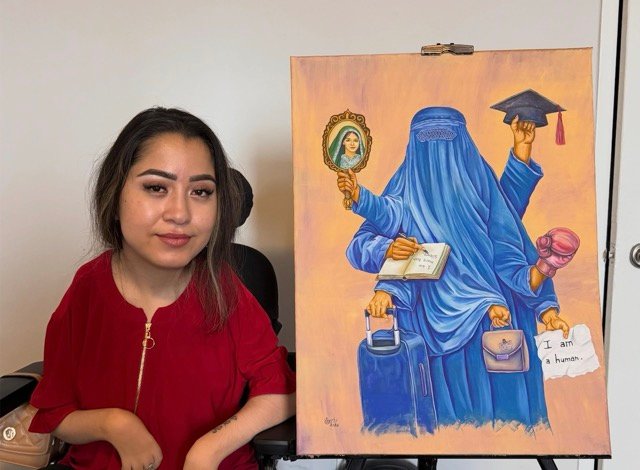
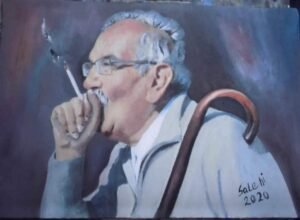
Afghan artist, Robaba Mohammadi and her painting of Afghan woman with burqa. Photo: From Robaba Mohammadi's Facebook page.
In a world where Afghan women are being pushed out of public life, silenced, and stripped of their most basic rights under Taliban rule—a group responsible for severe human rights violations— the voice of artist and activist Robaba Mohammadi cuts through the darkness with rare clarity. Her message is not only artistic; it is moral, political, and deeply personal.
Robaba was born with a physical disability that prevents her from using her hands and feet. Yet she refused to let this define the limits of her life. Instead, she transformed what many would consider an obstacle into a source of extraordinary strength: she paints using her mouth.
Robaba’s work, rooted in Realism, is detailed, expressive, and emotionally charged—a testament to resilience and a refusal to surrender to circumstance. Her website, robabapalette.com, showcases a body of work that is both technically refined and spiritually powerful, capturing the depth of Afghan life, womanhood, and struggle.
But Robaba’s art is only one part of her story. Her activism is equally fierce.
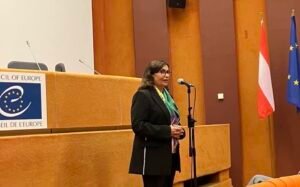
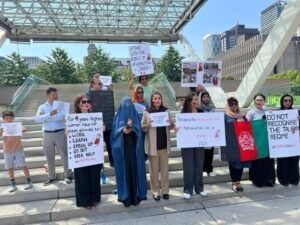
Speaking at a recent demonstration organized by the Afghan diaspora in Toronto, Canada, she expressed disappointment that more men had not shown up.
“When it’s a party, men attend in large numbers,” she said. “But when it comes to standing with women, we see who is truly with us.”
She described how social media has become a mirror—revealing who cares, who engages, and who remains silent as Afghan women face unprecedented repression.
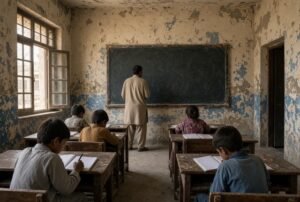
Her own life reflects the consequences of exclusion. She never had the chance to attend school because there were no educational facilities for physically challenged children. Her sisters and cousins were able to study, but under the Taliban, even those limited opportunities have been taken away.
“As an Afghan girl, I stand with Afghan girls,” she said. “If I stop speaking, people inside Afghanistan message me and ask why I am silent.”
Her advocacy, however, comes with emotional weight. Some accuse her of encouraging Afghan men to protest from the safety of her life abroad. But she rejects this criticism.
“From afar, what else can I do except encourage them?” she asks. Her message to Afghan men is blunt and uncompromising: dignity requires action.
“When their wives, sisters, and daughters are taken away in front of their eyes, silence is not dignity. They must be the voices of their families.”
Her words are not a call to reckless sacrifice but a plea for moral responsibility. She believes that if Afghan men rise together, they can reclaim their country from oppression. Her conviction is rooted not in naïve optimism but in lived experience—the experience of someone who has fought her entire life against limitations imposed by society, disability, and now political tyranny.
Robaba Mohammadi’s art is a form of resistance. Her voice is a form of courage. And her message is a reminder that advocacy is not a luxury—it is a duty. In a time when Afghan women are being erased from public life, her presence, her paintings, and her words insist on visibility.
She paints with her mouth, but she speaks with her whole being.