Afghan Diaspora Dialogue in Munich Highlights Search for Influence and Unity
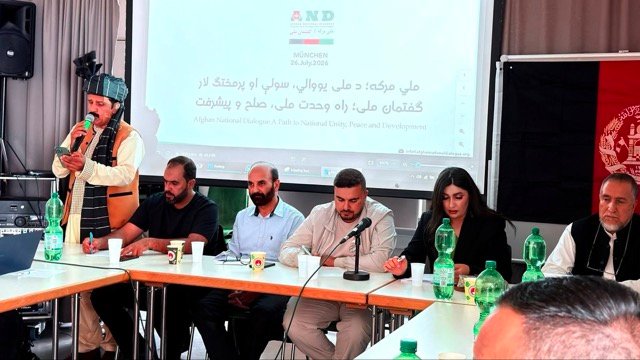
Participants of the Münich Dialogue on 26 July gathered to discuss the Afghan diaspora’s role in shaping national unity and defending fundamental rights. Photo: @National Dialogue, Münich
Without unity, strategy, and sustained engagement, the diaspora’s potential influence will remain unrealized.
The latest “Marka‑e Milli” national dialogue in Munich brought together members of the Afghan diaspora who are increasingly aware that Afghanistan’s political future may depend, in part, on how effectively Afghans abroad organize themselves.
While the country faces a deepening humanitarian crisis, restrictions on women and girls, and renewed violations of national sovereignty, the diaspora is attempting to build a coherent voice capable of shaping debate beyond Afghanistan’s borders.
The Munich gathering fits into a pattern seen earlier this year in Hamburg and Melbourne, where diaspora groups explored how fragmented communities abroad could become more coordinated.
Across these dialogues, one theme has remained constant: Afghans outside the country may now have more freedom to speak, mobilize, and advocate than many inside Afghanistan, but they lack the structures to turn that freedom into influence.
Discussions in Munich focused on three broad areas. First, participants examined Afghanistan’s political breakdown and the severe limitations imposed on women and girls. The consensus was that defending girls’ education and women’s right to work must remain central to any diaspora agenda.
Second, the dialogue addressed the social fragmentation that continues to undermine national cohesion. Participants argued that prejudice, exclusion, and factionalism—long‑standing features of Afghan politics—must be confronted directly if Afghans abroad hope to model a different political culture.
The third area centered on the diaspora’s own responsibilities. Speakers noted that Afghans abroad possess significant intellectual, financial, and organizational resources, yet these assets remain scattered.
The call was for a shift from informal activism to structured networks capable of supporting educational initiatives, women’s empowerment, and development projects. The refugee crisis in the region and Europe, along with recent strikes by Pakistan across the Durand Line, were cited as issues requiring coordinated advocacy rather than isolated reactions.
The Munich dialogue concluded with a clear message: without unity, strategy, and sustained engagement, the diaspora’s potential influence will remain unrealized. But with organization, it could become one of the few remaining spaces where Afghans can articulate national priorities and defend fundamental rights.