Melbourne Dialogue Captures a Diaspora Searching for Unity
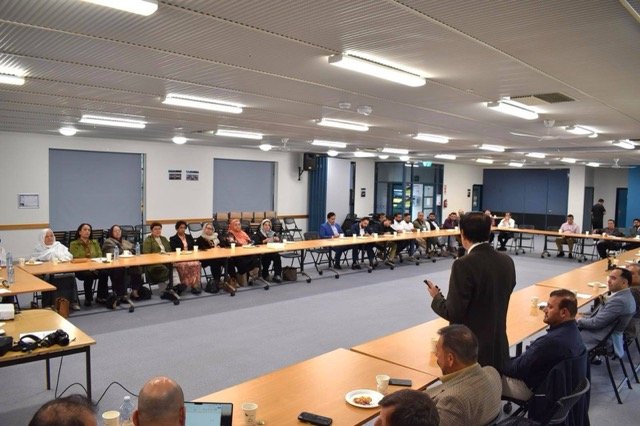
Melbourne’s Afghan community meets again, raising the question of whether these dialogues can build real unity or remain symbolic. Photo: ملي محور ګوند
By Kazim Jafari
The Afghan diaspora in Australia gathered in Melbourne for a new session of the National Dialogue, an initiative aimed at examining Afghanistan’s political crisis and the role of Afghan diaspora. The event brought together community members from political, academic and civic backgrounds, reflecting the diaspora’s growing engagement.
The session opened with formal remarks and the national anthem from the former Islamic Republic Government of Afghanistan. Organizers described the National Dialogue as an Afghan‑led and independent process meant to rebuild trust and create a platform where Afghans everywhere can contribute to national conversations. The tone echoed earlier discussions in Berlin, where the Afghan Diaspora Network reported on the diaspora’s rise as a political actor.
In Melbourne, the initiative’s mission was presented as promoting dialogue, tolerance, and mutual respect. Participants argued that Afghans abroad, especially those living in democratic societies, are uniquely positioned to model these values and influence international attention toward Afghanistan.
Discussions focused on Afghanistan’s core challenges. These included the absence of a legitimate political framework, deep social mistrust, restrictions on women’s rights, economic collapse, and the worsening situation of refugees in neighboring countries. Many of these concerns mirrored those raised in Berlin, where diaspora voices stressed the need for justice, inclusion, and civic participation.
The Melbourne gathering placed particular emphasis on the diaspora’s responsibilities. Participants called for stronger coordination among Afghan organizations in Australia, unified messaging, and more effective engagement with international institutions. They also highlighted the need to support women’s education and expand National Dialogue branches across Australian cities.
The event reflected a broader trend: the Afghan diaspora is increasingly organizing itself into civic and political platforms that seek to influence national debates. These efforts are multiplying across continents—from Berlin to Melbourne—and are shaping a new transnational political space.
Yet a central question remains. Are these dialogues forming a cohesive movement capable of real influence, or are they simply another addition to the long list of diaspora discussions? Only time will show whether they can produce tangible outcomes for Afghanistan’s future.
Kazim Jafari is a political science student at the University of Heidelberg in Germany.
Note: The contents of the article are the sole responsibility of the author. Afghan Diaspora Network will not be responsible for any incorrect statements in the articles.