A Little Kabul in Paris
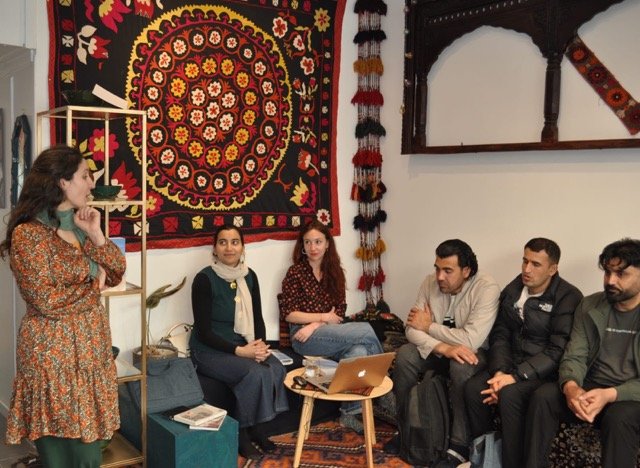
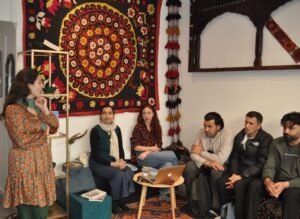
Sarah Hermann (left), founder of Kuchnay Kabul (Little Kabul) in Paris. Photo courtesy of Kuchnay Kabul/ADN.
How much of Afghan culture should be preserved abroad? How should traditions adapt to life in a new country? What does it mean to belong to two cultures at once?
Rue des Pyrénées stretches for kilometers through eastern Paris, cutting across some of the city’s most diverse neighborhoods. Lined with apartment buildings, cafés, grocery stores, and small family businesses, the long avenue climbs steadily through the 20th arrondissement, far from the tourist crowds gathering around the Eiffel Tower and the Louvre.
Hidden among the shops and residential buildings is a small cultural center called La Petite Kaboul — known in Pashto as Kuchnay Kabul, or “Little Kabul”.
Inside a sunlit classroom, the sounds of Pashto and French fill the room.
On a whiteboard are simple French words: un lieu, une heure, une couleur, la peur. Standing before six Afghan refugees, teacher Sarah Hermann moves effortlessly between French and Pashto, translating unfamiliar grammar and French vocabulary into familiar sounds.
The students follow closely.
Two children sit beside their fathers, temporarily joining the class during the summer school holidays. The children arrived in France only a month ago. Around them, other students carefully complete exercises while Hermann walks from desk to desk answering questions and offering encouragement.
Thousands of kilometers from Afghanistan, this classroom offers more than language lessons.
It offers belonging.
For many newly arrived refugees, life in France can be both hopeful and isolating. Learning a new language, navigating unfamiliar institutions, finding employment, and rebuilding social networks can feel overwhelming. In that context, a place where people can speak their own language, share common experiences, and meet others facing similar challenges becomes invaluable.
This classroom is part of Kuchnay Kabul, a small cultural center founded by Sarah Hermann, a French scholar who spent years studying Afghanistan and learning Pashto. Through academic research and long engagement with Afghan communities, she developed a deep connection to the country and its people. Over time, that connection evolved into something more practical: creating a space where Afghans and French citizens could meet, learn from one another and build relationships beyond stereotypes.
“The main objective is that Afghans and French get together, know each other and speak with each other,” Hermann says.
What began as a modest initiative has gradually become a gathering place for Afghans from different backgrounds, generations and migration experiences.
Language classes are only one part of the project.
Inside Kuchnay Kabul, visitors can take Dari and Pashto classes, learn calligraphy inspired by the Herat tradition, attend embroidery workshops, participate in poetry evenings, or join cultural discussions. The center also hosts book presentations, film screenings, traditional games and community gatherings.
The atmosphere is deliberately informal.
“We joke and call it a gossip group,” Hermann says with a laugh.
Yet what appears casual from the outside is carefully designed.
Many newly arrived Afghans struggle with loneliness and social isolation. Some feel hesitant to speak French in public. Others find it difficult to establish friendships outside their immediate circles. Cultural and recreational activities help remove those barriers.
Games often become an unexpected tool for integration.
“Afghans might feel embarrassed because of their language skills,” Hermann explains. “But after playing games, they feel better and start talking.”
The center’s activities reflect a simple philosophy: culture creates conversation.
Rather than focusing on politics or formal debates, participants connect through shared experiences and everyday questions. One evening, participants might discuss whether Afghan children growing up in Europe should learn Dari and/or Pashto and how these languages should be transmitted. Another conversation may explore how Eid celebrations differ between Afghanistan and the diaspora.
Questions of identity arise naturally.
How much of Afghan culture should be preserved abroad? How should traditions adapt to life in a new country? What does it mean to belong to two cultures at once?
Among male participants, discussions about traditional Afghan clothing frequently emerge.
“Some people think wearing Afghan clothes in the diaspora is important. Others disagree,” Hermann says. “It is interesting to hear everyone’s arguments.”
Politics, however, is largely absent. The association deliberately avoids partisan political debate and does not align itself with Afghan political factions.
“We do not discuss politics,” she says.
The decision is intentional. Many Afghans arrive carrying difficult memories, political disagreements or experiences of conflict. Kuchnay Kabul aims to provide a neutral environment where people can meet as community members rather than political factions.
The goal is dialogue, not division.
Women occupy a particularly important place within the center’s activities.
Monthly women-only gatherings bring together Afghan women who often have limited social networks in France. A babysitter is provided so mothers can participate freely. The center also offers women-only French classes in the mornings, with childcare provided so that mothers can attend. The gatherings combine practical support with social interaction. Activities range from conversations and workshops to sessions on cosmetics, self-care, and everyday life in France.
“Many Afghan women do not have many contacts,” Hermann says. “This gives them a place to meet and talk.”
For some participants, these gatherings represent one of the few opportunities to spend time outside family responsibilities and develop friendships with other Afghan women navigating similar transitions.
The center’s cultural programming continues to grow.
French authors who write about Afghanistan are invited to discuss their work. Travelers share stories and photographs from their journeys. Recently, Kuchnay Kabul acquired a projector and began hosting documentary and film screenings related to Afghan history and culture.
The screenings create opportunities for shared reflection and discussion.
Musicians have also expressed interest in contributing.
“We would like to start music lessons too,” Hermann says.
The ambition is to broaden the range of cultural activities available to both Afghans and French visitors, creating even more opportunities for exchange.
Yet behind the welcoming atmosphere lies a constant struggle to keep the project alive.
Kuchnay Kabul operates largely through volunteer work. Hermann receives no salary. Most of the people involved dedicate their time without compensation. Small membership fees and modest language-class payments help cover rent and basic operating expenses, but resources remain tight.
“Whatever I earned in Afghanistan, I have spent here,” she says.
Support often comes from within the Afghan community itself.
Local Afghan businesses provide tea, snacks, and other necessities. Volunteers help with administration, social media management, and event planning. Refugees produce much of the center’s online content, sharing photographs, videos, and stories that document community life.
Despite these efforts, financial sustainability remains one of the center’s greatest challenges.
Several applications for municipal funding have been unsuccessful.
“Every time a project is rejected,” Hermann says. “The bureaucracy takes so much time.”
The administrative burden can be frustrating for a small organization with limited personnel. Every funding application requires extensive paperwork, planning, and follow-up, with no guarantee of success.
Still, the center continues to grow.
Volunteers manage Kuchnay Kabul’s presence on Instagram, Facebook, and TikTok. Social media has become one of the organization’s most effective tools for reaching newcomers and maintaining community connections.
Hermann hopes one day to establish a chai khana, or tea house, that could generate a reliable source of income while also serving as a cultural gathering space.
A tea house, she believes, would not only help fund existing programs but also strengthen the center’s role as a community hub.
She would also like to expand the services offered by Kuchnay Kabul.
Future plans include counseling support and legal assistance for refugees navigating life in France. Conversations with volunteers and professionals have begun, but resources remain limited.
“We are only ten active people,” she says. “We cannot do everything.”
The challenges are not only financial.
As a French woman deeply involved with Afghan communities, Hermann often finds herself balancing competing expectations and cultural perceptions.
During media interviews, she typically chooses to wear a headscarf.
The decision is pragmatic as much as personal.
“If I do not wear it, people insult me online,” she says. “But in some of my professional roles, including teaching at a public university and certain interpreting assignments for public services, I am not allowed to wear it either. And if I am too publicly associated with the headscarf, I also worry that the association may be viewed differently by institutions and potential funders.”
Her experience reflects broader dilemmas faced by many people navigating different social, cultural, and institutional expectations. Identity is rarely straightforward. Expectations differ between communities, and individuals often find themselves navigating contradictory pressures.
These tensions are familiar to many members of the Afghan diaspora as they negotiate belonging in multiple cultural worlds simultaneously.
Yet despite the difficulties, Hermann’s commitment remains unchanged.
As she speaks, she points to photographs documenting the early days of Kuchnay Kabul.
The images show volunteers painting walls, carrying furniture, organizing books and transforming an empty space into a community center. Much of the work was done collectively, with limited resources but considerable enthusiasm.
Her pride is unmistakable.
But her ambition extends beyond maintaining the project.
“I want Kuchnay Kabul to stay alive without me,” she says. “I want it to be run by Afghans.”
That vision may be the center’s most important lesson.
The goal is not simply to preserve Afghan culture in exile or teach French grammar to newly arrived refugees. It is to create the conditions for long-term community ownership and autonomy.
Hermann hopes that, over time, Afghans themselves will assume leadership roles, organize programs and shape the institution’s future.
In many ways, that process is already underway. Refugees help produce social media content, organize activities, welcome newcomers and contribute ideas for future projects. Little by little, the center is becoming a collective effort rather than a personal initiative.
Back in the classroom, the lesson continues.
Students repeat French words. A volunteer helps one of the newcomers complete an exercise. The children drift quietly between desks.
Outside, Paris rushes forward as usual. Cars move along Rue des Pyrénées. Cafés fill with customers. Life continues at its familiar pace.
Inside Kuchnay Kabul, however, another journey is taking place.
It is the slow, patient, and determined effort to transform exile into belonging. Through language, culture, friendship, and shared experience, a small community is rebuilding itself far from home.
In a modest classroom in eastern Paris, little by little, a new chapter of Afghan life is being written.