DW Documentary: Pakistan’s Nuclear Shadow and the Army’s Grip on Power
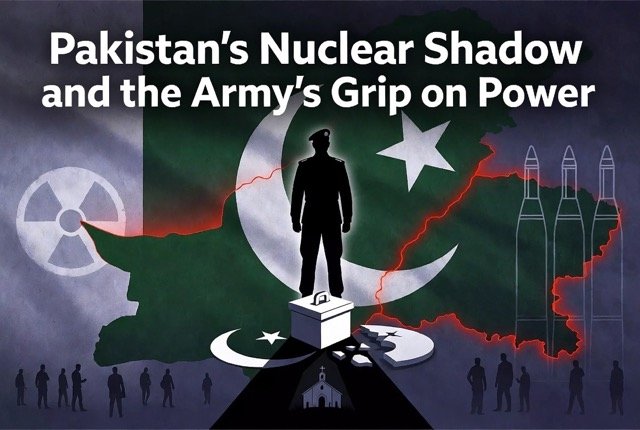
Pakistan’s nuclear power will remain a source of risk rather than strength. Democracy stays incomplete, and ordinary citizens continue to pay the price.
By Kazim Jafari
A new documentary by Germany’s state-funded international broadcasting network Deutsche Welle (DW), “Nuclear Power at a Crossroads,” paints a stark picture of Pakistan. The country holds about 170 nuclear warheads as of 2025. Yet its democracy remains weak, its economy struggles, and its military holds the real power.
The film shows how the army has shaped Pakistan’s destiny for decades. It argues that this military dominance is the main reason the country fails to build a stable democracy.
Kashmir sits at the heart of the problem. The Line of Control divides the disputed region between Pakistan and India. It is one of the most dangerous borders in the world. Gunfire is common. Both sides claim the land, and compromise looks almost impossible.
In spring 2025, violence flared again after an attack in Pahalgam. India and Pakistan traded missile strikes. Civilians paid the price. A retired Pakistani general told DW that if the country’s freedom is threatened, “nobody stops us” from going nuclear. This constant threat keeps the army at the center of national life.
Pakistan built its nuclear arsenal in secret. It never signed the Nuclear Non-Proliferation Treaty. International inspectors cannot visit key sites like the Khushab complex. Safety and control rest entirely in Pakistani hands.
The documentary recalls how nuclear scientist A.Q. Khan shared technology with North Korea, Libya and Iran. Many believe the military knew what was happening. Khan was never fully held to account. The episode damaged Pakistan’s reputation and raised fears that nuclear knowledge could leak further.
The army does not just guard the bombs. It runs large parts of the economy. Through foundations and companies, it owns cement factories, fertilizer plants, transport firms, and banks. Critics say these businesses get special deals on gas and other resources. Private companies struggle to compete.
Soldiers and their families enjoy top hospitals and exclusive housing. Ordinary citizens often cannot. The result is a state within a state. The military has become Pakistan’s most powerful political force. As one expert says in the film, anyone who claims otherwise is lying.
This power has a dark side. Radical Islamists openly call for an Islamic caliphate. Some reject the constitution and praise violence. The army once backed such groups for strategic reasons. Now it faces the consequences at home.
Christian communities have suffered repeated attacks. In 2013, suicide bombers killed more than 120 people at a church in Peshawar. Blasphemy laws make the situation worse. Accusations can spark mob violence, and justice is often missing. Other minorities and liberal voices also face threats.
The film ends with former Prime Minister Imran Khan. Once popular with young Pakistanis, he is now in jail serving a long sentence. He rose with army support but fell when he tried to challenge its control. His story shows how hard it is for any civilian leader to stay independent.
Pakistan has more than 250 million people. Most are young, and many live in poverty. Extremists threaten stability. The army claims it protects the nation. Yet the documentary asks a hard question: can an institution that dominates politics, the economy, and security also solve the country’s deepest crises?
The film suggests the answer is no. Until the military steps back and allows real civilian rule, Pakistan’s nuclear power will remain a source of risk rather than strength. Democracy stays incomplete, and ordinary citizens continue to pay the price.
For Pakistan’s neighbors, these internal problems create serious external risks. India faces the most direct threat. Afghanistan feels the spillover too. Extremists who find space in Pakistan often cross the border, fueling instability and making peace harder to achieve.
Iran watches carefully as well. Past nuclear leaks and shared militant networks raise concerns about further proliferation or cross-border trouble. China, Pakistan’s close partner, gains strategic depth but also inherits risks. An unstable nuclear neighbor complicates Beijing’s regional plans. Wider South Asia suffers from higher military spending, disrupted trade, and constant tension. When one country’s army holds both the bombs and the political levers, the whole neighborhood lives with the consequences.
Kazim Jafari is a political science student at the University of Heidelberg in Germany.
Note: The contents of the article are of sole responsibility of the author. Afghan Diaspora Network will not be responsible for any inaccurate or incorrect statement in the articles.