A Global Cry for Afghan Women: From Vienna to Toronto, Tehran to Melbourne, the Diaspora Rises
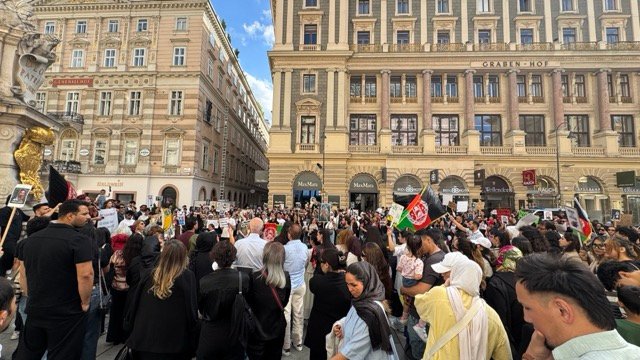
Several hundred Afghan diaspora gathered in Vienna's first district, Graben, to protest against Taliban policies that restrict women's rights. Photo: @Ali Ahmad
In one of the most coordinated acts of transnational Afghan activism since the Taliban’s return to power in 2021, thousands of Afghan diaspora communities across Europe, North America, and Australia staged synchronized demonstrations demanding the restoration of women’s rights in Afghanistan.
The protests—stretching from Vienna to Toronto, from Paris to Frankfurt, and from Tehran to Melbourne—were sparked by a series of recent crackdowns inside Afghanistan, including the violent suppression of women in Herat’s Jebrael district. But they were also the culmination of months of frustration over the Taliban’s gender‑apartheid policies, which have erased women from public life.
Across all cities, one symbol dominated: the tricolor flag of Afghanistan. Once contested within diaspora politics, the flag has re-emerged as a unifying emblem of resistance—a visual rejection of the Taliban’s white banner and a reminder of a republic, however imperfect, in which women could study, work, and participate in society.
The global Afghan demonstrations were not silent marches; they were vibrant, expressive, and deliberately public, scattered geographically across four continents. Music, dance, symbolic reenactments, and artistic performances turned the streets into stages of collective memory and defiance. The protesters marched under a single message: Afghan women must not be erased.
Below is a closer look at three of the most significant demonstrations—Toronto, Vienna, and Hamburg—each revealing a different facet of a global movement that is rapidly maturing.
Toronto: Art, Anger, and the Moral Burden of Distance
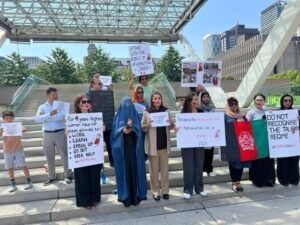
In Toronto, the Afghan diaspora gathered as part of the global wave of demonstrations to declare in one voice, “Education, Work, Freedom!”
Protesters demanded an end to gender apartheid in Afghanistan and condemned the Taliban’s policies that have stripped women of their most basic human rights. As participants emphasized, the right to study and the right to work are fundamental rights—rights that Afghan women have been denied.
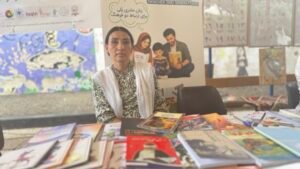
The celebrated Afghan visual artist Robaba Mohammadi—known internationally for painting with her mouth due to a physical disability—delivered one of the most emotionally charged speeches of the global protests. Her presence alone symbolized the resilience of Afghan women: a woman who overcame physical barriers to become an artist now standing against political ones that silence millions.
“I expected more men to attend today,” she told the crowd. “When it’s a party, men show up. But when it comes to standing with women, we see who truly cares.”
Her critique was not accusatory for its own sake; it was a call for moral consistency. In her view, the diaspora’s solidarity must be measured not by online posts but by physical presence and public courage.
Mohammadi spoke of her own childhood—one without access to school because Afghanistan lacked facilities for children with disabilities. Her sisters and cousins could study, but under the Taliban, even those limited opportunities have vanished.
“As an Afghan girl, I stand with Afghan girls,” she said. “If I stop speaking, people inside Afghanistan message me and ask why I am silent.”
Her speech captured a dilemma shared by many in the diaspora: the guilt of safety.
“They tell me I live in a peaceful place while they suffer,” she said. “But from afar, what else can I do except encourage them?”
Her message to Afghan men was blunt: “When your wives, sisters, and daughters are taken away in front of your eyes, silence is not dignity.”
Toronto’s demonstration, though smaller than Hamburg’s, was symbolically powerful. It showed how art, disability, exile, and activism intersect in the Afghan story—and how diaspora voices, even when far from home, carry emotional weight.
Vienna: “Afghan women do not need pity—they need their rights.”
In Vienna, the demonstration unfolded in the historic Graben near Stephansplatz, one of the city’s most iconic pedestrian boulevards. The choice of location was deliberate: a public, central space where Afghan voices could not be ignored. The protesters carried and chanted from placards reading “Let women learn! “Let girls go to school,” “Education, Work, Freedom,” and “We stand with Afghan women.”
The tricolor flag dominated the scene, held by women, men, and children—a symbol reclaimed from political dispute and redefined as a banner of women’s rights.
Shukria Rezaie, a teacher and one of the speakers, delivered a clear message: She described a country where women are banned from school, work, public life, and even basic movement.
“The Taliban have banned Afghan girls and women from society. They do not allow them to go to school, to work, or to speak freely. Afghan women do not need our pity—they need their human rights.”
Her voice trembled not with fear but with conviction. She reminded the crowd that millions of Afghan women continue to resist inside the country, fighting for their dreams despite the suffocating restrictions imposed on them.
“Even if we are far from each other, we stand for one another. Our hearts are with them, and their hearts are with us. Together, we are stronger,” Rezaie said.
Sayed Reza Sadat, one of the co-organizers, emphasized the national character of the protest:
“This is a national demand, not an ethnic one. That is why we march only under the Afghan tricolor.”
He warned that the diaspora will continue protesting “until women regain their rights and schools reopen.”
His statement addressed a long‑standing tension within the diaspora, where symbols often divide communities. But on this day, the flag unified them. Sadat also stressed that the majority of participants were women—a fact that underscored both the urgency of the cause and the shifting dynamics of diaspora activism.
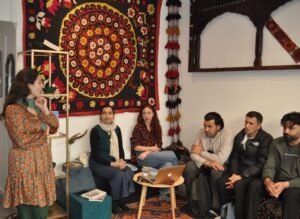
The Vienna protest was notable for its atmosphere: music and chants. These reenactments were not theatrical embellishments; they were reminders of lived realities inside Afghanistan.
Hamburg: The Epicenter of a Global Movement
Hamburg hosted the largest demonstration of all—a mass gathering that brought together hundreds of activists, families, students, and public figures, including the celebrated Afghan singer Farhad Darya. His participation gave the protest a cultural gravitas that resonated far beyond Germany.
“Afghan women deserve a future in which they can live without fear,” Darya told the crowd, his voice carrying across the square.
One female protester addressed the crowd with stark clarity:
“Women in Afghanistan are being systematically silenced, removed from public life, and stripped of their basic right to exist freely. When half of a society is erased, the whole country suffers. Do we want another forty years of this?”
Another speaker highlighted the courage of women inside Afghanistan who walk outside without a burqa (Chadari)—an act she described as “unbelievably brave.” She also criticized the German government for maintaining diplomatic channels with the Taliban:
“I want to give the German government a red card for negotiating with a group responsible for grave human rights abuses.”
Demonstrators demanded the closure of the Taliban‑run consulate in Bonn, arguing that granting diplomatic space to a regime that denies women basic rights is morally indefensible.
Hamburg’s demonstration was not only the largest; it was the most politically pointed. It framed the Taliban not as a distant problem but as a global human rights concern requiring international accountability.
Why These Protests Erupted — and Why They Matter
The immediate trigger for the global demonstrations was the violent crackdown in Western Herat’s Jebrael district, where Taliban forces arrested women and opened fire on protesters, killing at least two people and injuring dozens. The World Hazara Council’s statement condemning the violence circulated widely, fueling outrage.
But the deeper cause is cumulative:
- Nearly five years of gender apartheid
- The closure of schools and universities to women
- Bans on work, travel, and public participation
- The erasure of women from civic life
The diaspora’s response reflects a growing realization that silence is no longer an option. These protests were not isolated events; they were coordinated, intentional, and symbolically unified by the tricolor flag—a flag that, for one weekend, became the global emblem of Afghan women’s struggle.
The demonstrations from Toronto to Vienna to Hamburg mark a turning point in Afghan diaspora activism. They show a community that is no longer fragmented, no longer passive, and no longer willing to let the world forget Afghan women.
In the words of a protester in Hamburg:
“We refuse to accept a future where Afghan women are denied their rights and dignity.”
The diaspora has spoken—loudly, globally, and with remarkable unity. Whether the world listens remains the next test.