Afghan Women Lead Berlin Protest Against Taliban Policies
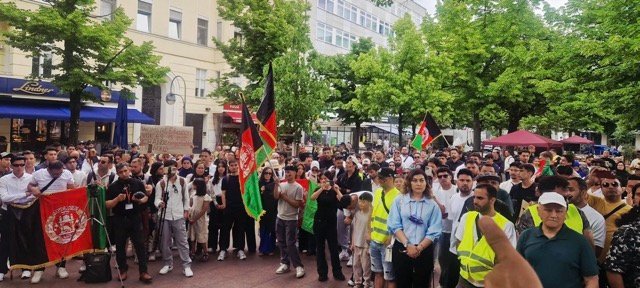
Afghan diaspora members gather in Berlin to protest the Taliban’s restrictions on women and to call for global solidarity. Photo: @Protesters
By Kazim Jafari
Hundreds of Afghans gathered in Berlin to protest the Taliban’s ongoing restrictions on women in Afghanistan. The demonstration brought together diaspora members from across Germany and several EU countries, with women forming the majority of participants. Many carried the tri‑color Afghan flag, turning the streets into a visible symbol of resistance and collective memory.
Protesters chanted “bread, work, freedom,” “education, work, freedom,” “no to Taliban, no to Taliban followers,” and “solidarity with Afghanistan.”
Live music and patriotic songs, including Sar Zameen-e Man, added emotional weight to the gathering, blending cultural pride with political urgency. Participants emphasized that the protest aimed to amplify the voices of Afghan women who have been silenced inside the country.
Placards captured the core message of the day: “They fear educated women,” “Afghan women are fighting for basic rights,” and “No to Taliban. No to pedophile government.”
The rally’s central demand was clear: education, work, and freedom are non‑negotiable rights for Afghan women and girls.
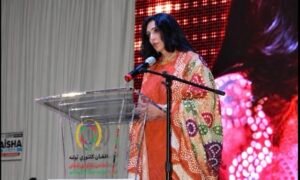
A tense moment unfolded when a female demonstrator asked, “Is there no Taliban in the Afghan embassy in Germany?” She was referring to the presence of Taliban‑appointed diplomats who continue to operate the Afghan embassy in Berlin. Organizers immediately removed her microphone. The incident quickly became one of the most debated aspects of the protest.
Afghan social‑media users reacted sharply. Many criticized the organizers for silencing a woman at a rally meant to defend women’s voices. Others questioned why diaspora activists were willing to condemn the Taliban but hesitant to confront German policy.
One user wrote: “This was not a protest. This was a project — a failed one. Why are you afraid to protest against the German government?”
For many, the irony was striking: a woman’s voice was muted not in Kabul, but in Berlin, a place where freedom of expression is protected. The episode exposed deeper tensions within diaspora activism—between controlled messaging and the raw anger of those who want to challenge not only the Taliban but also the international structures that enable them.
Ali Reza Karimi, one of the demonstrators, said activists had come “from different EU countries and different cities of Germany to raise the voices of Afghan women to the international community.” He stressed that for five years, Afghan women have been banned from education and public life, turning Afghanistan into “a dark place for women.” Their message, he said, was directed both to Europe and the Islamic world.
Another demonstrator emphasized that education is a right, not a privilege. She said, “Education is the right of Afghan girls and women, not a gift from the Taliban. Freedom is the right of the Afghan people, not something the Taliban can grant or take away.” She added that Afghan women are not forgotten history but victims of extremism who deserve global solidarity.
Among the protesters was Zahra Hussaini, holding a placard reading “Stop gender apartheid: education, work, freedom.” She explained that she began protesting in Mazar-e Sharif when the Taliban took over, and nearly five years later, she continues her activism in Berlin.
“As a woman and a human, I want to be the voice of women whose rights have been taken away,” she said.
Another participant, Saleha Aini, formerly an activist in Kabul, said she joined the protest to oppose the Taliban’s many decrees against women.
“We are in a safe place,” she said, “and we raise the voices of women in Afghanistan who are deprived of their rights.”
The Berlin protest highlighted both the strength and the fractures within the Afghan diaspora. While united in opposing the Taliban, the community continues to debate how boldly to confront host governments, international actors, and internal gatekeeping.
What remains clear is that Afghan women’s struggle is far from over—and Berlin’s streets once again carried their voices.
Kazim Jafari is a political science student at the University of Heidelberg in Germany.
Note: The contents of the article are the sole responsibility of the author. The Afghan Diaspora Network will not be responsible for any incorrect statements in the articles.