Afghan Returns from Pakistan Intensify Economic Strain as Families Face Shelter Crisis
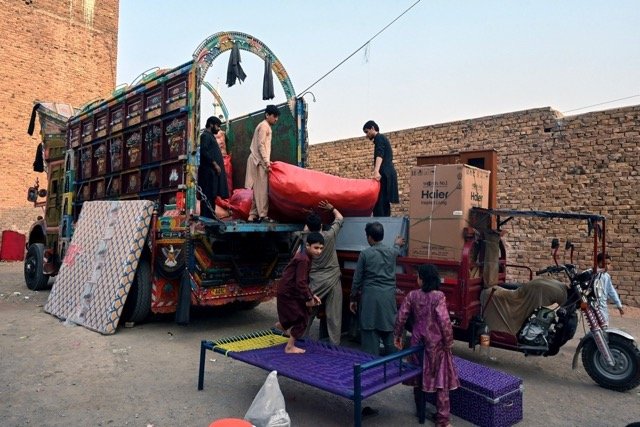
Afghan refugees are packing to be deported to Afghanistan. Photo: @Dawood Jabarkhail
Dawood Jabarkhel
The forced return of Afghan refugees from Pakistan has entered a new and destabilizing phase, reshaping both the humanitarian landscape and the economic ties that once connected Afghan communities to Pakistani markets.
What began as a policy targeting “undocumented foreigners” has evolved into a sweeping campaign that has uprooted families, shuttered businesses, and disrupted long‑standing economic networks.
Afghan traders and community leaders warn that the consequences are far deeper than a simple population movement. For many, the return is not only involuntary but also economically devastating.
Sayed Naqib Pacha, head of the Afghan Traders’ Union in Khyber Pakhtunkhwa, describes the situation as a dual crisis—one that affects both the displaced families and the broader economic ecosystem.
“In recent months, business activity has dropped sharply,” he said, noting that Afghan‑linked markets in Pakistan have weakened dramatically.
“The departure of Afghans has reduced trade by nearly 80 percent. Afghan customers were a major part of the market—transport, food, clothing, everything. Without them, businesses are collapsing.”
The economic fallout is only one part of the story. For the thousands of families now crossing back into Afghanistan, the return is marked by uncertainty and hardship. Many have spent decades in Pakistan, building lives, raising children, and establishing businesses. Returning to Afghanistan means starting from zero.
“Most of the families going back have no homes to return to,” Pacha explained. “After so many years in migration, they simply cannot afford to build a house. They are arriving with nothing.”
The lack of shelter has become one of the most urgent challenges. Families are arriving in provinces already struggling with poverty, limited infrastructure, and insufficient government capacity. Pacha urged Afghan authorities to take immediate action:
“The Taliban government must provide shelter, temporary camps, and proper living facilities. Without support, these families will face even more suffering.”
The crisis is not limited to ordinary refugees. Afghan business owners—many of whom invested heavily in Pakistan’s markets—are also being pushed out. Their departure is reshaping commercial dynamics on both sides of the Durand Line.
“It’s not just regular refugees leaving,” Pacha emphasized. “Many Afghan traders are also returning. They had investments in different sectors and formed a significant part of the market. But because of the current situation, they are limiting their businesses or moving them back to Afghanistan.”
For Afghanistan, this influx of traders could be an opportunity—if managed properly. Pacha argues that the Taliban government must act quickly to prevent further economic deterioration.
“The government in Afghanistan should create special facilities for traders—support for investment, easier business registration, and help with commercial documents and visas,” he said. “If these traders can operate smoothly, they can contribute to the economy instead of becoming another burden.”
The broader context of Pakistan’s expulsion campaign adds another layer of complexity. Since late 2023, Pakistani authorities have intensified pressure on Afghan communities, conducting raids, detentions, and mass deportations.
Many Afghans report harassment, extortion, and the confiscation of property. The suddenness of the policy has left families with little time to prepare, forcing them to abandon homes, businesses, and decades of accumulated assets.
The humanitarian implications are severe. Afghanistan, already grappling with economic collapse, drought, and limited international aid, is now absorbing hundreds of thousands of returnees.
Local communities lack the resources to support them, and government institutions remain overstretched. Without coordinated assistance, the returnees risk falling into deeper poverty, while the economic shockwaves continue to ripple across the region.
Pacha’s warning is stark: “If the problems of returning refugees and traders are not taken seriously, thousands of families will face economic and humanitarian crises, and the impact on trade will only worsen.” His message underscores a growing fear among Afghan communities—that without urgent intervention, the forced returns could trigger a broader economic and social breakdown.
The crisis unfolding at the border is more than a migration story. It is a test of Afghanistan’s capacity to absorb its displaced population, rebuild economic stability, and protect some of its most vulnerable citizens. Whether the government can rise to that challenge remains uncertain, but the stakes are unmistakably high.
Note: The contents of the article are the sole responsibility of the author. Afghan Diaspora Network will not be responsible for any incorrect statements in the articles.