Afghan Diaspora Rally in Brussels to Condemn Pakistani Airstrikes
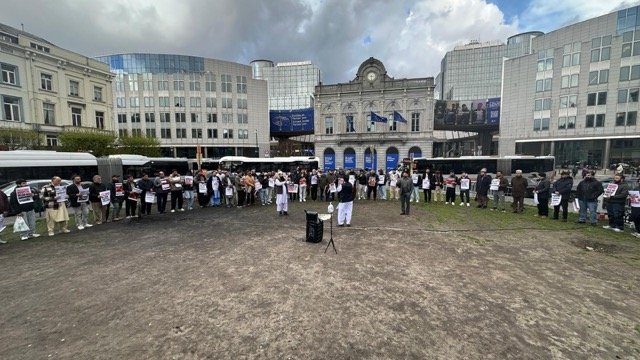
A few dozen Afghans rallied in front of the European Parliament in Brussels to condemn Pakistani airstrikes on a drug‑rehabilitation center in Kabul that killed more than 400 people and injured hundreds more. Photo: Larawbar Facebook page.
Dozens of Afghans from across Europe gathered on 25 March outside the European Parliament in Brussels to protest Pakistan’s recent airstrikes on Afghan territory, accusing Islamabad of violating Afghanistan’s sovereignty and carrying out attacks across the Durand Line. The demonstration captured the growing anger and grief felt within the Afghan diaspora as reports of civilian casualties continue to emerge.
The rally was organized by Larawbar, a political and cultural group that advocates for the reunification of Pashtun lands on both sides of the Durand Line. In posts shared on its official Facebook page, Larawbar urged Afghans in Europe to stand in solidarity with communities affected by the strikes and to raise international awareness about what it described as Pakistan’s “ongoing military aggression.”
Protesters held a wide range of banners and posters, many reflecting the raw emotions of the day. Slogans included “Pakistan violates Afghanistan’s sovereignty,” “Respect Afghan sovereignty,” “Stop bombing Afghanistan,” “No more airspace violation,” and “Targeting hospitals is a war crime.” Some signs highlighted specific incidents, such as “Pakistan killed cricket players in Paktiya,” while others demanded accountability: “Hold Pakistan accountable,” “End Pakistan’s aggression now,” and “No to Pakistan state terror.”
Speakers at the event called on the European Commission to suspend Pakistan’s preferential trade access under the GSP+ scheme, arguing that such privileges should not be granted to governments accused of systematic human rights violations. They urged EU institutions to take a stronger stance and press Pakistan to halt airstrikes and respect Afghanistan’s territorial integrity.
Participants also voiced frustration with Afghanistan’s de facto authorities. Several speakers condemned the ongoing ban on girls’ education, describing it as a “historic injustice” that continues to harm Afghan society and calling for its immediate reversal.
The demonstration came amid widespread outrage following Pakistan’s latest airstrikes, which reportedly struck multiple provinces and a drug‑treatment center in Kabul. Local reports claim that more than 400 people were killed and hundreds more injured, many of them vulnerable patients receiving care. The scale of the casualties has deeply shaken Afghans both inside the country and across the diaspora.
Similar protests have taken place in several countries, including the UK, Switzerland, and Canada. Organizers say more gatherings are planned in the coming weeks as diaspora communities continue to mobilize and call for international action.
For many who stood in Brussels, the message was clear: Afghan civilians must be protected, and those responsible for attacks across the Durand Line must be held to account.