Kuchnay Kabul in Paris: Where Language, Memory, and Exile Intertwine
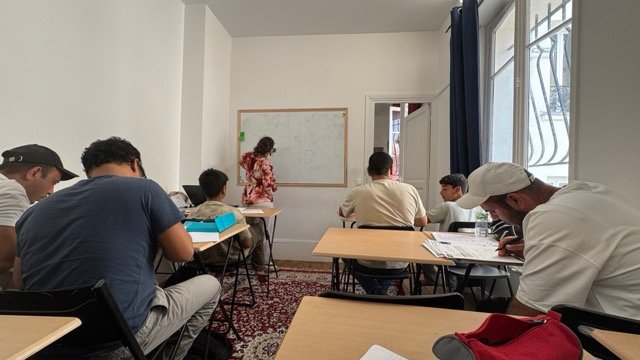
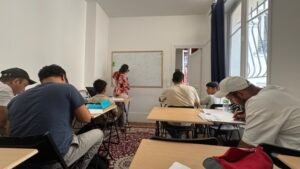
French-through-Pashto class taught by Sarah Hermann at Kuchnay Kabul in Paris. Photo: @Ali Ahmad
“French is not our mother tongue. We try to learn it so we can integrate. Without the language, we are deaf and blind.”
On rue des Pyrenees, a narrow street in northeastern Paris where bakeries open early and the smell of fresh bread drifts into the morning air, there is a small room that feels like a world suspended between past and future. Inside, three Afghan refugees sit cross‑legged on a thin mattress spread across the floor. A tall bookshelf towers over them, filled with volumes on Afghan history, poetry, politics, and art—collected or donated over the years by Sarah Hermann, the French scholar who founded Kuchnay Kabul (Little Kabul) and who, to the astonishment of many Afghans, speaks fluent Pashto.
The room is modest, but its emotional gravity is immense. It is a place where exiles reclaim pieces of themselves, where French is taught through Pashto, and where newcomers learn not only grammar but how to breathe again in a foreign land. For Obaidullah and Ashhabuddin Omarkhail—both from Kunduz—and Keramat Khan from Kapisa, this room has become a lifeline.
Their stories echo the broader experience of Afghans in France. According to InfoMigrants, Afghans remain one of the largest refugee communities in the country, facing significant integration challenges—from navigating bureaucracy to securing stable housing and employment. Yet, as the report notes, there are also Afghan success stories: individuals who have built careers, completed degrees, and contributed to French society despite the obstacles. Kuchnay Kabul stands at the intersection of these two realities: hardship and hope.
Obaidullah: “Without language, we are deaf and blind.”
Obaidullah, 40, arrived in France five years ago—just days before the fall of Kabul. Originally from Kunduz, he once ran an oil company, a life that now feels distant. He sits with his young son beside him, both listening intently as Hermann explains a French verb conjugation in Pashto.
“I found Kuchnay Kabul through TikTok,” he says with a faint smile. “French is not our mother tongue. We try to learn it so we can integrate. Without the language, we are deaf and blind.”
He repeats the phrase slowly, letting the weight of it settle. For him, learning French is not an academic pursuit—it is survival. He pays for the classes from his own pocket, an informal arrangement many refugees rely on when official language programs are inaccessible or insufficient.
Obaidullah lives with his two underage sons in Paris, while his wife and two other children remain in Afghanistan. The separation gnaws at him, but he holds onto hope:
“My family will soon join me,” he says. “First we must learn the language. Second, learn a profession. I cannot go to university, but I want vocational training.”
When he speaks about Kuchnay Kabul, his voice softens. “It feels good when I hear the name. It reminds us of our homeland. When I see the books, the art of Afghanistan, I feel love for my country. Everything here reminds us of home.”
In this small room, surrounded by books and memories, he finds a fragment of Kabul—something familiar in a city that often feels overwhelming.
Ashhabuddin Omarkhail: “I have fixed every car except Ferrari and Lamborghini.”
Beside him sits Ashhabuddin Omarkhail, also from Kunduz. Single, soft‑spoken, and carrying the weight of a long migration, he left Afghanistan in 2014. His journey took him through Iran, Turkey, Bulgaria, Serbia, and finally France, where he arrived in December 2021.
“I found Kuchnay Kabul through TikTok too,” he says. “I called the association many times. I sent messages on WhatsApp. When they replied, I was so happy.”
Unlike Obaidullah, Omarkhail never went to school in Afghanistan. His education was the workshop. “I am a car mechanic,” he says proudly. “I started working when I was seven years old. I have worked for 23 years. I have fixed every type of car—every problem. Only Ferrari, Lamborghini, and Bugatti I have not touched.”
He laughs lightly, but there is pride in his voice. His hands, calloused from decades of labor, rest gently on his knees as he speaks.
His asylum interview is scheduled for September. He meets with his lawyer regularly, preparing for the questions that will determine his future. “I wait to see if I get asylum,” he says quietly.
For him, Kuchnay Kabul is more than a classroom—it is a place where he feels seen. “When a French lady speaks Pashto, it is very attractive,” he says with a shy smile. “I enjoy when she speaks Pashto. She writes in Pashto. Kuchnay Kabul reminds us of big Kabul, our capital. It reminds us of our love for our home country.”
Keramat Khan: “Here, she teaches us with every detail.”
The youngest of the three, 18‑year‑old Keramat Khan from Kapisa province, sits with an attentive posture, absorbing every word around him. He left Afghanistan five years ago and spent three years in Iran, one year in Turkey, and now one year in France.
He attends a French class through social services, but he prefers Kuchnay Kabul. “Here I learn faster,” he says. “Because they teach French in my mother tongue.”
He speaks with admiration about Hermann. “She teaches us with every detail. Other teachers do not teach like this. She translates everything—pronunciation, pictures, examples. She knows what to teach.”
Khan’s asylum case has already been rejected once, but he is waiting for the appeal. Despite the uncertainty, he remains determined. “I want to learn the language and do vocational training,” he says.
When asked what Kuchnay Kabul means to him, he pauses. “I love to hear the name,” he says softly. “It feels like part of our soul is represented in this association.”
Afghans in France: Struggle and Resilience
The experiences of Obaidullah, Omarkhail, and Khan mirror the broader reality facing Afghans across France. As InfoMigrants reports, Afghans remain one of the largest refugee communities in the country, yet they confront some of the toughest integration barriers.
Many Afghans spend months—or even years—waiting for asylum decisions, often living in temporary shelters or overcrowded accommodation. Others struggle to secure stable housing, navigate complex administrative systems, or access consistent language training. For those who arrived after long journeys through Iran, Turkey, or the Balkans, the trauma of displacement and years spent without legal status add further layers of difficulty.
Despite these challenges, the same report highlights that Afghan resilience is unmistakable. There are Afghan engineers working in French companies, artists exhibiting their work, entrepreneurs opening restaurants, and students completing degrees at French universities. These success stories underscore how targeted support—especially language instruction, vocational training, and community‑based initiatives—can transform the trajectory of a refugee’s life.
Kuchnay Kabul fits precisely into this ecosystem of grassroots support. It is not a government program or a large NGO. Instead, it is a small, intimate space built on trust, cultural understanding, and the belief that language is the first step toward rebuilding a life. In a landscape where formal systems often fall short, Kuchnay Kabul offers what many Afghans need most: a place to learn, to belong, and to begin again.
A Corner of Kabul in Paris
Kuchnay Kabul is small—three adjoining rooms that feel like one continuous Afghan space. The front room is lined with shelves of books and Afghan artifacts, with embroidered Pashto and Dari textile pieces hanging on the walls, and chairs arranged for guests and visitors. The second room is more intimate, furnished with a mattress and pillows, and another shelf of books, evoking the warmth of a traditional Afghan sitting area. The third room serves as the main classroom.
Despite its modest size, the emotional gravity of Kuchnay Kabul is immense. It is a place where exiles reclaim pieces of themselves. The books on Afghanistan, the Pashto lessons, the shared stories, the laughter, and the quiet moments of concentration all form a fragile but powerful bridge between past and present.
Sarah Hermann, whose work is profiled in detail in Afghan Diaspora’s feature on her, has created something rare: a space where refugees are not merely students but custodians of their own culture. Her ability to speak Pashto, her sensitivity to Afghan history, and her commitment to teaching French through the mother tongue have made Kuchnay Kabul a beacon for Afghans across Paris.
For Obaidullah, Omarkhail, and Khan, this room is where they prepare for the future—learning French, planning vocational training, and navigating asylum procedures. But it is also where they reconnect with the past, where the memory of Kabul, Kunduz, Kapisa, and the lives they left behind feels close enough to touch.
In exile, identity can feel scattered. But in Kuchnay Kabul, on rue des Pyrenees, three men sit on a mattress surrounded by books and find a moment of belonging. Here, language is not just a tool—it is a lifeline, a hope, and a quiet act of rebuilding.