Taliban Diplomacy and Europe’s Migration Dilemma
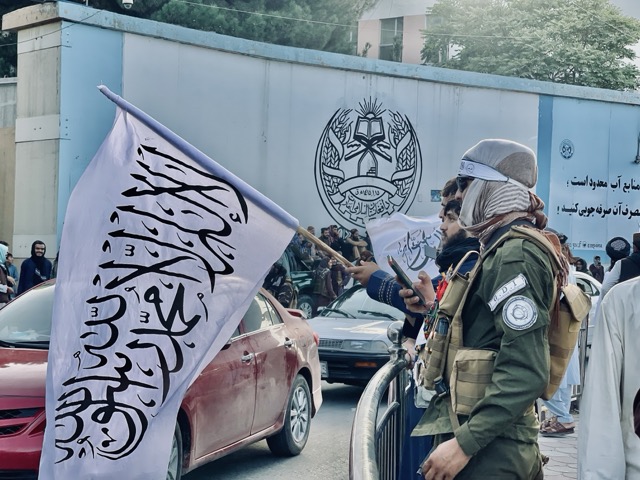
A Taliban fighter in Kabul with the group's official flag. Photo: @AADIL for ADN
Inviting Taliban representatives to Brussels—even under the guise of technical discussions—provides the group with a platform to claim international legitimacy.
By Kazim Jafari
An open letter signed by members of the European Parliament, the German Bundestag, and Afghan political leaders has intensified a growing political storm in Brussels: the European Commission’s decision to host Taliban representatives for what it calls “technical talks” on migration. For critics, this is not a technical matter at all—it is a political turning point with profound consequences for human rights, European credibility, and the safety of Afghan refugees across the continent.
The letter argues that the Taliban’s presence in Brussels risks crossing a red line that the EU itself established after the fall of Kabul in August 2021. The Union’s engagement framework was built on four conditions: respect for human rights, humanitarian access, counter‑terrorism commitments, and inclusive governance. The signatories insist that none of these conditions have been met. Instead, Afghanistan has descended into the world’s most extreme system of gender persecution, with women and girls erased from public life, civil society crushed, and dissent violently suppressed.
Yet despite this deterioration, Taliban officials were granted visas to enter Europe. For many lawmakers, this represents a dangerous shift from principled diplomacy to transactional bargaining over migration control.
No one articulated this alarm more forcefully than Hannah Neumann, a German Member of the European Parliament from the Greens, who posted a video on X sharply criticizing the Commission’s decision. Neumann, who has served in the European Parliament since 2019 and now chairs the Delegation for relations with Iran, warned that Europe is repeating the same mistakes Germany made when it began engaging the Taliban under the label of “technical talks.”
In her words, “the Commission only calls it technical talks—but frankly, that’s how it started in Germany. They called it technical talks to enable deportations.”
Neumann described how the Taliban used these early meetings to demand symbolic and political concessions: first an invitation to Germany, then control of consulates in Bonn and Berlin, and most recently a request for eight additional consulates.
According to Neumann, these consulates became tools of transnational repression, holding lists and addresses of Afghans who fled Taliban persecution.
“Now they are scared,” she said, “and what is the German government doing? Just handing over all the addresses.”
Her warning is blunt: the same pattern could now unfold across Europe.
The open letter echoes this concern. It argues that inviting Taliban representatives to Brussels—even under the guise of technical discussions—provides the group with a platform to claim international legitimacy. For a regime that has aggressively sought recognition, a visit to the heart of the European Union is a symbolic victory.
The letter stresses that such engagement undermines Afghan civil society, women’s rights activists, and diaspora communities who have fought to keep Afghanistan on the global agenda.
The migration dimension is central to this controversy. Several EU member states face domestic pressure to reduce asylum numbers and accelerate deportations. The Taliban, eager for recognition, have signaled willingness to accept deportees—an offer that some governments may find politically convenient. But the letter warns that deporting Afghans to a country where extrajudicial killings, torture, and reprisals are documented by UN bodies would violate international law and expose vulnerable individuals to grave danger.
Neumann’s intervention highlights the moral contradiction at the heart of this policy shift. She points out the absurdity that “Belgium has given the Taliban visas, while the people who fought the Taliban side by side with us are under life‑threatening situations in Afghanistan and cannot get visa appointments for years.”
Her frustration is palpable: “Five years ago, everybody said we’re not going to turn our back on the people of Afghanistan. Today, the European Union just did the last tiny bit to turn its back and walk away.”
The open letter frames the issue as a test of Europe’s political identity. If the EU compromises its human rights commitments for migration control, it risks eroding the very principles it claims to defend. It also risks emboldening authoritarian actors who view human rights norms as negotiable.
At the same time, the letter warns of a broader security implication: the Taliban’s growing capacity for transnational repression. Afghan refugees across Europe already report intimidation, threats, and surveillance. Granting the Taliban diplomatic access could expand their ability to target dissidents abroad.
Ultimately, the controversy reveals a deeper tension within European migration policy: the struggle to reconcile domestic political pressures with international obligations. The open letter urges EU institutions to resist the temptation of short‑term deals and to reaffirm that human dignity cannot be traded for migration management.
Whether European leaders will heed this warning remains uncertain. But as Neumann emphasized, the European Parliament intends to hold the Commission accountable. The stakes—for Afghan refugees, for European credibility, and for the future of human rights diplomacy—could not be higher.
Kazim Jafari is a political science student at the University of Heidelberg in Germany.
Note: The contents of the article are the sole responsibility of the author. Afghan Diaspora Network will not be responsible for any incorrect statements in the articles.