How Afghan Diaspora Communities Rebuild Identity Far From Home

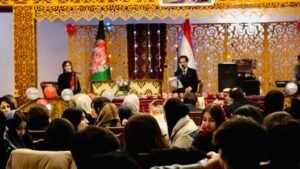
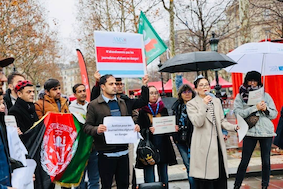
Members of the Kunar Cultural Association in Köln after the 2025 Kunar River Poetry program. Photo: @Attock for ADN
By Wakeel Attock
Migration is never just a physical departure. For Afghans who have left their homeland over the past decades – driven by war, instability, and economic pressure – displacement has meant reconstructing identity, memory, and social belonging from the ground up.
Alongside the pain of exile, Afghans have carried language, culture, and a determination to rebuild community wherever they land. In this process, Afghan cultural associations in Europe have evolved far beyond simple gatherings; they have become spaces of social connection, collective healing, and alternative leadership. The Kunar Cultural Association in Cologne, Germany, stands as one of the clearest examples of this transformation.
Founded nearly nineteen years ago, the association emerged at a moment when the Afghan population in Cologne was rapidly growing. Its founders quickly recognized that without a cultural anchor, the younger generation – children raised between two worlds – risked losing their sense of identity. Culture, they believed, could serve as a bridge between the new society they were entering and the homeland they had left behind.
One of the most distinctive features of the association is its horizontal leadership model. There is no single authority figure, no rigid hierarchy. Decisions are made collectively, and responsibilities are shared. For a community shaped by negative experiences with political power, this approach has been transformative. It builds trust, encourages participation, and allows members to see themselves not as passive attendees but as co‑creators of their own communal space.
Cultural activities are the most visible part of the association’s work, yet behind them lies a deeper social purpose. The long‑running “Kunar River Poetry” is not merely an evening of poetry; it is a space where language, memory, and shared pain find expression. In exile, poetry becomes a form of emotional relief – a way to articulate loss, displacement, and the friction of adapting to a new society. These gatherings quietly support mental well‑being, offering a place where people can speak, listen, and feel understood.
A Community That Adapts, Supports, and Sustains Itself
In recent years, the association has expanded its focus beyond cultural nostalgia. Discussions on Afghanistan’s political and social crises – especially the ban on girls’ education – have become central to its programming. Through seminars and community dialogues, members engage with these issues from academic, ethical, and personal perspectives. In doing so, the association has become a parallel space for civic engagement, offering a form of social awareness that remains possible even when political expression is restricted back home.
The COVID‑19 pandemic further tested the resilience of diaspora communities. When in‑person gatherings became impossible, the Kunar Cultural Association quickly shifted to online seminars and virtual events. This transition was more than a technical adjustment – it demonstrated the adaptability of diaspora networks and their ability to remain active even in moments of crisis.
Young people are at the heart of the association’s work. For Afghan youth in the diaspora, the primary challenge is integrating into a new society while maintaining their cultural identity. Educational workshops, family discussions, and mentorship initiatives have encouraged many young members to pursue higher education and professional development. In this way, the association functions as an informal support system, filling gaps that formal institutions often overlook.
Yet the journey is not without obstacles. The lack of a permanent cultural center, limited financial resources, and the exhaustion that comes with volunteer‑driven work all threaten the sustainability of such initiatives. Still, the community persists – powered by social capital, shared purpose, and the belief that culture can hold a scattered people together.
Humanitarian work has become another important dimension of the association’s identity. During natural disasters in Afghanistan, members have mobilized funds and sent aid to provinces such as Herat, Paktia, Paktika, and Kunar. These efforts are more than charity; they reflect a moral obligation felt deeply within the diaspora – a sense that distance does not diminish responsibility.
Ultimately, the story of the Kunar Cultural Association raises a profound question: What does culture mean in exile? For this community, culture is not a relic of the past. It is a living tool – one that organizes daily life, shapes collective imagination, and sustains social bonds. It is a way of belonging, of resisting erasure, and of envisioning a future that honors both heritage and new beginnings.
The experience of this association shows that the Afghan diaspora, despite its distance from home, continues to build, support, and transform community life. And it does so through the enduring power of culture.
Afghan poet Wakeel Attock previously served as the director of culture for the eastern provinces of Laghman and Nooristan.
Note: The contents of the article are of sole responsibility of the author. Afghan Diaspora Network will not be responsible for any inaccurate or incorrect statement in the articles.