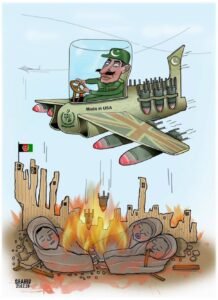
Growing Up in Exile: One Girl’s Journey Through War, Refuge, and Belonging
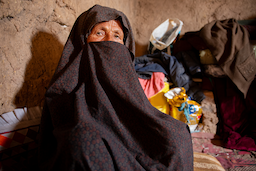
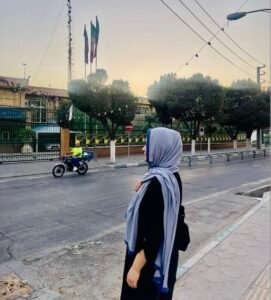
Photo: @NRC
By Mehmood Jan Babar, Peshawar
I was eight or nine years old when I first saw her: a tiny Afghan girl with dust on her face, fear in her eyes, and nothing in her hands except the fingers of her trembling mother.
Her name was Marghalara, only four years old then, and she had just arrived in our narrow street in Peshawar with her exhausted parents who had escaped the Soviet invasion of Afghanistan.
It was the winter of displacement — not just for her family, but for an entire Afghans who were pouring into Pakistan and Iran in numbers that the world had not witnessed since the Second World War. Their arrival was sudden, massive, and heartbreaking.
The women of our street rushed out of their homes the moment they saw the strangers. My mother wrapped her shawl around her shoulders and began collecting utensils, quilts, flour, oil, soap — anything that could help the terrified newcomers. Other women followed, handing over what little they could spare.
That scene, more than any news headline or historical document, became my first introduction to the Soviet-Afghan war.
I did not know then that this little girl walking into my neighborhood would remain in Pakistan for the next over four decades. Nor did I know that our childhoods — though born in different countries — would become intertwined in a story shaped by wars, politics, and the shifting friendship between nations.
Growing Up Side by Side
Marghalara soon became a familiar presence in our street, speaking a Qandhari Pashto dialect subtly different from the Yousafzai dialect of the Peshawar Valley. She would sit on the ground playing with mud, and when my friends and I ran across the lane, she would watch with shy curiosity.
We were two children growing up under the same sun, breathing the same air, but living two entirely different fates.
I was growing up in my own homeland, while she was growing up in exile. Yet we shared something unspoken: both our childhoods were shaped by a war that neither of us understood.
While we played cricket near the railway tracks, thousands of Afghan families continued streaming into Peshawar. The refugee column became longer than the Grand Trunk Road itself. Some settled in the city, some in makeshift tents at the edge of the suburbs, and many were moved into camps in Peshawar, Nowshera, Haripur, Kohat, Chaman, and Quetta.
These were not temporary visitors; these were people building entire lives in Pakistan.
The Great Afghan Exodus
The Soviet invasion turned Afghanistan into a battlefield and pushed millions of Afghans across the Durand Line. Pakistan’s initial plan was to stop the refugees near the ‘border’. But the scale of displacement defeated every strategy. Camps quickly overflowed. Eventually, they were allowed to move deeper inside the country. Peshawar, my city, became a soft capital for the Afghan cause.
Government schools added new sections for Afghan children. Hospitals overflowed. Markets expanded. And slowly, Afghans became part of the city’s fabric in a way no one could have predicted.
Marghalara’s family was just one among thousands that settled in Peshawar city itself — in its streets, and rented houses. She learned Urdu before learning Dari, the official language of Afghanistan, which is basically the Afghan dialect of Persian. She knew Pakistan’s culture before knowing her own country’s geography. She grew up eating chappal kabab, playing with local children, and studying in Pakistani schools.
Her life became an example of what hundreds of thousands of Afghan children were experiencing: growing up in a land not legally theirs, but emotionally their only home.
The Rise of Jihad
While refugee children were learning alphabets and nursery rhymes in Pakistan’s schools, a very different movement was growing in the mountains across the Durand Line.
By the early 1980s, Jihad (holy war) Fund collection boxes appeared in almost every mosque, square, and bazaar. Public announcements in buses urged people to donate for Afghan Mujahideen. Young men with loudspeakers gathered outside Jinnah Park and Qissa Khwani Bazaar, asking for money and moral support.
Darra Adam Khel, known for its traditional gun-making craftsmanship, suddenly found itself at the center of an underground arms economy. Crates of ammunition and weapons were transported northward, while fighters from various Afghan groups were trained in camps across the tribal belt.
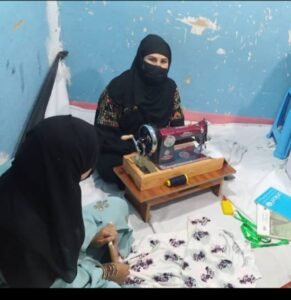
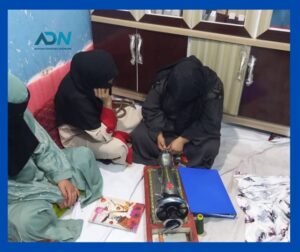
And yet, even as the machinery of war intensified around us, the families living in our neighborhood were simply trying to survive — stitching clothes, cleaning homes, attending school, and waiting for news from relatives left behind in Afghanistan.
It felt like two worlds coexisting: the world of jihad and the world of childhood.
I remember thinking sometimes that Marghalara and the Afghan war were both growing together — one as a child, the other as an international movement. Both expanding, both becoming permanent parts of our life.
Becoming an International Stage
By the mid-1980s, Peshawar was no longer the quiet frontier city it had once been.
Arab volunteers arrived for jihad — young men from Saudi Arabia, Egypt, Yemen, Algeria, and Kuwait. They carried Qurans and Kalashnikovs, spoke in languages we could not understand, and prayed with intensity that made even local clerics pause.
Turkish students, who had come to study in Pakistani universities, were drawn into the Afghan cause. Journalists from Europe and America stayed in cheap hotels, filing dispatches about the Soviet occupation.
The city became a meeting ground of ideologies and nationalities. In the streets, one could hear Pashto, Arabic, Urdu, Persian, English, and sometimes Russian.
Amid all this, Marghalara continued growing like any Peshawari child — attending weddings, learning local customs, and slowly absorbing a culture that was not hers by birth but had become hers by destiny.
Culture and Economy Transformation
The Afghan presence did not just affect politics — it reshaped our social and economic life.
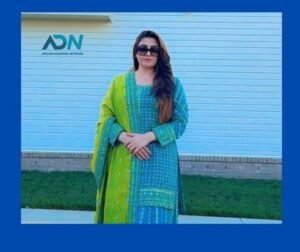
The aroma of Kabuli Pulao (an Afghan dish) began drifting through the bazaars. Afghan bakers introduced tandoor-style bread, bigger and softer than local naan. Afghan tailors brought their own craft — embroidered frocks, velvet wedding dresses, bright turbans, and waistcoats that became fashionable even among Pakistanis.
Cheap Afghan labor rebuilt roads, houses, and markets. Afghan herbalists set up stalls. Afghan cobblers and mechanics opened workshops that still stand today.
Entire neighborhoods became hybrid Afghan-Pakistani spaces.
To us children, it all felt normal.
To historians, it was one of the largest cultural shifts in Pakistan’s modern history.
The Price Pakistan Paid
By the late 1990s and early 2000s, the consequences of two decades of war began to explode inside Pakistan.
Former Federally Administered Tribal Areas (FATA) became a battleground of global terrorism. Militants, foreign fighters, intelligence networks, and drone campaigns turned the tribal belt into one of the most dangerous regions in the world.
The cost was devastating.
• Around 100,000 Pakistanis killed;
• Millions displaced internally;
• Daily suicide blasts;
• Economic devastation in Khyber Pakhtunkhwa and FATA;
• Entire generations traumatized, and radicalized.
As bombs exploded in mosques, bazaars, and markets, Afghan families continued living among us — shopkeepers, students, laborers, and neighbors. They too feared the violence, just as we did.
For Marghalara’s family, this period brought new hardships. Some of her relatives moved to a refugee camp in Haripur, around 190-kilometre southeast of Peshawar. Later, after her marriage, she herself shifted there — another chapter of displacement inside the country she had called home.
9/11 — The Turning Point
Nothing changed the Afghan-Pakistan equation as sharply as 9/11.
Within days, American officials landed in Islamabad demanding unconditional support. Pakistan, once a close ally of the United States, found itself accused, pressured, and ultimately bound under the infamous slogan: “Do More.”
It created a deep rupture between two long-time partners. But the political cost was even heavier in Afghanistan.
After 2001, newly funded Afghan media houses began shaping public opinion. Dozens of television channels opened. Narratives shifted quickly. Pakistan was portrayed as the villain of Afghan misery.
Afghan children who had grown up in Pakistan; who had spoken Urdu with ease and played cricket with us — now consumed media that declared Pakistan an enemy. I remember the shock when Afghan friends began saying things I had never imagined they would.
Suddenly, the country that sheltered their families for decades was blamed for every failure of the international intervention.
And yet, despite the changing rhetoric, life for Afghan families in Pakistan continued quietly. Children kept going to schools. Businesses continued. Weddings were held. Relationships remained.
But a slow bitterness had begun to grow.
Children of Exile
By the time the Taliban returned to power in 2021, a new generation of Afghans in Pakistan had emerged — a generation born on Pakistani soil, educated in Pakistani institutions, speaking Pakistani Urdu with Yousafzai dialect, and deeply rooted in local culture.
Yet, legally, they were still Afghans. They were children who knew Pakistan as their only home and Afghanistan as a distant story told by elders.
Marghalara’s own children grew up like this. Her grandchildren were born in Peshawar hospitals. They spoke the same street slang as local kids. They loved Pakistani cricket teams, and studied in the same schools as our children.
They were Afghan by passport, Pakistanis by upbringing, and homeless by circumstance.
Taliban, TTP, and the Final Break
The most painful chapter came more recently, when Pakistan realized that Afghan Taliban officials were allowing Tahrik-e Taliban Pakistan (TTP) militants to operate freely across the border.
This was not just a security issue — it was an emotional betrayal for a country that had supported Afghan refugees for nearly half a century.
Pakistan’s frustration grew. Attacks increased. The situation became untenable. And then came the toughest decision: the push to send undocumented Afghans back.
For families like Marghalara’s, this was a shock larger than any they had faced before. After over forty years in Pakistan — almost her entire life — she was told she must leave.
The Day She Left
The day before she departed, she visited our neighborhood. The lanes had changed — new houses, new shops, new children playing — but the nostalgia in her eyes was unmistakable.
“This is the only home I know,” she whispered.
Her grandchildren stood beside her, confused and silent. Pakistan was their birthplace. They had never seen Afghanistan. To them, Kabul was a sound from news, not a place on earth.
When Marghalara walked away towards the bus that would take her to Torkham, tears flowed silently down her face. She was leaving not just a house or a city — she was leaving her entire life, her memories, her childhood, her friendships.
And I stood watching her departure, realizing that this was not just her story.
It was the story of half a century of shared humanity; broken policies; shifting alliances; a war that became a neighbor; a generosity that turned into resentment; and a final goodbye between two wounded nations.
Marghalala’s departure felt like a metaphor for the relationship between Pakistan and Afghanistan itself — once close, then complicated, and finally separated by history.
Ordinary Lives, Extraordinary History
Marghalara is not one woman. She is a symbol of hundreds of thousands of Afghans who lived their entire lives in Pakistan and are now returning to a homeland they do not know.
Her story shows: how geopolitical decisions change the fate of ordinary people; how Pakistan paid a huge price for a war it did not start; how the US–Pakistan “do more” pressure damaged trust; how Indian and Western media reshaped Afghan perceptions; how refugee children became victims of politics; how Peshawar became a witness to world history; and how a shared culture, built over 45 years, can break in a single policy shift.
Her life mirrors the tragedy of two nations bound by geography but divided by narratives.
As she crossed the border — having arrived as a child and leaving as a grandmother — she carried with her nearly half a century of memories, friendships, and unspoken pain.
Her story is Pakistan’s story. Her exile is Afghanistan’s story. And her departure is the final chapter of a long, complex relationship — written not by governments, but by ordinary people like her.
This feature was originally published on the writer’s personal website, www.crossroads24.com/pk/
Mehmood Jan Babar: The author is a seasoned journalist with 28 years of experience in print, electronic, and digital media, and currently serves as Bureau Chief of SAMAA TV in Peshawar. He has extensively covered regional politics, conflict, refugee crises, and major socio-economic issues throughout his career. He can be reached through mehmoodjanbabar@gmail.com
Note: The contents of the article are of sole responsibility of the author. Afghan Diaspora Network will not be responsible for any inaccurate or incorrect statement in the articles.