Forced Returns Deepen Afghan Refugee Crisis
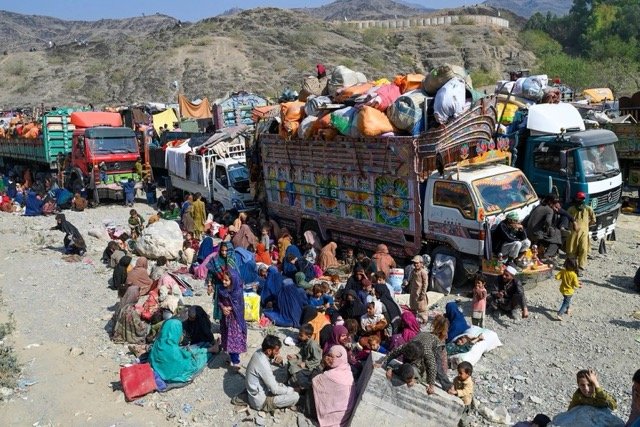
Returnee families on the Afghan side of the Durand Line sit barefoot beside a truck stacked with their home items, capturing the human cost of Pakistan’s forced returns. Photo: @Dawood Jabarkhail
Dawood Jabarkhail
The scale of deportations is staggering, and the scenes along the Durand Line show it clearly. More than 146,000 Afghans have been forcefully returned from Pakistan in 2026, according to Human Rights Watch (HRW).
At Torkham crossing point, families sit on the ground beside overloaded trucks, children are barefoot, and women are exhausted after days of waiting. What should be an orderly crossing has turned into a choke point of fear, uncertainty, and administrative collapse.
HRW’s April 21, 2026 report describes a sharp escalation in raids, arrests, and expulsions. Pakistani police have intensified operations since early 2026, targeting Afghans regardless of their legal status.
HRW notes that “police have detained Afghans with valid visas and asylum documents,” spreading panic among communities who have lived in Pakistan for decades. The organization warns that these actions “violate the principle of non‑refoulement,” which prohibits returning people to places where they face persecution.
The pressure is most visible at the Durand Line crossing at Torkham. Thousands of refugees wait in unmoving lines, some for up to twenty days. The delays are not just the result of high traffic. They reflect limited processing capacity, weak coordination, and the absence of a functioning management plan. When only a small number of vehicles are allowed to move each day, thousands are left stranded without shelter, water, or medical care.
The economic burden is crushing. Transport costs have surged to 600,000–800,000 Pakistani rupees, a spike that suggests market manipulation and poor oversight. Many refugees say they sold their last belongings simply to afford the journey. For families already facing eviction and police harassment, these inflated prices deepen their vulnerability.
HRW’s findings show the scale of the crackdown. More than 1 million Afghans were forcibly returned in 2025, and the pace has accelerated this year.
Daily expulsions exceeded 4,000 people in late April, overwhelming the Durand Line crossing. HRW documents nighttime raids, confiscation of phones and cash, and deportations without due process. Some refugees report that Pakistani police demanded bribes for release.
The human toll is severe. Families arrive on the Afghan side of the Durand Line exhausted and unsure of what awaits them. Women and children are especially vulnerable to illness, dehydration, and psychological distress.
“My daughter is ill, and I can’t take her to the hospital in fear of police arrest,” said an Afghan woman in Islamabad to HRW.
Aid groups warn that the lack of shelter, sanitation, and medical support could trigger outbreaks of disease. One refugee told HRW the situation felt like “a nightmare with no end,” capturing the despair many now face.
For second‑ and third‑generation Afghans born in Pakistan, the crisis is even more disorienting. Many have never lived in Afghanistan. They now return to a country struggling with economic collapse, limited services, and severe restrictions on women and girls.
HRW emphasizes that journalists, activists, former government employees, and others perceived as critics of the Taliban face heightened risks upon return.
The situation along the Durand Line reveals how political tensions, administrative failures, and security concerns combine to create a humanitarian emergency.
Long queues, soaring transport costs, and the absence of basic services are not isolated problems. They are symptoms of a broader collapse in refugee protection.
HRW warns that Pakistan’s current approach “treats refugees as a security threat rather than people in need of protection,” a framing that has fueled public hostility and justified harsher measures.
As deportations continue, pressure on Afghanistan’s fragile economy and overstretched social systems will intensify. Without coordinated action, the crisis at Torkham risks becoming a long‑term humanitarian disaster—one that exposes the urgent need for a rights‑based approach to refugee protection.
“Pakistan should take action against abusive police practices and immediately stop forcibly returning Afghan refugees,” reported HRW.
“Other governments should raise their concerns about these practices with the Pakistani government, as well as denounce continuing human rights violations by Afghanistan.”
Note: The contents of the article are the sole responsibility of the author. Afghan Diaspora Network will not be responsible for any incorrect statements in the articles.