A War Crime in Kabul the World Chose to Ignore
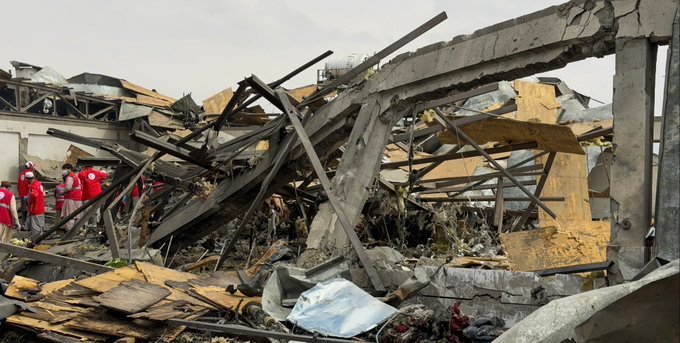
Aftermath of Pakistan’s 16 March airstrike on the Kabul rehabilitation center. Photo: Jan Egeland, Norwegian Refugee Council.
Human Rights Watch’s investigation into Pakistan’s March 16, 2026 airstrike on the Omid Drug Rehabilitation Center in Kabul exposes one of the deadliest attacks on Afghan civilians in recent memory — and one that unfolded while the world was distracted by the escalating US–Iran confrontation and global economic anxiety driven by rising oil prices. As international attention drifted elsewhere, Afghans once again bore the cost of geopolitical indifference.
According to Human Rights Watch (HRW), the strike — which destroyed three buildings inside a well‑known 2,000‑bed medical facility — was unlawful and potentially a war crime. HRW documented at least 143 deaths and more than 250 injuries, most of them patients. The de facto authorities in Kabul report an even higher toll: more than 400 civilians killed. Many were gathered to break their Ramadan fast when the missiles hit.
Pakistan claimed it had targeted “technical support infrastructure and ammunition storage facilities,” yet HRW’s analysis — supported by satellite imagery, eyewitness accounts, and verified videos — found no evidence of military activity, ammunition depots, or secondary explosions. The destroyed buildings were a dining hall, a residential block housing 450 patients, and a guard room used to store food and cooking oil.
Under international humanitarian law, medical facilities enjoy special protection and may only be targeted if used for hostile acts — and even then, only after a clear warning. No such warning was issued. No such justification has been proven. The United Nations described the “complete destruction” of a block housing adolescents in treatment, underscoring the civilian nature of the site.
The aftermath reveals a deeper tragedy: Afghanistan’s limited forensic capacity left families searching morgues and hospitals for days. Some victims remain unidentified. Others may never be found.
This attack was not only indiscriminate but disproportionate, meeting the threshold for a war crime. Yet it occurred at a moment when global powers were preoccupied with oil markets, regional escalation, and their own political crises.
For the Afghan diaspora, silence is not an option. Accountability must not be sacrificed to geopolitical convenience. Pakistan must face an impartial investigation — and the world must finally acknowledge Afghan civilian lives as worthy of protection, not footnotes to larger conflicts.