“I am only surviving,” Afghan Women Struggle to Survive Pakistan’s Deportations
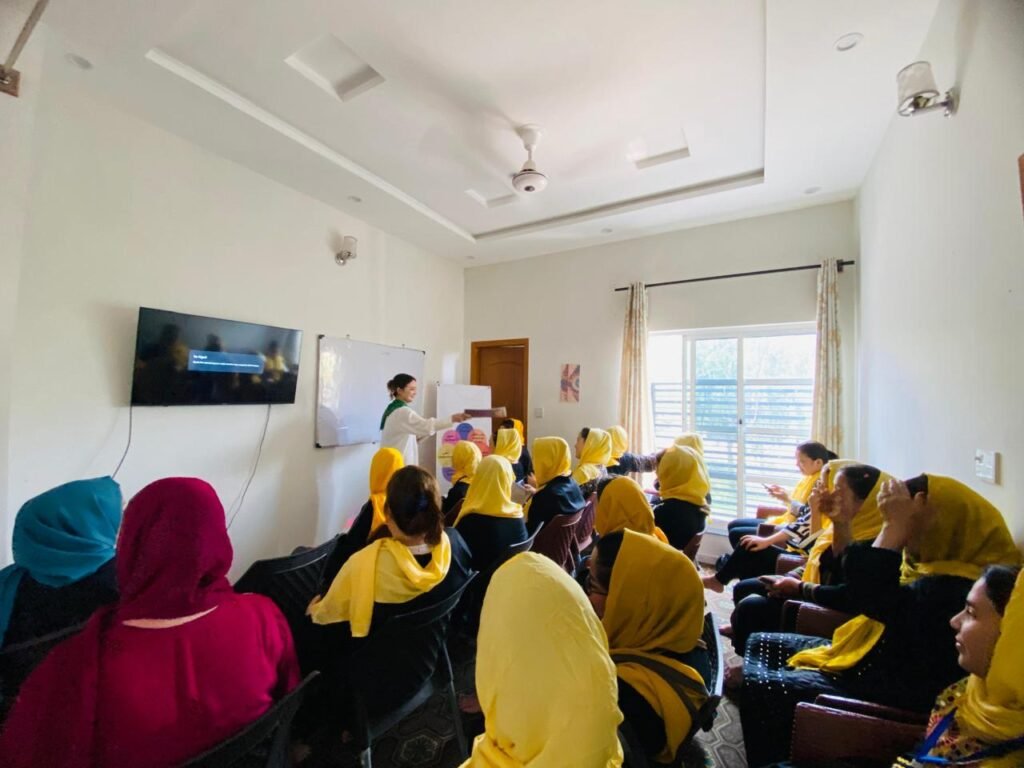
A workshop session attended by Afghan refugee women in Islamabad. Photo: @Niki
ADN
When Niki (a pseudonym used to protect her identity) crossed into Pakistan in late 2021, she believed she had finally outrun the terror that shadowed her every step in Kabul.
But nearly four years on, she has found herself trapped in a different kind of fear, quieter, more suffocating, and relentlessly inescapable.
“I am only surviving,” she says quietly. “I don’t live, because I don’t have a life.”
Niki, 26, graduated from the Faculty of Economics just a year before the Taliban returned to power. Her family’s work, her parents with the Human Rights Commission and Ministry of Women’s Affairs, her siblings in government, made them immediate targets.
When their neighbors, former military employees, were arrested and disappeared, the family knew they could be next.
They burned documents linking them to the former government. They packed quickly. And they fled.
The seven members of Niki’s family crossed legally into Pakistan, but legality offered little protection.
“When you arrive, you can’t open a bank account, can’t get a SIM card, can’t work, can’t study,” she recalls. Her younger siblings were barred from school. Hospitals mistreated Afghans. In refugee neighborhoods around Islamabad and Rawalpindi, exploitation and discrimination were daily realities.
Her older sister, a doctor, tried to find work with Pakistan’s Red Crescent Society, but was rejected. Niki herself applied for many positions, only to be asked for sex in exchange for employment.
“I stopped applying,” she says. “I understood I would not be accepted unless I gave something I refused to give.”
Refusing despair, the sisters looked for other paths. Afghan medical professionals in exile formed volunteer groups to provide ethical care to refugees who feared visiting Pakistani hospitals. With support from Uplift Afghanistan, Niki took on coordination roles, supporting doctors, pharmacists, and nurses, and serving as a link between refugee communities and humanitarian workers.
She also created networks of women artisans, embroiderers, tailors, and home-based workers, helping them organize, access microloans, and sell their products with dignity rather than rely on handouts. The initiative grew into an informal women’s collective named Niki, meaning goodness.
“We covered nearly 5,000 families,” she says. “Some women didn’t want free aid, they wanted to earn.”
Niki became a social mobilizer working on health, mental health, and menstrual awareness projects. She built databases of vulnerable families, organized exhibitions, and ran activities for children coping with trauma.
But even as she built hope for others, her own life was slowly shrinking.
“We Live Locked Inside”
Since Pakistan began mass deportations of undocumented Afghans in 2024, the atmosphere in refugee settlements has turned suffocating. Police raids have intensified. Arbitrary arrests have become routine.
“People lock themselves inside their homes,” Niki explains. “Sometimes they ask their neighbors to lock the door from outside so the police think no one is inside.”
Entire families avoid going out. Parents are arrested while their children remain home, or vice versa. Many Afghans sleep lightly, fully clothed, ready to flee or hide.
Niki’s own experience was brutal. One day, police scaled the wall of her home and stormed inside. Without visas, impossible to obtain without paying thousands in bribes, her entire family was detained. A female police officer mocked them:
“Why don’t you go back to your country? Why don’t you speak Urdu? Are you even Muslims?”
Niki was held in a deportation center for three days. “The treatment was inhumane,” she says. “I was too scared. I had done nothing wrong.”
Through mediators and significant pressure, she secured a one-month visa extension. But she knows that if she is arrested again, she will be pushed across the Durand Line.
And what awaits Afghans on the Afghan side terrifies her even more.
“Returned people told us stories that give us goosebumps,” she says. “Taliban take biometrics, check their lists, separate people they want. I cannot imagine being handed to them.”
From Shelter to Expulsion
Since Afghans first fled to Pakistan in 1978, the country has hosted millions escaping war, from the Soviet invasion to civil conflict, the U.S.-led war, and the return of the Taliban. After the 2021 takeover, another 600,000 Afghans crossed the border, many of them women and girls fleeing gender apartheid: bans on schooling beyond sixth grade, restrictions on work, and limits on movement without a male guardian.
But Pakistan’s stance has shifted sharply. Once viewed as Islamabad’s former proxies, the Taliban now face strained relations with Pakistan. Islamabad accuses the Taliban of harboring Tehrik-e-Taliban Pakistan (TTP) militants responsible for attacks inside Pakistan, while the Taliban claim Pakistan supports Islamic State–Khorasan Province (ISKP).
As TTP attacks surged in 2023, Pakistan launched a mass deportation campaign targeting Afghans. The fragile relationship between the two sides has since deteriorated further. Border skirmishes escalated into direct confrontation, culminating in Pakistani airstrikes in Kabul and Kandahar, strikes Pakistan said targeted “important sites.” Residents reported explosions and low-flying jets as Taliban forces rushed to the areas hit.
Although the two sides later agreed to a brief ceasefire, distrust remains high. Caught between them are Afghan refugees, treated not as civilians seeking protection but as bargaining chips in a geopolitical struggle.
Between Collapse and Survival
Despite the circumstances, Niki remains the sole income earner in her family. Her salary, 50,000 Pakistani rupees per month (around $175), barely covers food and rent. The small rental income from the family’s Kabul home fills the gaps, but any medical emergency threatens their stability.
Humanitarian aid has never reached them. UNHCR registration, once a path to resettlement, has slowed to a near standstill. Some families are rejected after four years of waiting.
“There is no clarity,” she says. “We don’t know how they decide who is resettled and who is not.”
Her mental health has deteriorated under constant pressure.
“I cannot cry anymore,” she says. “I want to feel sadness, anger, happiness, anything. But everything inside me is locked.”
Fear is constant. The future is blank.
A Life Without Safety Nets
Niki describes her emotional state with painful precision: loneliness, responsibility, exhaustion, burnout.
“I have no rights here,” she says. “I don’t know what will happen tomorrow.”
She hopes for safety, not just for herself, but for all Afghan women.
“If I leave Pakistan, what about the people who remain? We need a permanent solution for Afghan women, a guarantee for our lives.”
Returning to Afghanistan remains impossible under Taliban rule.
“I cannot imagine stepping into Afghanistan again,” she says. “I want to stay alive.”
She knows the world’s attention has drifted away from Afghan refugees. The deportations, the fear, the arbitrary arrests rarely make headlines.
But she also knows she cannot stop fighting, not for herself, not for others.
“I feel like a guerrilla fighter,” she says with a faint, exhausted smile. “I go out, do my work, help people. Then I hide again.”
For now, she remains suspended between borders, unwanted in the country she fled, unwelcome in the country where she sought refuge.
All she asks for is simple:
“A life with safety. A life without fear. A life where women can live, study, work, and breathe.”
Until that day, Niki, still not her real name, waits in a small, rented home on the outskirts of Islamabad, listening for the sound of another police raid.
And she tries, against all odds, to stay alive.