Pashtun Unity and the Durand Line: Manzoor Pashteen’s Anti-Colonial Message in Germany
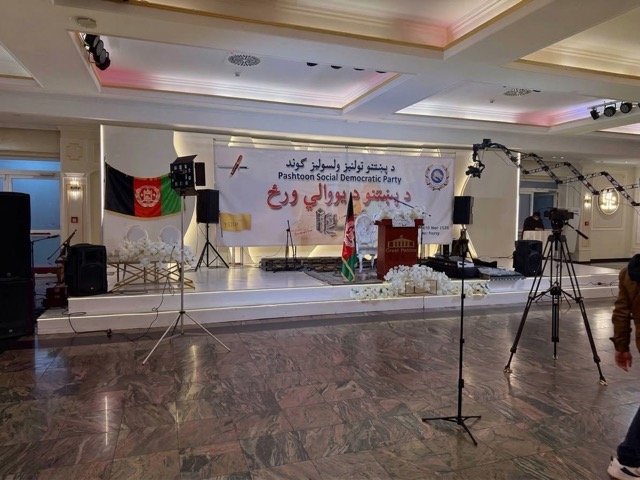
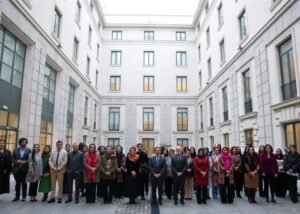
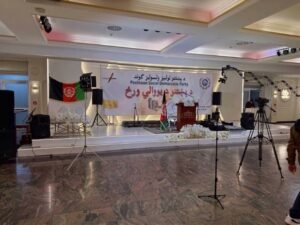
Photo:@Pashtoon Social Democratic Party, Germany
The division of Pashtun populations across the Durand Line remains the central historical injustice shaping the region’s politics today.
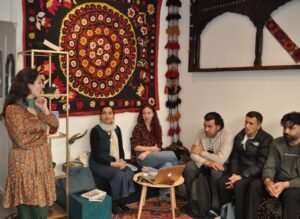
The annual observance of “Pashtun Unity Day” in Germany has long served as a gathering point for Pashtun cultural and political activists across Europe. Yet this year’s event, organized by the Pashtun Social Democratic Party in the city of Hürth on 14 November, carried a distinctly political tone. While speakers addressed topics ranging from girls’ education in Afghanistan to the preservation of the Pashto language, the most consequential intervention came from Manzoor Pashteen, leader of the Pashtun Tahafuz Movement (PTM), who framed Pashtun unity as an explicitly anti-colonial struggle.
In an online address to participants, Pashteen argued that the very title of the event, “Pashtun Unity Day,” represented a challenge to colonial legacies. According to him, the division of Pashtun populations across the Durand Line remains the central historical injustice shaping the region’s politics today.
Pashteen’s argument followed a familiar theme within strands of Pashtun nationalist thought. He described the Durand Line simply as a project intended to divide a people who had historically shared language, culture, and geography. In his words, British colonial rulers, unable to dominate Afghans through military means, sought instead to fragment them politically. That division, he argued, continued after the end of British rule through the policies of the Pakistani state.
The speech was notable not only for its criticism of Pakistan but also for its effort to frame contemporary Pashtun politics within a broader anti-colonial narrative. Pashteen portrayed Pakistan as inheriting and continuing structures of control first established during British colonial rule. He repeatedly emphasized that Pashtun political mobilization should be understood through this historical lens.
Pashteen also argued that Pakistan’s security and economic structures disproportionately burden Pashtun regions. He claimed that Pashtuns are often recruited to fight in conflicts while political and economic benefits flow elsewhere. Referring to both Balochistan and the former tribal areas, he accused the Pakistani state of exploiting peripheral regions and using Pashtun populations as a buffer in broader geopolitical struggles. For Pashteen, this pattern is not merely a contemporary policy issue but part of a longer colonial legacy that continues to shape relations between the state and its Pashtun periphery.
The prominence of such narratives is not limited to PTM circles. Germany has increasingly become a venue for diaspora activism involving Pashtun, Baloch, and Sindhi groups critical of Islamabad. Recent gatherings and initiatives have framed their demands in anti-colonial terms and called for greater international attention to questions of self-determination, political representation, and human rights in Pakistan’s peripheral regions. In this context, the Hürth event reflected a broader trend in which diaspora communities are using European political space to revisit historical grievances and articulate alternative visions of the region’s future.
Whether one agrees with this interpretation or not, Pashteen’s speech touched upon a debate that remains deeply contested more than a century after the signing of the 1893 Durand Agreement.
Recent historical scholarship has contributed new dimensions to that discussion. A review of Nabi Sahak’s book Anglo-Afghan Power and Politics, 1893-1947: The Durand Line Unmasked argues that the conventional history of the Durand Line rests on significant archival gaps and unresolved questions. The review highlights the absence of the original Persian text of the agreement, the lack of the Amir’s signature and seal on surviving English versions, and missing records from the negotiations that took place in Kabul. It argues that these gaps complicate claims that the Durand Line’s legal and political foundations are historically settled.
Such arguments do not automatically invalidate the existing so-called “international border”, but they help explain why the Durand Line continues to occupy a powerful place in Afghan and Pashtun political imagination. For many activists, the issue is not merely territorial. It is linked to questions of identity, sovereignty, historical memory, and the relationship between state boundaries and ethnic communities.
Yet the politics of Pashtun unity face challenges of their own.
The call for unity is emotionally compelling, particularly among diaspora communities that often seek to maintain connections across borders. However, translating that aspiration into a practical political project is far more difficult. Pashtuns today live under different states, legal systems, and political realities. Their priorities differ across Afghanistan, Pakistan, Europe, and the wider diaspora.
Moreover, not all Pashtuns view political unity through the same lens. Some focus on cultural preservation and language. Others emphasize human rights, constitutional reform, democratic participation, or economic development. PTM itself emerged primarily as a movement against enforced disappearances, extrajudicial killings, and militarization in Pakistan’s Pashtun regions rather than as a movement centered exclusively on border politics.
The Hürth gathering nevertheless demonstrated that the Durand Line remains a potent symbol. Speakers repeatedly returned to the themes of shared identity, historical injustice, and cross-border solidarity. Pashteen’s speech, in particular, reflected an effort to connect contemporary Pashtun grievances with a longer historical narrative stretching back to the colonial era.
As political space in parts of the region becomes increasingly constrained, diaspora forums like the one in Germany are becoming important arenas for these debates. Whether such discussions can influence realities on the ground remains uncertain. What is clear, however, is that more than 130 years after the Durand Agreement, the questions it raised about identity, borders, and belonging continue to animate political discourse among many Pashtuns on both sides of the line.