Can the HearUs Summit in Madrid Deliver for Afghan Women?
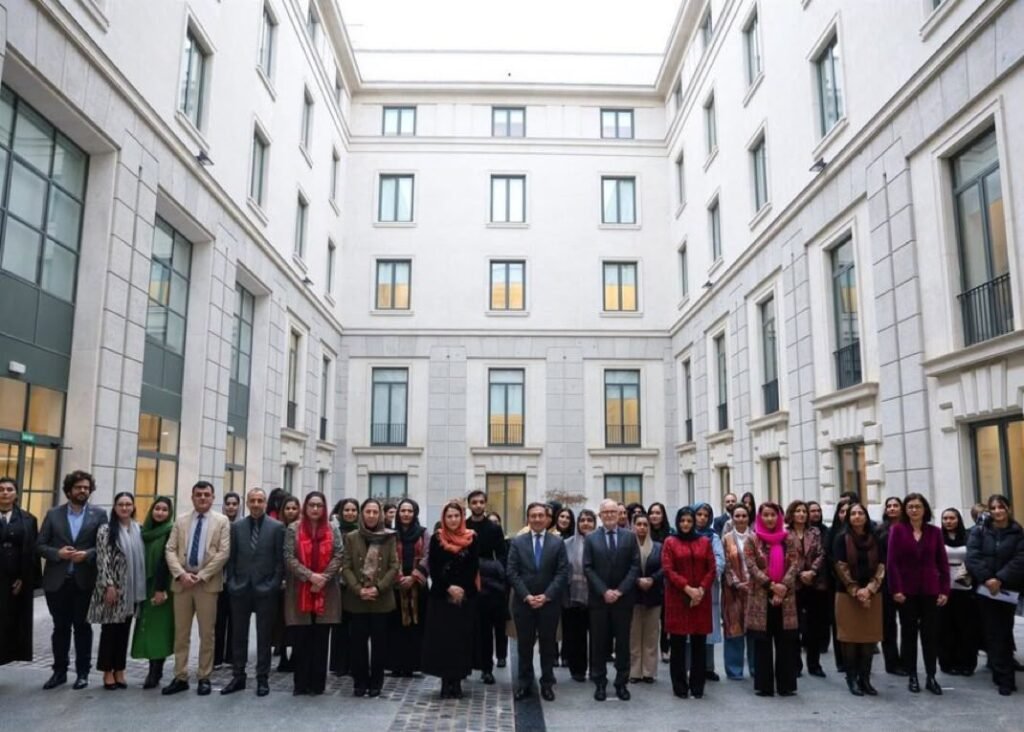
Photo: @Women for Afghanistan
The summit’s central theme is accountability. Yet accountability remains one of the most contested concepts in discussions about Afghanistan.
By Kazim Jafari
On 22-23 November, Madrid will host the fourth HearUs Summit, described by organizers as the largest gathering of Afghan women leaders and their allies outside Afghanistan. Organized by Spain’s Ministry of Foreign Affairs and Women for Afghanistan, the summit aims to advance “justice and peace through accountability” and bring together Afghan women leaders, diplomats, UN representatives, policymakers, human rights advocates, and civil society organizations.
The agenda is ambitious. Discussions will focus on education, economic empowerment, international justice, Islamic perspectives on women’s rights, and women’s leadership in peacebuilding. Organizers will also launch a “One Million Signatures” campaign to mobilize international support for Afghan women and girls.
At a time when Afghan women remain excluded from secondary and higher education, many professions, and much of public life, few would question the need for international solidarity. The more difficult question is whether another high-profile conference can produce anything beyond statements of support.
The summit’s central theme is accountability. Yet accountability remains one of the most contested concepts in discussions about Afghanistan.
Accountability for whom?
If the target is the Taliban, the challenge is obvious. Conferences can raise awareness and generate political pressure, but they cannot themselves hold rulers accountable. Five years after the Taliban’s return to power, international conferences, resolutions, and statements have done little to reverse restrictions on Afghan women and girls. While advocacy has succeeded in keeping the issue visible, its practical impact remains difficult to measure.
The summit’s emphasis on international justice reflects this dilemma. Participants are expected to discuss legal avenues and accountability mechanisms, but organizers have not explained what new instruments are being proposed or how discussions might translate into concrete political outcomes.
The accountability question also extends beyond the Taliban.
The HearUs Summit presents itself as a platform for Afghan women’s leadership. But who defines that leadership? Who decides which women participate and which voices remain absent?
Many Afghan women inside Afghanistan continue to face severe restrictions that limit their ability to engage internationally. At the same time, a relatively small group of activists, organizations, and advocacy figures has become highly visible in international forums. Their work has undoubtedly helped keep Afghanistan on the global agenda, but it has also generated questions about representation.
Do summit participants reflect the social, ethnic, regional, and political diversity of Afghan women? Are selection processes transparent? Are alternative viewpoints and grassroots voices adequately represented?
These questions are particularly important because many participants live and work in democratic countries where accountability, transparency, and participation are considered essential values.
Some critics have also called for greater transparency regarding funding, organizational governance, and decision-making processes within parts of the Afghan advocacy sector. Others argue that public scrutiny should apply equally to all actors, including those who advocate accountability on the international stage. Whether or not such criticisms are justified, they point to a broader reality: accountability gains legitimacy when it is applied consistently.
None of this diminishes the importance of the Madrid gathering. The HearUs Summit remains one of the few international platforms dedicated specifically to Afghan women’s concerns. Its ability to convene policymakers, international organizations, and Afghan activists in one place is significant.
But if the summit seeks to move beyond solidarity, as organizers promise, success will require more than speeches and declarations. It will depend on whether participants can demonstrate how accountability will be pursued, how representation will be broadened, and how Afghan women, both inside and outside the country, can play a meaningful role in shaping decisions that affect their future.
For Afghan women, the challenge is no longer visibility. It is influence. The real test for HearUs is whether it can help transform one into the other.
Kazim Jafari is a political science student at the University of Heidelberg in Germany.
Note: The contents of the article are the sole responsibility of the author. Afghan Diaspora Network will not be responsible for any incorrect statements in the articles.