The Writing That Survives Prison: Khalid Qaderi’s Writing of Resistance
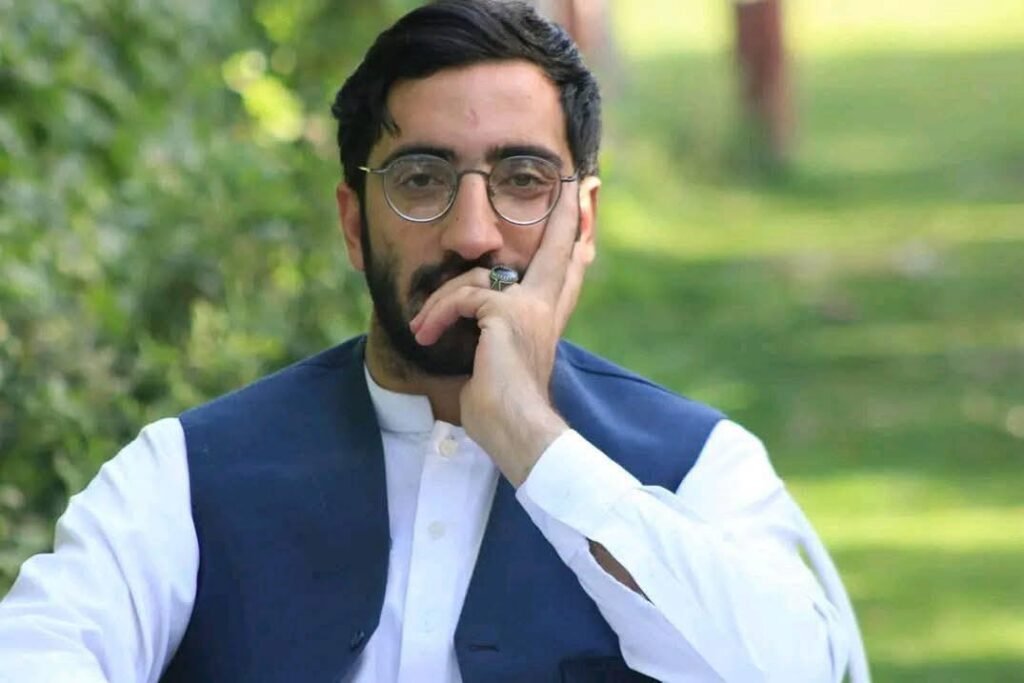
Khalid Qaderi - Afghan writer from Western Herat province. Photo:@Khalid Qaderi Facebook page.
The Word as a Seized Space
By Ivan Pozzoni
Khalid Qaderi’s writing emerges within a geography in which language is never merely language. An Afghan poet, short-story writer, and journalist from Herat, Qaderi hosted cultural programs for Radio Nawruz and published the collection Darakhti dar avakher-e payez (درختی در اواخر پاییز),(A Tree in Late Autumn, Nashr-e Jawan, Herat, 2018). In March 2022, he was arrested by the Taliban intelligence service in Herat and sentenced by a military court to one year in prison; the charges included journalistic, cultural, and writing activities. After eleven months in detention, he left Afghanistan, traveling through Iran before settling in France. His writing therefore becomes a paradigmatic case of language under pressure: a verse need not be formally criminalized for a political apparatus to perceive cultural production as an alternative space of subject formation. A text such as Shahri ke zananash eid nadarand (شهری که زنانش عید ندارند, (“The City Whose Women Have No Holiday,” Rah-e Madaniyat, 2019) constructs this tension through a sophisticated pragmatics of memory. Its opening, «عید روزه در راه بود. سال آخر روزهای سیاه طالبانی» (“The Eid holiday was approaching. It was the final year of the Taliban’s dark days”), does not formulate a political thesis: it places the speaker within a recognizable temporal framework. The speech act is therefore indexical: «سال آخر» (“the final year”) simultaneously signals a biographical temporality and a historical rupture. Private memory becomes public memory through the choice of an apparently innocuous referent: the holiday. The following sentence radicalizes the procedure: «هنوز هم شهر بوی و طعممردانه داشت» (“The city still had a masculine smell and taste”). The expression attributes sensory properties normally associated with a body to an urban space. From the perspective of analytical criticism, this is a metaphorical predication: “city” becomes the perceptual subject, while “masculine” becomes an atmospheric quality. Pragmatically, the utterance generates an implicature: masculinization is not confined to institutions; it invades the ordinary perception of the world. The reader is not given an abstract definition of domination; the reader smells it. Here Jacques Rancière provides a particularly productive point of comparison. In The Politics of Aesthetics, he defines the distribution of the sensible as “the system of self-evident facts of sense perception” (Continuum, 2004, 12). Qaderi operates precisely at this threshold: politics enters perception before entering argument. The ‘masculine’ city does not simply describe a social structure; it reconfigures what can be sensed, remembered, and named. The mechanism becomes visible again in the maternal line «عیدت مبارک. شاهزاده مادر» (“Happy holiday. Mother’s prince”), (Shahri ke zananash eid nadarand, Rah-e Madaniyat, 2019). The illocutionary act is an affective speech act: the mother creates a micro-institution of recognition within the domestic sphere. The ritual formula protects the child, for a moment, from the political grammar surrounding him. The contrast between the intimate deixis of “mother” and the monumentality of external power creates a semantic fracture. Resistance begins in the possibility of calling someone by a name different from the one assigned to them by the public order.
Body, Memory, Pain: A Politics of Enunciation
Qaderi’s strength emerges most clearly when material detail takes the place of ideological declaration. «بیست سال است، مادر سر هر عید بوی پودر لباسشویی میدهد» (“For twenty years, at every holiday, the mother has smelled of laundry detergent”) (Shahri ke zananash eid nadarand, Rah-e Madaniyat, 2019). The temporal expression ‘twenty years’transforms a domestic gesture into historical duration. Detergent becomes a memory cue: a sensory signal capable of condensing repetition, women’s labor, and survival. Research on autobiographical memory shows how sensory cues can reactivate strongly contextualized mnemonic configurations; Qaderi constructs precisely this cue-dependent recollectionin literary form. The reader is not informed about the past; the reader is subjected to a smell. The passage continues: «بیست سال است دستانش زیر آب فراوان چروکیده شدهاند» (“For twenty years, her hands have become wrinkled under so much water”) (Shahri ke zananash eid nadarand, Rah-e Madaniyat, 2019). The hand functions as a synecdoche of labor: the body preserves what official history tends to erase. The sentence contains no explicit political category; it constructs evidence through the body. It is a form of embodied testimony, in which the body becomes an archive. The climax is «اماعید هیچگاه روی زنانهاش را به او نشان نداده است» (“Yet the holiday has never shown her its feminine face”) (Shahri ke zananash eid nadarand, Rah-e Madaniyat, 2019). The holiday possesses a ‘face’ and a ‘feminine’ dimension: the collective ritual is anthropomorphized and simultaneously deprived of its promise of joy. The negation «هیچگاه» (“never”) closes the temporal circuit opened by “twenty years”. The syntax produces a closure: what should be cyclica, the holiday, remains incomplete. The comparison with Judith Butler clarifies the political dimension of the procedure. In Precarious Life: The Powers of Mourning and Violence, Butler asks: “Who counts as human? Whose lives count as lives? And, finally, What makes for a grievable life?” (Verso, 2004, 20). Qaderi responds through the literary production of grievability: he renders visible a domestic life that power tends to confine to insignificance. The maternal gesture, the hand, the smell of detergent, and the absent feminine face of the holiday become mechanisms of recognition. The same logic runs through the text Zan, زندان؛ زندگی (Woman, Prison; Life, Rukhshana Media, 2023): «در جغرافیای ما، زن بودن معادلرنج کشیدن است» (“In our geography, being a woman is equivalent to suffering”). The noun ‘geography’ is decisive: the female condition is spatialized. Suffering does not appear as an individual accident; it becomes a property of a social territory. The copular proposition ‘being a woman = suffering’ produces extreme semantic compression. Qaderi continues: «زن در هر قالبی، تار و پودش را با غم بافته است» (“In every form, a woman has woven her warp and weft with sorrow”) (Zan, زندان؛ زندگی, Rukhshana Media, 2023). The textile metaphor transforms suffering into structure. Pain is not merely a content added to female life; it becomes the fabric of life itself. The image can be placed in dialogue with Donna Haraway, who in Staying with the Trouble asks us to think through relations as processes of ‘becoming-with’ (Duke University Press, 2016, 4). In Qaderi’s case, becoming-with takes on a coercive dimension: the female subject is produced within a network of familial, carceral, and social relations that predefine her position. The sentence «مادر بودن اما، هر دردیرا ضرب در خودش میکند» (“Being a mother, however, multiplies every pain by itself”) (Zan, زندان؛ زندگی, Rukhshana Media, 2023), brings the procedure onto the level of conceptual metaphor. ‘Multiply’ introduces an almost mathematical lexicon into affective experience: pain becomes an operation. The text thus performs a cognitive transformation of suffering. Quantitative hyperbole renders measurable what normally escapes measurement.
From Prison to Circulation: Writing Against Invisibility
The second stage of Qaderi’s experience modifies the relationship between text and reality. In the autobiographical account of prison, writing no longer serves merely to remember violence that has already occurred: it serves to prevent the carceral experience from being erased. Qaderi observes that «زندان پر از داستانهای نخوانده و ناگفته بود» (“The prison was full of unread and untold stories”), (Zan, زندان؛ زندگی, Rukhshana Media, 2023). The pair ‘unread / untold’ constitutes a negative coordination: the prison is defined through the language that is missing. Writing therefore becomes a second exit from prison, an exit through narration. Here Achille Mbembe provides a particularly precise conceptual framework. In Necropolitics (University of Minnesota Press, 2019, 92), he speaks of ‘death-worlds’, “new and unique forms of social existence” in which entire populations are maintained in conditions that transform them into ‘living dead’. Qaderi’s prison can be read within this framework as a space for the reduction of subjectivity. Writing reconstructs the capacity to name.The aesthetic-political dimension becomes even more evident in comparison with Hito Steyerl. In The Wretched of the Screen (Sternberg Press, 2012, 32) Steyerl defines the poor image as “a copy in motion”. Qaderi’s practice can be approached through the same metaphor: the resistant text survives through circulation, reproduction, and migration among radio, print, social media, and diaspora. The word loses exclusive control of its original location and acquires mobility. The material precariousness of communication can become a condition of persistence. Nicholas Mirzoeff, in The Right to Look: A Counterhistory of Visuality (Duke University Press, 2011, 24), defines countervisuality through a “dispute over what is visible as an element of a situation”. Qaderi’s writing performs an analogous operation at the linguistic level: it determines which bodies, memories, and forms of suffering can enter the public scene. Aesthetics thus becomes a politics of visibility. The text does not replace political action; it modifies the perceptual field within which action can be recognized. Ruth Wilson Gilmore, in Abolition Geography: Essays towards Liberation (Verso, 2022, 93), formulates an essential proposition: “freedom is a place”. Qaderi implicitly reverses this relationship: when place becomes prison, the text can construct another space of belonging. The page, the radio, and the story published in exile constitute an alternative geography. Diaspora becomes a narrative counter-space. Anna Tsing, in The Mushroom at the End of the World (Princeton University Press, 2015, 4), invites us to follow possibilities of existence “amidst the terrors of indeterminacy”. Qaderi’s writing possesses a similar structure: it does not promise complete narrative redemption. It preserves fragments, smells, bodies, mothers, prisoners, and memories. The art of resistance becomes an art of persistence. Fred Moten and Stefano Harney, in The Undercommons: Fugitive Planning & Black Study (Autonomedia, 2013, 110), describe study as a practice in which “the incessant and irreversible intellectuality of these activities is already present.” The principle allows Qaderi’s cultural practice to be read beyond the reductive category of the ‘persecuted writer’. His radio work, poetry, fiction, prison memoir, and testimony constitute different forms of fugitive intellectuality: intelligence that continues to produce meaning under pressure. Neuroscience finally helps explain why this writing is not simply documentary testimony. The repetition of temporal formulas, sensory objects, and bodily images creates retrieval cues, while metaphor enables complex experiences to be compressed into linguistic units that can be readily reactivated. The text becomes a technology of memory. The repetition of “twenty years,” hands immersed in water, the smell of detergent, and the absent feminine face of the holiday creates a memory loop: the reader is brought back to the same point through minimal variations. From the perspective of predictive processing, the narrative establishes ritual expectations—holiday, mother, home, joy—and progressively violates them. Surprise emerges through prediction error, while memory retains precisely the violated expectation. Qaderi’s resistance writing is therefore simultaneously linguistic, embodied, and political. Pragmatically, it modifies what can be said. Aesthetically, it modifies what can be perceived. Anthropologically, it preserves forms of life that power tends to render anonymous. Neurocognitively, it transforms memory into a repeatable sequence. Politically, it produces counter-publics: communities of readers and listeners capable of sharing an alternative narrative repertoire. His writing does not coincide with a political slogan. Its force emerges from its ability to perform something more concrete: to give a linguistic body to what power would prefer to leave voiceless. The mother who smells of detergent, the wrinkled hands, the holiday without a feminine face, the woman transformed into a prisoner of her own social role, the unread stories of the prison: all are fragments of the same operation. Qaderi restores names, sensations, and memory to subjects who risk being reduced to administrative categories. In this sense, ‘writing of resistance’ does not simply mean writing against the Taliban. It means preventing violence from determining the meaning of things as well. A prison can control a body; it can control a microphone; it can impose silence on a public voice. The text continues to circulate. And when it circulates, it reopens the space of speech.
About the author: Ivan Pozzoni was born in Monza in 1976. He introduced Law and Literature in Italy and the publication of essays on Italian philosophers and on the ethics and juridical theory of the ancient world; he collaborated with several Italian and international magazines. He wrote 152 volumes, wrote 1000 essays. His verses/essays are translated into 30 languages.
Note: The contents of the article are the sole responsibility of the author. Afghan Diaspora Network will not be responsible for any incorrect statements in the articles.