What It Means to Be a Feminist: A Feminism That Makes No Noise
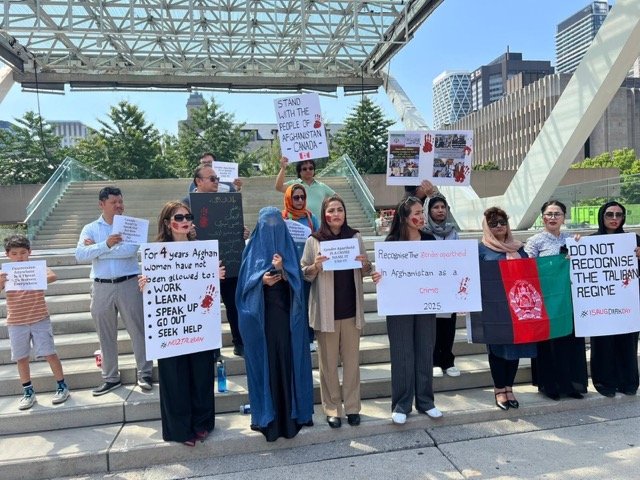
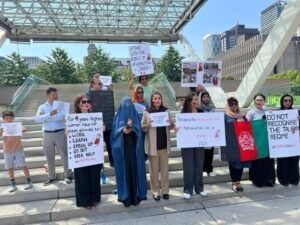
Afghan diaspora women during a demonstration in Canada against the Taliban. Photo: @Munisa Mubariz Facebook.
Being a feminist today does not necessarily require wearing a slogan or joining a rally, even as those actions remain legitimate and sometimes necessary tools of political pressure.
By Giorgia Pietropaoli
Everyday resistance redefining the struggle for human rights: from Afghanistan to India, the resilience of those who refuse to be erased.
Beyond the rallies, the demonstrators, and the slogans—important yet sometimes perceived with a degree of condescension—lie an even more powerful resistance against dominant male chauvinism. It is the quiet, immensely effective resistance of Afghan women. Stepping far outside the role of helpless victims, they are carrying out their own feminist revolution with dignity and determination, defending everything the Taliban regime is striving to strip away.
From the matriarchal systems of prehistory to the unacknowledged daily management of the economy—from the household sphere to major industrial groups—women have always known how to make a difference. As mothers, sisters, daughters, and friends, they carry the weight of management and responsibility on shoulders that are only deceptively fragile.
When people think of feminism, the collective imagination almost automatically rushes to public squares: purple flags, chants, banners—the necessary and sacred noise of those demanding denied rights. This form of mobilization possesses undeniable historical value: it was the voice that delivered the right to vote, divorce, abortion, and equal opportunity legislation. Yet, reducing feminism exclusively to this public and collective gesture means losing sight of its most widespread and, in many ways, hardest-to-tell form: the one played out every single day without cameras or applause—inside homes, markets, underground schools, offices, and fields.
It is a feminism built on minimal gestures repeated with quiet defiance: the woman who continues to teach neighborhood girls how to read even when it is forbidden; the worker who silently negotiates a space of economic autonomy within a marriage that fails to recognize her as an equal; the manager who must prove twice as much every day compared to what a male colleague takes for granted. It does not make headlines, it does not generate hashtags, yet it alters the deep structures of society far more than we tend to believe.
Afghanistan as a Mirror and a Warning
Today, Afghan women embody this silent resistance perhaps more than any other group in the world. Since the Taliban’s return to power in August 2021, the rights of Afghan women have been dismantled piece by piece: secondary and university education denied, employment opportunities drastically restricted, the requirement of a male chaperone to move around, and the female voice banned even from public spaces. It is a systematic campaign of erasure that goes far beyond the deprivation of rights: it is an attempt to erase women’s public existence as active individuals.
Yet, in a scenario designed to crush any possibility of reaction, Afghan women have refused to merely endure. They have established secret schools in their living rooms, teaching young girls barred from formal education. They have continued to write, often under pseudonyms, documenting what is happening through literature, poetry, and social media wherever possible. They have kept small economic ventures alive—tailor shops, bakeries, artisan workshops—allowing them to avoid total dependence on a system that wishes to render them invisible. Some have chosen exile to make their voices heard from abroad; others have chosen to stay, convinced that their physical presence, however quiet, is itself a political act.
This is not passivity. It is a form of resistance that rejects the label of “victim” while fully acknowledging the violence endured. It represents the vital difference between being the passive object of a story written by others and reclaiming—even under the most extreme conditions—a margin of agency, choice, and dignity.
The Thread Linking Prehistory to the Present Day
To understand the full scope of this resistance, it is worth broadening our historical perspective. Archaeology and anthropology over recent decades have challenged the long-held assumption that primitive social organization was invariably patriarchal. In many prehistoric communities, women’s roles in resource management, knowledge transmission, and community care were central—often equal, if not predominant in certain phases. Whether these societies were truly matriarchal or simply more balanced than subsequent narratives suggested, one fact remains clear: female subordination is not a law of nature, but a historical, social, and cultural construct—and therefore, in principle, reversible.
From prehistory to the present day, the common thread binding women is the invisible, everyday management of complex systems. It is labor that traditional economics has long simply refused to count. Domestic work—cooking, cleaning, caregiving, organizing, mediating family conflicts—has never entered GDP calculations; yet, without it, no economy could function. It is the paradox of an enormous value made structurally invisible.
The same pattern, albeit in different forms, repeats itself at the highest levels of professional life. Women who manage departments, lead projects, and sit on corporate boards today often carry a double burden: the demand for professional competence—which they must demonstrate under a level of scrutiny rarely applied to male colleagues—and the unstated yet real burden of care (for children, aging parents, and family networks) that continues to fall disproportionately on them, even alongside demanding careers.
Mothers, Sisters, Daughters, Friends: A Chain of Responsibility
There is a defining element connecting the Afghan woman secretly teaching the alphabet to a child and, for instance, the European manager coordinating an international team: the capacity to carry a weight that society tends to minimize or take for granted on shoulders that are extraordinarily resilient. Mothers who hold entire families together through economic or emotional crises; sisters who step up for one another when institutional support fails; daughters who care for aging parents; friends who form informal yet unshakeable networks of mutual support when other protections are absent.
This chain of responsibility should not be idealized as an inherent “female virtue,” for doing so risks naturalizing—and thus justifying—a structural imbalance that needs to be acknowledged, named, and redistributed. Yet, it must be told, because it is precisely in this daily, often solitary management that we measure a vast, underestimated portion of women’s contribution to the stability of societies everywhere.
Being a Feminist Today
Being a feminist today does not necessarily require wearing a slogan or joining a rally, even as those actions remain legitimate and sometimes necessary tools of political pressure. It means recognizing, naming, and valuing every form of resistance and contribution that women bring to light, often without fanfare. It means viewing Afghan women not as victims to be pitied, but as the protagonists of a struggle that, under the harshest imaginable conditions, has refused to surrender. It means restoring value—both economic and symbolic—to the work of care that has sustained families, communities, and entire productive systems without ever appearing on official balance sheets.
Ultimately, it means understanding that feminism is not a banner to raise once a year, but a lens through which to view daily life: in how we raise our sons and daughters, how household responsibilities are shared, how we evaluate the work of a female colleague, and how we tell—or fail to tell—the stories of the women who came before us.
The quietest revolution is often the hardest to eradicate because it has no single face to target, no single sign to tear down, and no single march to disperse. It lives in thousands of persistent, seemingly small daily gestures. And it is precisely in this widespread, capillary, nearly invisible determination that the true battle for equality is being fought today—in Afghanistan as everywhere else.
About the author: Giorgia Pietropaoli based in Rome, Italy, is a teacher of classical literature. She holds a degree in Classical Philology from Sapienza University of Rome, where she subsequently earned a Master’s degree in Political Science.
Driven by a profound passion for linguistics, she also pursued studies in Persian Language and Literature at the same institution.
As a writer and investigative reporter for “Focus On Africa Magazine”, she is actively engaged in journalism, education, and activism. She specializes in Middle Eastern dynamics—with a particular focus on Iran and Afghanistan—and is deeply committed to the advocacy of human rights.
She is the author of the essay “Afghanistan. Dove tutto cambia per non cambiare mai” (“Afghanistan: Where Everything Changes So Nothing Ever Changes”), published by Infinito Edizioni. Furthermore, she translated from Persian and edited the Italian editions of “Parole dall’esilio” (“Words from Exile”) by Somaia Ramish and :Sinfonia di pace” (“Symphony of Peace”), published by AllAround.
Note: The contents of the article are the sole responsibility of the author. Afghan Diaspora Network will not be responsible for any incorrect statements in the articles.