Pakistan’s Mediation Myth in US–Iran Conflict
By Rahmatullah Achakzai
A recent report, citing anonymous U.S. officials, alleged that Iran moved some military and civilian aircraft, including a reconnaissance RC-130 plane, to Pakistan’s Nur Khan Air Base during the Iran-U.S. conflict, possibly to shield them from American strikes, while Pakistan simultaneously presented itself as a diplomatic mediator between Tehran and Washington. Pakistan acknowledged that Iranian aircraft were present for diplomacy-related logistics tied to ceasefire discussions.
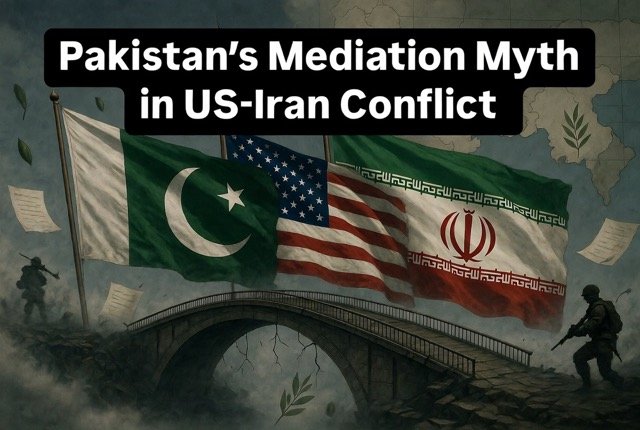
While Pakistan has publicly presented itself as a mediator in the ongoing war between the US-Israel and Iran, the boasting is much far from the realities. Islamabad is not a mediator but just a facilitator of talks, as revealed by the developments of direct talks between American and Iranian delegates in Pakistan’s capital. Pakistan’s cosy approach toward the US and the mistrust of Iran and Israel towards Islamabad further limited its credibility.
The ancillary role it played during the negotiations and in shaping up the outcome can be gauged from the fact that Islamabad carried no weight in any part of the actual talks. It was evident that Pakistan could not influence either party in the negotiations in order to bridge the trust gap, thus ending up becoming just a logistical partner in the entire process.
Moreover, Pakistan also had no control over the post-talk escalations as well, as the US threatened blockades at the Strait of Hormuz. So, if things are seen with deeper meaning, Pakistan initially emerged as a key player in negotiations, the subsequent developments and final outcome revealed that Pakistan was a mere postman in the mediation game.
It may have been unusual for the world to see Pakistan taking the center stage as negotiations between the US and Iran began, as the news flow from the country is usually associated with terrorism, Islamic extremism, coups, inflation, poverty, and financial problems.
Then why did Pakistan emerge as a crucial factor as the calls for mediation started taking root strongly amid an escalating armed conflict that threw the entire global supply chain off track? Pakistan has been loyal to the US since the days their friendship dates back. The US has historically controlled Pakistan in a true sense by exercising strong influence on the country’s policy decisions through financial aid and geopolitical pressure.
And Pakistani Army Chief Asim Munir’s growing closeness in the context of American security concerns vis-à-vis Afghanistan and China’s growing influence in the Middle East turned out to be a deciding factor for Pakistan to become an ideal choice for the role of facilitator.
As a constrained choice, Iran approved Pakistan as a neutral place for talks since there were no US military bases. Iran did not have trust in Pakistan, thanks to the suspicion of Islamabad sharing crucial information with the US and its direct military deal with Saudi Arabia. Yet, Iran decided to go ahead with the meetings in Pakistan as it found Pakistan useful, though not trustworthy.
Moreover, Iran has reasons not to show faith in Islamabad even though both countries have had strong historic ties. Islamabad did not name the US while condemning attacks on Iran as well as the killing of Ayatollah Ali Khamenei. Even as Pakistan is expected to maintain neutrality, it has sent troops to Saudi Arabia to counter Iran, adding to Tehran’s dismay.
Israel has openly criticized Pakistan, saying it does not see Pakistan as a “credible player” in the mediation talks and accepting that it allowed Islamabad just to stay in sync with its ally, the US. Pakistan’s position became weaker after its defence minister called Israel “evil and a curse for humanity,” “cancerous,” and “to get rid of European Jews.” Moreover, Pakistan does not recognize Israel and has always opposed its legitimacy and is reported to have ties with terror groups, especially Hamas.
A general question being asked is how come Pakistan, which was once on the sidelines, became central to the mediation talks. As the discussion over the ceasefire continued and subsequent developments occurred, it became clear that Pakistan was merely a facilitator that would provide a platform for meetings between the warring parties.
It is not unusual to infer that Iran views Islamabad as tilting toward the United States, whereas Israel perceives Pakistan as biased toward Iran due to religious affinity and geostrategic proximity.
Pakistan’s overall negative image, arising out of its involvement in the major global terror attacks, its historical alignments and deep religious-ideological connections, intricate and botched up diplomatic relations; and its previous failures in mediation, stopped the country from playing the active role of a mediator in the ongoing conflict. Its part remained peripheral, confined to providing a diplomatic platform rather than shaping the trajectory of negotiations.
Rahmatullah Achakzai is a journalist based in Balochistan, covering human rights, regional politics, and cross-border issues.
Note: The contents of the article are the sole responsibility of the author. Afghan Diaspora Network will not be responsible for any incorrect statements in the articles.