Afghan Musician Farhad Darya: “Afghanistan’s History Is Mostly Lies”
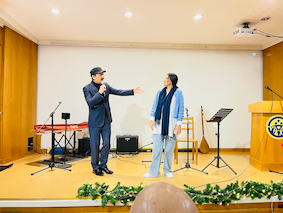
Farhad Darya (left) is Afghan singer, composer and rights activist. Photo: @Ali Ahmad for ADN
By Kazim Jafari
Farhad Darya is one of Afghanistan’s best-known musicians, whose songs have accompanied several generations through war, displacement, and political change. Now living in the United States, he continues to reflect publicly on Afghanistan and Afghan society – not as a politician, but as an artist shaped by exile and long engagement with his country.
In a recent conversation with Kaaj Magazine, a newly established online platform focusing on Afghanistan and the Afghan diaspora, Darya spoke with journalist and founder Farahnaz Frotan about displacement, public judgment, and the meaning of happiness in a society marked by long conflict. The discussion took place at Darya’s home in the US and focused less on biography than on the ideas that have sustained his work over decades.
Leaving one’s country, Darya said, breaks a person. Standing up again after that break is difficult, especially when exile brings isolation, loss of status, and uncertainty. He described his approach to life as one based on trust: planning carefully while accepting that not everything can be controlled. This mindset, he said, has helped him continue working despite repeated setbacks.
Over time, Darya noted, his relationship with the Afghan people has changed. Earlier in his career, he admitted, he was more judgmental. Today, he tries not to judge even those who criticize or attack him. This does not mean that criticism has no effect. On the contrary, he acknowledged that public judgment – particularly from fellow Afghans – has been deeply painful at times. What troubles him most, he said, is when people see only success and forget that public figures are also ordinary people with failures and vulnerabilities.
One of the most difficult experiences he described was his involvement in humanitarian aid following the Herat earthquake in October 2023. Despite sending funds and coordinating assistance through local contacts, he faced harsh accusations and public suspicion for fraud and corruption. Even after sharing documentation, the criticism continued. The episode affected him seriously, leading to depression and ultimately to his decision to step away from further humanitarian aid work.
Rather than treating this as a personal dispute, Darya connected it to a broader social issue. Decades of war and deprivation, he argued, have created deep mistrust within Afghan society. Anger has become easier to express than joy, and public figures are often viewed with suspicion. In this environment, even acts of solidarity can become sites of conflict.
This mistrust, Darya believes, also shapes Afghan attitudes toward happiness and music. Many Afghans, he said, have grown up with suffering as a constant presence. Pain feels familiar and reliable, while happiness feels uncertain and temporary. As a result, music and public celebration are sometimes questioned or opposed – not necessarily because people reject joy, but because they have little experience sharing it.
Darya’s own migration experience informs this understanding. He recalled his early years in Europe, particularly in Germany, as a time of deep loneliness. He felt invisible in public spaces and gradually disconnected from both his surroundings and his sense of self. Those years, he said, help him understand why many Afghans today struggle to believe in a future.
Darya emphasized that Afghans living in Kabul or elsewhere have every right to feel hopeless about the future. He criticized the country’s historical narratives, describing much of Afghanistan’s history as distorted or false, with only small segments reflecting truth. Rather than lecturing or imposing optimism, Darya said he respects individual judgment and acknowledges the difficulty of life and the uncertainty of the future. For those whose hearts are broken, he argued, the only meaningful “investment” is in personal belief and self-trust. No government, no system, he insisted, can create hope for them; people must discover their own reality and chart their own path forward.
The conversation also touched on the idea of homeland. For Darya, homeland is not limited to geography. It is carried through people, values, and representation. Afghanistan, he suggested, has often demanded loyalty without offering security in return, forcing many Afghans in exile to redefine what belonging means.
Music remains central to that process. Darya described music as a keeper of memory that needs time to be understood. Some of his songs, he noted, were not embraced when first released but later became widely loved. This, he said, reflects how societies change and how culture cannot be frozen in the past.
Happiness, in Darya’s view, is not about forgetting suffering. It is about creating space for humanity despite hardship. War, he said, reflects human weakness; joy and creativity reflect resilience. In a society where pain has long dominated public life, even small moments of happiness can carry significance.
While realistic about Afghanistan’s current challenges, Darya sees his role as limited but clear: to continue making music, to offer moments of hope without denying reality, and to remain connected to people at home and in the diaspora. In a country where suffering has been constant, he argues, allowing happiness to exist is not a luxury – it is a necessity.
Kazim Jafari is a political science student at the University of Heidelberg in Germany.
Note: The contents of the article are of sole responsibility of the author. Afghan Diaspora Network will not be responsible for any inaccurate or incorrect statement in the articles.