How the Afghan Diaspora Keeps Culture Alive as Traditions Fade at Home
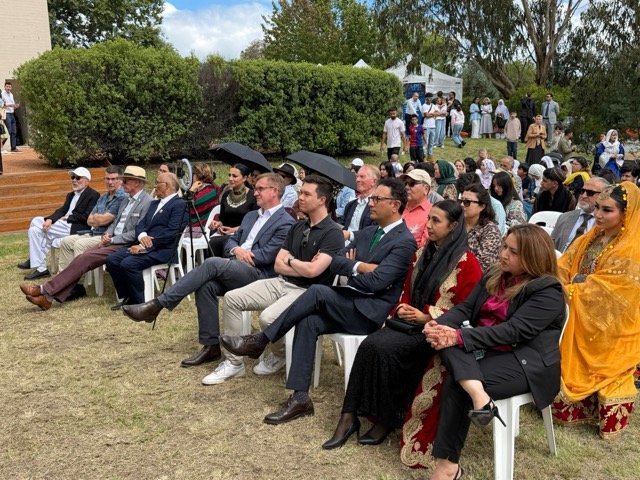
Afghan Ambassador Wahidullah Waissi (third from right, front row) with participants at a Nawroz and Eid celebration in Canberra, Australia. Photo: Afghan Embassy in Australia.
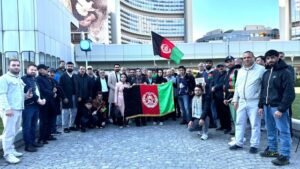
In 2026, as Nawroz 1405 (2026) and Eid al‑Fitr arrived side by side, Afghan communities across the world turned Vienna, Hamburg, Stockholm, Toronto, Canberra, and dozens of other cities into vibrant islands of celebration. These gatherings — joyful, public, and intergenerational — unfolded at a moment when cultural expression inside Afghanistan remains restricted or discouraged. For the global Afghan diaspora, the dual holidays became more than seasonal festivities; they became a collective act of cultural continuity and a reminder that Afghan identity does not end at the Durand Line or the borders of exile.
Nawroz, with its 3,000‑year history, symbolizes renewal, the rebirth of nature, and the endurance of a shared civilizational heritage stretching across Afghanistan, Iran, Central Asia, and beyond. Eid al‑Fitr, marking the end of Ramadan, carries its own spiritual weight — a celebration of gratitude, compassion, and community. Their rare overlap this year created a powerful moment of unity. Yet inside Afghanistan, Nawroz was muted or banned, and public Eid gatherings were heavily restricted. This absence has pushed the diaspora into a new role: the primary guardians of Afghan cultural memory.
In Vienna, the Afghan Wulas Kultur & Sportverein hosted one of Europe’s most spirited Nawroz celebrations. Nearly 200 Afghans — families, elders, youth, and children — gathered around Afghan food tables, poetry recitations, traditional music, and children’s activities. A second gathering at the Afghanistan Cultural Association (AKIS) office brought together around forty participants for a combined Eid and Nawroz celebration, blending festivity with practical discussions on migration regulations. These events reflected a truth familiar to diaspora communities everywhere: celebration and adaptation often unfold side by side.
In Sweden, Uppsala’s Afghan community marked the dual holidays with a large gathering organized by the Salsal Association and the Afghan Ha Association. The Afghan Embassy highlighted the event, where cultural performances and community greetings created a warm, inclusive atmosphere. Najibullah Mohajer, the chargé d’affaires, emphasized Nawroz as a symbol of renewal and unity, noting that its overlap with Eid offered a rare opportunity to deepen solidarity among communities navigating life in a multicultural society.
Hamburg added a powerful civic dimension. On March 20, the city’s historic City Hall (Rathaus) hosted a grand Nawroz celebration organized by the Left Party’s parliamentary faction — a tradition since 2014. Afghan‑German politician Heela Latifi described the significance of holding Nawroz in the heart of the city’s political life: for many migrants, entering the Rathaus for this celebration is the first time they feel truly invited into the civic space.
“People say they only feel truly welcomed into the city through this event,” she noted.
But the emotional weight of diaspora life was also present. Zahra Hosseini, who arrived in Germany just a month earlier, experienced her first Nawroz in exile. A native of Mazar‑e‑Sharif — where Nawroz is celebrated as the Mela‑ye Gul‑e Surkh amid blooming roses and massive public gatherings — she described the day with quiet sadness.
“I don’t feel good,” she said. “I’m far from my family, and this Nawroz has a completely different color for me.” Her words captured a truth often overshadowed by the colorful photos of diaspora events: celebration abroad is always tinged with longing.
The most elaborate celebration unfolded thousands of kilometers away in Canberra, where the Afghan Embassy hosted a grand joint ceremony for Nawroz and Eid on March 22. With the participation of Australian officials, diplomats, civil society representatives, cultural activists, and a large Afghan community, the event became a showcase of solidarity and shared identity. After Quran recitation and the national anthems of Afghanistan and Australia, Ambassador Wahidullah Waisi, Afghanistan Peace Foundation regional head Nader Saikal, and several Australian political leaders — including Federal MP Julian Hale and Canberra Parliament Speaker Peter Keane — delivered remarks. They highlighted Nawroz as a multi‑millennial heritage and emphasized the need for global support for Afghan women and girls facing severe restrictions at home.
The ambassador also expressed condolences for the recent deadly attack on a Kabul rehabilitation center, condemning the loss of young lives and calling for the protection of civilians amid rising regional tensions. One of the event’s most powerful moments was the introduction of the “Thousands of Suns” campaign, a nationwide Australian initiative collecting messages of solidarity for Afghan women and girls. Hundreds of handwritten notes were displayed, and guests were invited to add their own.
Cultural performances — from live music and Attan to a special Samanak program by artist Sharif Sahil — filled the embassy grounds with color and rhythm. Tug‑of‑war competitions, children’s activities, and a Nawrozi bazaar featuring handicrafts, carpets, and traditional foods created a festive, communal atmosphere. The event concluded with a raffle and expressions of gratitude to volunteers and partner organizations.
Across continents, the Afghan diaspora’s celebrations reveal a deeper reality: when cultural expression is restricted at home, diaspora communities become the primary carriers of tradition. Nawroz and Eid shift from habitual rituals to intentional acts of preservation. Public celebration becomes a form of soft resistance — a way of asserting continuity against erasure. Intergenerational transmission becomes urgent, as parents teach their children what Afghanistan once sounded, smelled, and felt like.
In 2026, the Afghan diaspora demonstrated that culture is not bound by geography. Nawroz and Eid — symbols of renewal and gratitude — found new life in European halls, Australian embassies, and community centers across the world. As Afghanistan faces cultural suppression and political uncertainty, these global celebrations serve as a reminder that identity travels, survives, and adapts. The diaspora’s spring is not a replacement for the one lost at home, but a promise that Afghan culture will continue to bloom wherever its people gather.