Paper Tiger Diplomacy: The Structural Failures of China’s Mediation Strategy
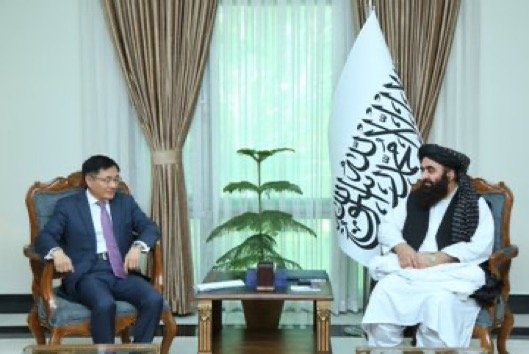
Taliban Foreign Minister Amir Khan Muttaqi meets with China’s Special Envoy for Afghan Affairs, Yue Xiaoyong. Photo: @TalibanMoFA on X.
By Nasir Khattak
On the morning of 27th February, Pakistan declared open war on Afghanistan. Fighter jets struck Kabul, Kandahar, and Paktia province. Hundreds of thousands of civilians are caught in active conflict between two countries that China has spent nearly a decade claiming it could reconcile. Beijing’s response, delivered by Foreign Ministry spokesperson Mao Ning at a routine press briefing, was to express that China was “deeply concerned” and to urge both sides to “remain calm and exercise restraint.” This is the statement of a bystander. It is also, in miniature, the complete story of Chinese mediation.
For the past several years Beijing has positioned itself as a new kind of global peacemaker, one that offers dialogue without coercion, development without conditionality, and consensus without the hectoring moralism of the West. Wang Yi’s 2023 brokering of the Iran-Saudi normalisation was held up as proof. The trilateral dialogues on Pakistan and Afghanistan were held up as proof. China’s intervention in the 2025 Thailand-Cambodia border conflict was held up as proof. Across every one of these cases, the same pattern has now fully revealed itself; China is extraordinarily good at convening parties and claiming credit, and extraordinarily unwilling to do the costly work that actually resolves conflicts. Today’s war is the clearest evidence yet.
The Facilitation Trap: Beijing Mistakes Process for Outcome
The most fundamental problem with China’s approach is that it has designed a mediation doctrine optimised for announcement, not resolution. In the Iran-Saudi case, analysts have concluded that the primary drivers of rapprochement were Riyadh and Tehran’s own strategic calculations, with Iraq and Oman providing the substantive negotiating framework over the years of groundwork. China stepped in as a late-stage “suitable and decent guarantor” once the deal was largely constructed. Yet Beijing received almost all the credit. Iran’s April 2024 drone strikes on Israel led to officials from the CPC stating that China’s role had always been as “a mere facilitator, not a Western-style mediator or guarantor,” and that Beijing would “under no circumstances” use economic muscle to punish either side for violations. The trilateral committee’s third meeting in December 2025 could point to little beyond the fact that 85,000 Iranian pilgrims had performed Hajj without incident. Trade, political reconciliation, and any meaningful curb on Iranian proxy activity never materialised.
The Pak-Afghan theatre represents China’s most comprehensive mediation failure, and it is playing out in real time. The record of that positioning is long and unimpressive. China launched the trilateral foreign ministers’ dialogue in 2017, produced the Afghanistan-Pakistan Action Plan for Peace and Solidarity in 2018, hosted the fifth trilateral dialogue in Beijing in May 2025, and convened a sixth round in Kabul in August 2025, where Wang Yi announced that both sides had “expressed clear willingness to elevate diplomatic relations and agreed in principle to exchange ambassadors.” Six weeks later, Pakistan launched Operation Khyber Storm, striking targets in Kabul and Paktika. The ambassador exchange never happened. A ceasefire brokered in October 2025 was not brokered by China at all, but by Qatar and Turkey in Doha. Two rounds of peace talks in Istanbul then collapsed without agreement by November, with talks indefinitely suspended. Saudi mediation efforts also failed in December. And today Islamabad has declared open war.
What Beijing produced throughout this entire crisis was a series of multilateral joint statements and ministerial photo opportunities. The September 2025 quadripartite communique issued by China, Iran, Pakistan, and Russia on Afghanistan ran to nine paragraphs of diplomatic boilerplate, “expressing deep concern” about TTP and urging “effective, concrete and verifiable actions” from the Taliban without specifying any mechanism for enforcement or any consequence for non-compliance. China, holding a $62 billion CPEC relationship with Pakistan and having extended zero-tariff trade access to the Taliban in 2024, possessed leverage over both parties that it demonstrably refused to use. The ceasefire it could have anchored was instead assembled by Qatar and Turkey. The war it claimed to be preventing is now being fought.
The Thailand-Cambodia conflict of 2025 delivered Beijing’s most public embarrassment, precisely because it erupted in China’s own strategic backyard. When border clashes killed at least 38 people and displaced over 300,000 civilians, Wang Yi hosted consultations, deployed Special Envoy Deng Xijun on shuttle rounds, and framed the conflict as a legacy of Western colonialism requiring Chinese wisdom. The ceasefire was then attributed publicly to Trump’s direct personal intervention at the ASEAN summit in Kuala Lumpur, with Xi Jinping reduced to affirming at APEC in Busan that China had helped “in its own way.” The ceasefire subsequently collapsed, and China was again dispatching envoys while Thai airstrikes resumed. Meanwhile, Thailand was buying 43 percent of its arms imports from China in 2024, according to defence data. Beijing was arming one side in a conflict it claimed to be resolving.
Interest Before Principle: How Commercial Logic Corrupts Chinese Mediation
China’s mediation doctrine is not a foreign policy strategy in any meaningful sense; it is a commercial and reputational strategy with diplomatic packaging. Every case reveals the same underlying logic; mediation is pursued when it protects Belt and Road corridors or secures energy supplies, and abandoned the moment those interests require applying real pressure.
In the Thailand-Cambodia case, China’s activism was driven by the need to protect BRI corridors connecting Yunnan to Bangkok, its $8.4 billion investment in Thailand’s Eastern Economic Corridor, and its infrastructure exposure in Cambodia. The concern was not peace; it was supply chain stability. In the Iran case, China purchases an estimated one million barrels of Iranian oil per day despite US secondary sanctions, a dependency that should provide extraordinary leverage over Tehran’s behavior. In practice, however, Beijing has explicitly refused to deploy that leverage for fear of damaging a commercially vital relationship. Iranian funding of Houthi operations in Yemen and proxy forces across the region continued without interruption after the March 2023 agreement.
The Pakistan-Afghanistan theatre makes the same point from the security angle. In October 2024, China quietly extended unilateral concessions to the Taliban government that came with no security conditionality whatsoever. This has been speculated to be a gesture to ensure that the Taliban cooperates on containing Uyghur militants.
What China has consistently refused to do across all these cases is pay the costs effective mediation requires: sanctioning violators, providing security guarantees, establishing accountability frameworks, or allowing commercial relationships to be subordinated to peacebuilding objectives. Instead, it produces joint statements, dispatches envoys, and allows state media to describe each activity as historic.
China’s Global Security Initiative is premised on the theory that economic interdependence and institutional dialogue will, over time, transform adversarial security relationships. This theory fails systematically in conflicts driven by ideology, territorial sovereignty, or sectarian grievance, precisely the kinds of conflict China has chosen as its mediation showcase. The Durand Line dispute and the Iran-Saudi rivalry are not problems that BRI investment can dissolve. Beijing’s doctrine is designed specifically to avoid the conditions under which mediation succeeds, because those conditions are incompatible with the commercial logic that actually runs Chinese foreign policy. Until that contradiction is resolved, China will keep producing peace announcements rather than peace.
Nasir Khattak specializes in the China-Pakistan region, with a particular focus on the economic relations between the two countries.
Note: The contents of the article are of sole responsibility of the author. Afghan Diaspora Network will not be responsible for any inaccurate or incorrect statement in the articles.