From Kabul to the Diaspora: Unified Afghan Grief and Divergent Analyses After Pakistan’s Airstrike
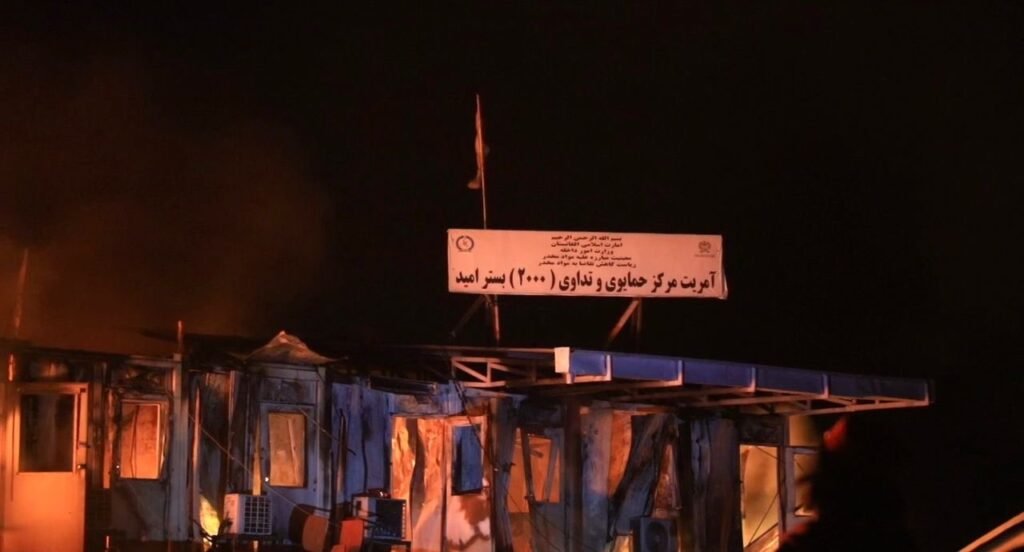
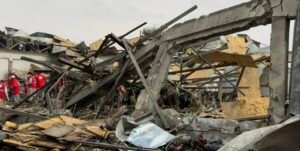
The Rehab center that was bombed by Pakistani airstrike. Photo: @Afghan social media
The Pakistani airstrike on a drug‑rehabilitation center in Kabul — killing more than 400 people and injuring hundreds more — has shaken Afghans across the world. The attack, which overwhelmingly targeted civilians, has become more than a tragic event; it has reopened long‑standing debates about sovereignty, legitimacy, and the complex entanglement of Afghanistan with regional power politics. From Kabul’s devastated neighborhoods to the far‑flung Afghan diaspora, the strike has triggered a wave of grief, anger, and intense political introspection.
While the vast majority of Afghans — inside the country and abroad — have condemned the attack as a blatant violation of humanitarian norms, a small but vocal segment of the diaspora has echoed Pakistan’s narrative. This divergence has exposed deeper fractures within Afghan political identity and diaspora alignments, revealing how decades of war have not only fragmented the country’s institutions but also its interpretive frameworks.
A Nation in Mourning, a Diaspora in Debate
For most Afghans, the moral stakes are clear. As writer Homaira Qaderi put it, even if the casualties were “four, not four hundred,” each life lost represents “a homeland in itself.” Her words reflect a widespread sentiment: Afghan suffering has become so normalized that some observers have lost the capacity to recognize the human cost of geopolitical maneuvering. The attack, for many, is not an isolated incident but part of a long pattern of Pakistan’s interference in Afghanistan — a pattern in which civilians repeatedly pay the highest price.
Humanitarian voices have reinforced this view. Jan Egeland of the Norwegian Refugee Council, after visiting the site, stated that civilians and civilian infrastructure must never be targeted, emphasizing that all parties are bound by international humanitarian law to protect non‑combatants. His statement aligns with international legal standards: even if the Taliban had used the facility as a “human shield” — a claim not supported by independent observers — such a tactic would itself constitute a war crime, but would still not justify an airstrike on a site housing thousands of vulnerable patients.
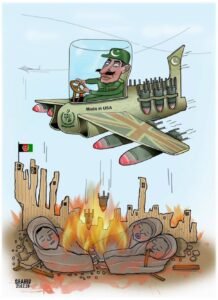
Afghan journalists have echoed this legal framing. One noted that Pakistan’s claim of “precise and professional” strikes collapses under scrutiny: a state cannot simultaneously boast of precision and plead ignorance about the presence of civilians. If Pakistan did not know, it is an intelligence failure; if it did know, it is an act of deliberate brutality.
The Karimi–Nabil Exchange: A Window Into Afghan Political Anxiety
The public exchange between filmmaker Sahra Karimi and former intelligence chief Rahmatullah Nabil has become emblematic of the deeper tensions shaping Afghan discourse. Karimi’s critique rests on a fundamental suspicion: that the Taliban–Pakistan confrontation is not a genuine rupture but part of a broader psychological and geopolitical choreography. Her argument reflects a widespread belief among Afghans that both actors have historically operated in tandem, and that any apparent conflict must be scrutinized for hidden motives.
She raises a pointed question: if Pakistan truly seeks to weaken the Taliban, why are civilians — not Taliban leaders — the primary victims? Why is there no reciprocal pressure on Pakistani soil? For Karimi, the danger lies not only in the violence itself but in the subtle normalization of the Taliban as defenders of Afghan territory. By addressing the Taliban as actors capable of “real will,” she argues, Afghan elites risk reinforcing a narrative that grants the group unintended legitimacy.
Nabil’s response reframes the debate around moral clarity. For him, condemning the killing of civilians is not a political act but an ethical imperative. He warns that interpreting every statement through the lens of psychological warfare risks eroding the very capacity to condemn atrocities. Yet he also acknowledges the multi‑layered nature of warfare in the region: conflicts in Afghanistan often operate simultaneously as real battles and strategic games, shaped by actors far beyond the visible frontlines. His position is that complexity must not obscure accountability — neither Pakistan’s nor the Taliban’s.
Their exchange reveals a broader crisis within Afghan political discourse: a struggle to interpret events in a context where truth, strategy, and manipulation are deeply intertwined. Whether one prioritizes moral clarity, as Nabil does, or structural suspicion, as Karimi urges, both perspectives highlight the same underlying reality — Afghans remain trapped between external aggression and internal fragmentation.
A Fragmented Diaspora, a Shared Grief
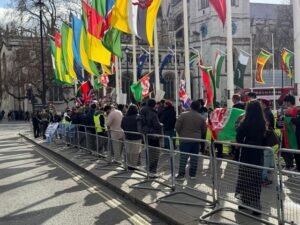
The diaspora’s divided response reflects long‑standing political cleavages. Some diaspora members, driven by absolute opposition to the Taliban, view any blow against the group as justified, even when civilians are harmed. Others see the attack as yet another chapter in Pakistan’s decades‑long strategy of destabilizing Afghanistan. Former diplomat Ashraf Haidari situates the airstrike within a broader regional crisis, arguing that Afghanistan has once again become a battleground for competing agendas, with Afghans bearing the human, political, and security costs.
The debate ultimately reveals a painful truth: Afghanistan’s fragmentation is not only territorial or political but also interpretive. Afghans do not merely disagree on solutions; they increasingly disagree on the meaning of events themselves. The airstrike has become a prism through which deeper anxieties are refracted — about sovereignty, legitimacy, diaspora responsibility, and the moral boundaries of resistance.
Yet despite these divisions, one point remains clear: the victims were civilians. Their deaths demand accountability, not geopolitical justification. And in a region where war often operates on multiple layers — real, strategic, and psychological — the insistence on protecting civilian life may be the last remaining moral anchor in an otherwise shifting landscape.