Afghanistan’s Growing Resilience through Trade Diversification amidst Border Tensions
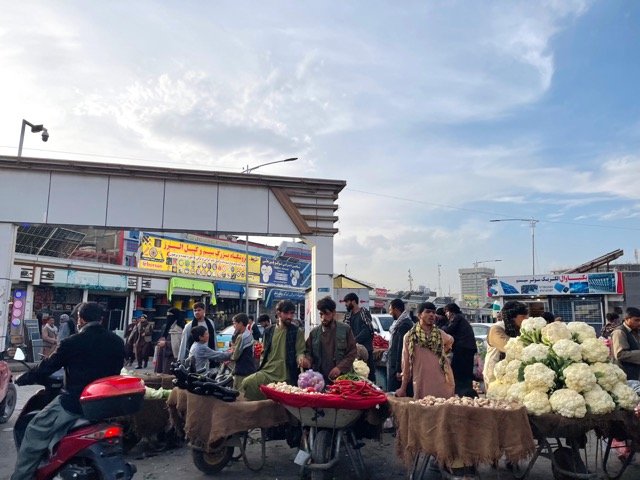
A market spot in central Kabul. Photo by @AADIL for ADN
By A. Shafaq
The economic recovery phase of the landlocked economy of Afghanistan is heavily reliant on regional trade. Surprisingly, Afghan exports have almost doubled since 2021. In 2024, export value reached $1.8 billion compared to $850 million in 2021[1]. However, there has been a significant rise in imports as well, leading to an overall trade imbalance. Thus, measures like supporting more local businesses to enter international markets have gained prominence in Kabul’s agenda.
However, Kabul’s sustenance of trade activities is contingent on geoeconomics, which has not been positioned in its favor lately. Its neighbor to the east, Pakistan, with which it shares about 2600 km of the border, has impeded the trade growth. Afghanistan is currently faced with two challenges, double jeopardizing its trade situation. One is its decline in trade with one of its major trading partners, Pakistan, due to growing hostilities, leading to trade revenue loss. There has been a decline in trade activities between the two neighbous. The bilateral trade fell by 40 percent as of January 2026. There has been a suspension of all trade activities between the two since 10 October 2025[2][3].
Second, tensions at the border have limited the cargo transit from Pakistan’s territory. Given that Pakistan has been the gateway to the seaport of Kabul, the situation is concerning. The prolonged border closure is causing additional hardships to Afghanistan, due to disrupted supplies of food items imported from Pakistan, including flour, rice, vegetables, and poultry. This has raised the prices in Afghanistan’s markets[4].
These rising hostilities with Islamabad have compelled Kabul to proactively seek newer trade alignments, as maintaining trade resilience is of utmost priority for Kabul. This has led to significant strategic trade diversification. As the transit corridors remain disrupted by Islamabad, traders are relying on alternative routes through Iran and Central Asia[5].
Due to Iran’s concessions, which involve offering their cargo a 30% cut in port tariffs, 75% off storage fees, and 55% off docking charges, Afghan traders are now increasingly transiting their cargoes via Iran’s Chabahar port[6][7]. Thus, the India-backed Chabahar port has helped in minimizing shipment delays and provided ease of doing business to the traders despite the border disputes. Moreover, they have extended the overland shipments via Uzbekistan, Turkmenistan, and Tajikistan.
Afghanistan is taking measures to steer away from its heavy reliance on Islamabad as a trade partner. By actively reviving older trade ties and forming new ones, Afghanistan seems to be growing strong.
With high-level political visits to India in November 2025, the two countries are writing new chapters of trade diplomacy[8]. Besides, the bilateral trade between the two historic trade partners has been reviving over time. In 2024, India’s exports to Kabul were valued at $333.52 million, with the export basket majorly comprising pharmaceuticals, vehicles, apparel, and other agricultural allied products[9]. On the other hand, Afghanistan’s saffron, dry fruits, nuts, and handicrafts find an immense scope among the Indian buyers. Besides, the International North-South Transport Corridor (INSTC), a multimodal route linking Mumbai with Europe via Bandar Abbas/Chabahar, Iran, and Central Asia, is of special economic and strategic significance for Afghanistan as it provides a scope for minting transit revenue and ensuring domestic stability along key highways.
The bilateral trade between Iran and Afghanistan has also registered a surge, reaching to $3.5 billion in 2025. In the last six months, Iran-Afghan trade value has surpassed that of Afghanistan and Pakistan[10].
In Kabul’s search for reliable trade partners[11], the Taliban has started actively engaging with its northern neighbors in Central Asia. Afghanistan’s trade with Central Asian economies has grown steadily, reaching nearly $1.7 billion[12]. In 2024, Kabul signed a road map with Kazakhstan to raise bilateral trade to $3 billion in the coming years, while Kabul also doubled its exports via Turkmenistan’s border in 2025, compared to previous years. Though Kabul has a considerable amount of work to do in strengthening ties with the alternative partners, it has started taking action in that direction.
The swift response to the border closure by diversifying trade routes and partners reflects the growing resilience of the fragile economy and the ability to respond to regional geopolitical bullying. The measures taken by Kabul, by increasingly reducing its trade dependency on Islamabad through trade route diversification, are shooting two birds with one stone. First, Kabul has been able to protect its trade flows, which, as mentioned, is indispensable for its economy’s health, given their reducing reliance on international aid. Second, diversification is being leveraged as an opportunity to bolster its economic ties with India, Iran, and other Central Asian partners[13]. International trade is crucial for Afghanistan’s growth engine and for reducing aid dependency[14]. Looking forward, this diversification could provide Kabul with long-term benefits while reducing its susceptibility to frequent political arm-twisting by regional powers.
A. Shafaq (pseudonym) is a researcher and lecturer at one of the private universities in Kabul.
Note: The contents of the article are of sole responsibility of the author. Afghan Diaspora Network will not be responsible for any inaccurate or incorrect statement in the articles.
[1] https://www.arabnews.com/node/2585672/amp
[2] https://kabulnow.com/2026/01/afghanistan-pakistan-trade-drops-40-amid-prolonged-border-closure/
[3] https://gulfnews.com/business/pakistans-trade-deficit-with-neighbouring-countries-surges-44-1.500419972
[4] https://amu.tv/223768/
[5] https://www.reuters.com/world/asia-pacific/afghan-trade-resilient-2025-iran-central-asia-routes-offset-pakistan-closures-2026-01-06/
[6] https://www.reuters.com/world/asia-pacific/afghanistan-shifts-trade-iran-route-avoid-pakistan-closures-2025-11-14/
[7] https://www.reuters.com/world/asia-pacific/afghan-trade-resilient-2025-iran-central-asia-routes-offset-pakistan-closures-2026-01-06/
[8] https://www.ndtv.com/world-news/afghanistan-turns-to-india-for-trade-expansion-in-sharp-snub-to-pakistan-9666383
[9] https://tradingeconomics.com/india/exports/afghanistan
[10] https://stratnewsglobal.com/neighbours/afghanistan-moves-trade-to-iran-to-remove-pakistan-dependency/#:~:text=Landlocked%20Afghanistan%20is%20leaning%20more,not%20stop%20when%20borders%20close.%E2%80%9D
[11] https://www.juancole.com/2025/12/afghanistan-economically-dependence.html#:~:text=Those%20factors%20have%20ensured%20that,to%20$2%20billion%20in%202025.
[12] https://tolonews.com/business-192899
[13] https://moderndiplomacy.eu/2026/01/06/afghan-trade-holds-steady-in-2025-despite-pakistan-border-closures/#:~:text=Afghan%20traders%20increasingly%20utilized%20Iran’s,neighbour%20and%20enhancing%20economic%20resilience.
[14] https://www.intracen.org/our-work/projects/afghanistan-advancing-trade-phase-ii