The Afghan Barista Who Conquers Vienna’s Coffee Rituals One Cup at a Time

Habib, owner of Café Latte Art in Vienna’s 9th district near the University of Vienna. Photo: @Ali Ahmad
Afghan diaspora entrepreneurship is often spoken of in broad, often reductive, strokes-resilience, adaptation, cultural blending. But few personal stories illustrate these sweeping themes as profoundly as that of Habib, the founder and quiet maestro behind Vienna’s beloved Café Latte Art.
His is not merely a tale of business success in a foreign land; it is a narrative forged by decades of survival, painstakingly slow integration, fiercely held cultural pride, and a deep, almost civic-minded sense of responsibility to those following his difficult path.
Habib, like many Afghans uses one name, arrived in Austria in 2000 with no plan beyond survival. He had fled Afghanistan as a teenager after the fall of Dr. Najibullah’s government in 1992, spent years between Turkmenistan and Ukraine, and eventually entrusting his fate to smugglers who led him to the Austrian border. When police asked whether he wished to stay or move on, he chose Austria by necessity rather than destiny.
“I did not have the money to go further to Germany,” he recalls.
He would end up staying for 25 years – and becoming a model of Afghan diaspora entrepreneurship.
From Refugee Camp to the Coffee Counter
Habib’s early years in Austria were marked by uncertainty. He spent seven years waiting for an asylum decision, a limbo that pushes many refugees into despair. Instead, he saw it as time to prepare.
“I found a language book and started learning German,” he says. “After six months, I was able to communicate.”
Support came unexpectedly. A Caritas (Charity organization) worker who noticed his Ukrainian/Russian language skills asked him to translate when she visited the refugee camp. She later helped him move to Vienna from Burgenland, where he began vocational training in hospitality. But even then, barriers remained:
“Getting permission to work was not common for asylum seekers,” he says. “My Austrian mother (a woman voluntarily helping him) did not believe it when I showed her I had permission.”
As he worked four days a week and studied on the fifth, he found a second job in a small café in Vienna’s Naschmarkt – a tourist frequent visiting spot.
“This was the first time I started working in a café shop,” he remembers. “The first time I tasted café in my life.”
He excelled quickly, promoted from the kitchen to cashier, then barista. His talent took him to the national stage when he placed second in a coffee-making competition – an achievement that would later help secure his citizenship.
“All those appreciation letters helped me get my citizenship very quickly,” he says.
But the real turning point came a decade later.
Café Latte Art: A Business Built on Blending Cultures
In 2015, Habib opened Café Latte Art, a modest space that would grow into a multicultural hub. Starting the business, he insists, was not the hard part.
“Starting a business is easy. Maintaining it is difficult,” he explains. “You must have all the information and relevant experience.”
What sets his café apart is not only the quality of its coffee but the philosophy behind it. He understood early that an exclusively Afghan-style business would not survive in Vienna.
“Our culture is tea,” he says. “But I cannot make a living with a tea house here.”
Instead, he blended Afghan values with Vienna’s world-famous coffee culture.
“We should respect the culture of this society but at the same time preserve our own,” he says. “I tell Afghans who come for business consultation: mix Austrian culture with Afghan culture.”
His café became a bridge – Austrians came for the coffee, Afghans for the community. He has trained more than 300 people in barista skills, many referred by Austria’s labor market service (known Arbeitsmarkt Service) employment agency. Iranian migrants also come for training, turning his café into a small, formal entrepreneurship academy.
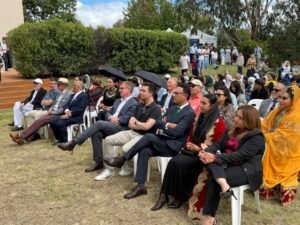
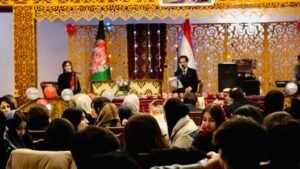
Beyond business, he uses Afghan cultural events to showcase both heritage and professionalism. “We show host society that we can integrate ourselves, reach some heights. We bring their culture of coffee to new heights – better than them,” he laughs.
At home, he insists on preserving Afghan identity. “We speak Dari at home,” he explains, despite his Turkmen roots and his wife’s Pashtun background. “We celebrate every Afghan cultural event. We do not want our children not to know Afghan culture.”
Diaspora Responsibility and the Future of Afghan Entrepreneurship
For Habib, entrepreneurship is inseparable from responsibility – both to the host country and to his community. He acknowledges how long asylum waiting periods push some refugees into frustration or even crime, but he makes no excuses.
“If migrants themselves say refugees should be arrested or deported if they commit a crime, we cannot blame Austrians for saying the same,” he notes.
His goal has long been to uplift newcomers through training and mentorship. In 2015, during Europe’s refugee influx, he even offered free information sessions twice a month for Afghans interested in business.
His message to the diaspora is consistent and direct:
“Whatever we are, we represent one nation – Afghanistan. If we are united and help each other, it is good. If one Afghan commits a crime, we are all associated with that Afghan.”
He dreams of one day taking his skills home. “This is my desire,” he says. “To transfer my knowledge to Afghanistan if the situation is right.”
A Case Study of a Bigger Story
Habib’s story captures the spirit of Afghan diaspora entrepreneurship: born of necessity, built through perseverance, and enriched by cultural duality.
It challenges common narratives about refugees as passive recipients of aid. Instead, it shows how given the chance, they can become business owners, trainers, cultural ambassadors, and contributors to the economies that host them.
As for Café Latte Art, it stands today as more than a coffee shop. It is a space where Austrian and Afghan cultures coexist, where new migrants learn skills, and where a man who once arrived with nothing rebuilt his identity and helped others do the same.
Habib sums up his philosophy simply:
“You must wait, learn, and adjust yourself. Learn the language. Learn the system. Try your best to reach a good position.”
His journey shows that diaspora entrepreneurship is not just about business – it is about belonging, responsibility, and the quiet power of building something with your own hands.