“We Are Tired of Advocacy”: Fawzia Koofi on Afghan Women
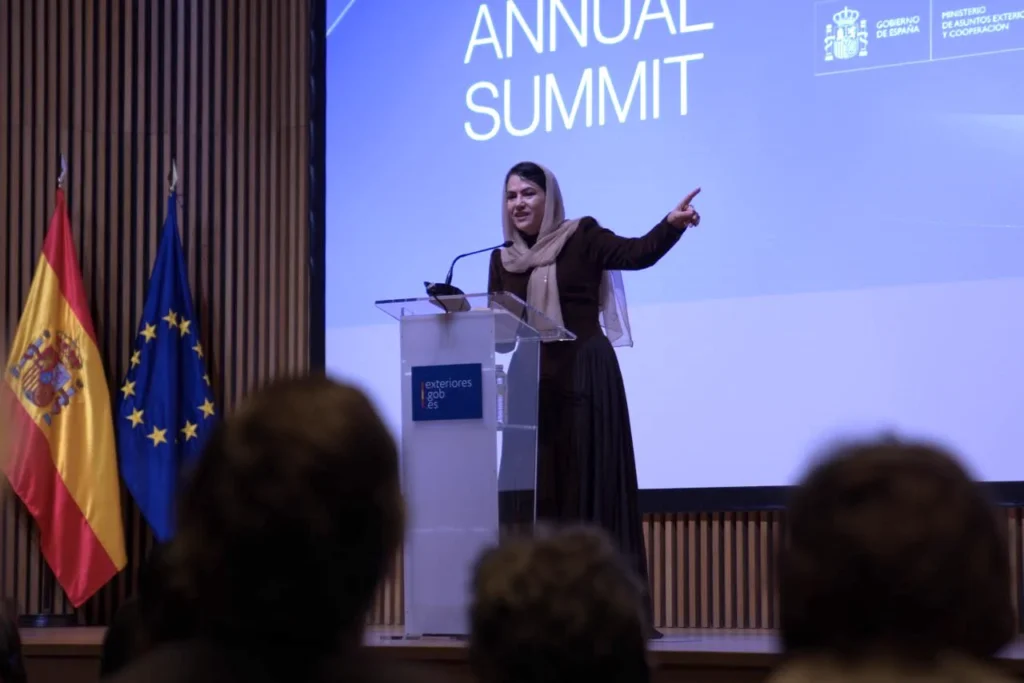
Afghan women's rights activist Fawzia Koofi. Photo: @Women for Afghanistan.
Nothing can justify the Taliban’s systematic restrictions on women and girls. Yet many Afghans continue to ask whether accountability should apply more broadly across Afghanistan’s political landscape.
By Kazim Jafari
At the Fourth HearUs Summit in Madrid, Afghan women’s rights advocate Fawzia Koofi delivered a message that reflected both exhaustion and determination. Addressing diplomats, UN representatives, activists, and Afghan women leaders, she argued that the time for merely discussing the plight of Afghan women has passed.
“We are tired of advocacy,” she said.
The statement was not rhetorical. For Koofi, it reflected a lifetime of activism. She recalled beginning to advocate for girls’ education as a child and finding herself, more than four decades later, still campaigning for the same basic rights. Her remarks captured a growing frustration among Afghan women who feel that international sympathy has not translated into meaningful change inside Afghanistan.
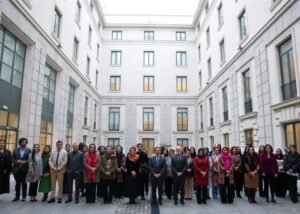
The Madrid summit, organized by Spain’s Ministry of Foreign Affairs together with Women for Afghanistan, was held under the theme “The Leadership of Afghan Women to Achieve Justice and Peace through Accountability.” The gathering sought to place Afghan women at the center of discussions about the country’s future and to strengthen international efforts aimed at justice and accountability.
For Koofi, however, the value of the summit extended beyond diplomacy.
She praised Spain not only for supporting Afghan women politically but also for providing what she described as a space of belonging at a time when many Afghans feel they have lost their country, identity, and political voice. The summit, she argued, has evolved from an advocacy forum into a platform that aspires to transform words into action.
Her comments came as Spain intensified its criticism of Taliban policies. Opening the summit, Spanish Foreign Minister José Manuel Albares described the Taliban’s treatment of women as “gender apartheid” and insisted that those responsible would eventually be held accountable. He emphasized that Spain would not recognize the Taliban as Afghanistan’s legitimate authorities as long as they continue systematically violating women’s rights.
The language is significant.
Increasingly, governments, legal scholars, and human rights advocates are using the term “gender apartheid” to describe the institutionalized exclusion of women from education, employment, and public life in Afghanistan. Spain has gone further by supporting efforts to recognize gender apartheid within international law and advocating for stronger legal mechanisms against forced marriage, gender-based persecution, and other violations.
Koofi’s description of conditions inside Afghanistan reinforced this argument.
She noted that Afghanistan remains the only country in the world where girls and women are systematically denied access to secondary and higher education. These restrictions affect millions of women whose lives are increasingly confined to their homes.
The exclusion, she argued, extends far beyond classrooms.
Women have largely disappeared from government employment and many sectors of the labor market. According to Koofi, the most painful consequence is not simply unemployment or loss of income, but the erosion of women’s social existence.
“What is more heartbreaking,” she said, “is that they have given women the feeling that they do not exist.”
That observation speaks to what many Afghan women describe as a broader process of erasure. Restrictions imposed since 2021 affect education, employment, movement, public participation, and representation. As a result, many women believe they are being pushed out of society itself.
Koofi also raised concerns about child marriage. Referring to recent Taliban regulations, she argued that economic hardship and restrictive policies are creating conditions in which girls become increasingly vulnerable to early and forced marriages. For many impoverished families, marrying off a daughter has become a coping mechanism in the face of economic desperation.
A central part of her speech challenged Taliban claims that such policies are rooted in Islam.
Koofi argued that the exclusion of women is fundamentally political rather than religious. In her view, women’s rights have become casualties of a system designed to consolidate power. She maintained that many Islamic scholars reject the Taliban’s interpretation of religion and view women’s education and participation as fully compatible with Islamic principles.
Beyond rights and religion, Koofi painted a bleak picture of Afghanistan’s economic reality. She described a country rich in natural resources yet increasingly defined by poverty, malnutrition, and dependency. Hospitals, she argued, are filled with malnourished women and children while shortages of female doctors, nurses, medicine, and medical equipment continue to grow.
For Koofi, this is not simply a humanitarian crisis.
It is a political crisis.
Indeed, one of the most important questions emerging from the Madrid summit concerns the meaning of “action” and “accountability” itself. Calls for accountability were repeated throughout the gathering, but what exactly do they entail?
Few participants appear to be advocating military intervention, and countries such as Spain have consistently favored diplomatic, legal, and political measures. Spain already refuses to recognize the Taliban government and supports international investigations into human rights violations, including efforts to document abuses and strengthen accountability mechanisms.
Yet significant uncertainties remain. The Taliban currently controls the Afghan state and shows little indication that it considers itself accountable to international institutions or external pressure. If recognition has already been withheld and condemnation has become routine, what additional tools are available to influence Taliban behavior?
The accountability debate also extends beyond the current rulers.
Nothing can justify the Taliban’s systematic restrictions on women and girls. Yet many Afghans continue to ask whether accountability should apply more broadly across Afghanistan’s political landscape. The collapse of the republic in 2021 was preceded by years of corruption, political fragmentation, and governance failures. Critics argue that some former officials and political elites who now advocate for democracy and human rights have never fully accounted for their own role in creating the conditions that enabled the Taliban’s return.
This does not create moral equivalence between the two. The Taliban’s exclusion of women remains unprecedented in its scale and scope. But it raises a difficult question: can accountability be selective?
The challenge facing Afghan women today is therefore larger than documenting abuses. It is about defining a political future in which all actors are held responsible for their actions.
Koofi’s speech reflected a broader transformation in Afghan women’s activism. Increasingly, activists are no longer asking simply to be heard. They are demanding justice, representation, and consequences.
Whether the HearUs Summit can help translate those demands into tangible outcomes remains uncertain. What Koofi made clear, however, is that many Afghan women believe the era of advocacy alone has run its course. The real question now is whether the international community can move beyond expressions of solidarity and toward forms of accountability that have both credibility and impact.
Kazim Jafari is a political science student at the University of Heidelberg in Germany.
Note: The contents of the article are the sole responsibility of the author. Afghan Diaspora Network will not be responsible for any incorrect statements in the articles.