Two Fronts, One Doctrine: Pakistan’s Proxy Warfare from Kashmir to Afghanistan
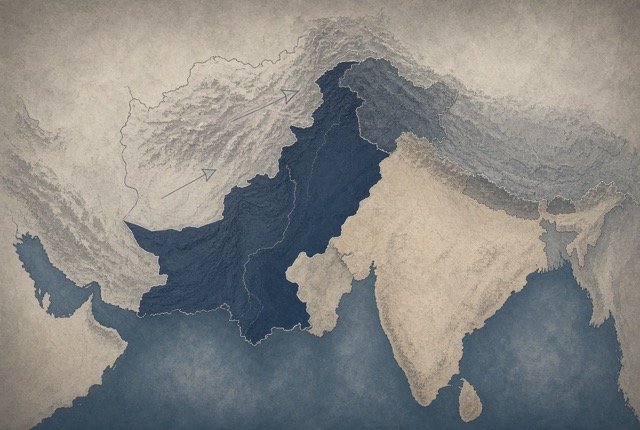
Pakistan helped create the Afghan Taliban and supported the Haqqani Network, which US Admiral Michael Mullen told the Senate in 2011 was basically an arm of Pakistan’s intelligence agency.
By Rahmatullah Achakzai
Pakistan’s use of jihadist proxies against its neighbors is not a thing of the past. It remains a key part of its state policy, active on two fronts and supported by the top military leadership. This is based not only on intelligence reports but also on public records from Western governments, UN sanctions committees, and statements from Pakistan’s own officials.
Since 2021, the main change has been the location of Pakistan’s sub-conventional warfare in the region, not the approach. This approach, originally used against India in Jammu and Kashmir, is now also aimed at the Taliban government in Afghanistan, which Pakistan helped bring to power in August 2021. Field Marshal Syed Asim Munir has overseen this shift, resulting in two ongoing proxy conflicts, a military standoff with India, unilateral airstrikes in Afghanistan, and no outside power willing to step in to stop Pakistan’s dangerous game.
Notably, this strategy is not new, and it goes back more than 70 years to when Pakistan gained independence. In 1947, Pakistan sent tribal fighters into Jammu and Kashmir, used similar tactics in Operation Gibraltar in 1965, and made it official policy in the 1980s when General Zia-ul-Haq managed American and Saudi support for the Afghan mujahideen. The networks, training camps, and fundraising systems built for that war were never taken apart after the Soviets left in the early 1990s. Instead, they were used in Jammu and Kashmir after 1989 and again in Afghanistan after 1994, following the strategy of gaining “strategic depth” in its western neighbor. For the Pakistan military establishment, this kind of subconventional warfare offered enough room for deniability, which was more valuable than direct intervention.
There is a long record of sanctions against terrorist outfits based in Pakistan, but these measures have had little effect on stopping terrorism in the region. The United States labelled Lashkar-e-Taiba (LeT) and Jaish-e-Mohammed (JeM) as terrorist organizations in December 2001, and the UN added LeT to its sanctions list in May 2005. The US Treasury named Masood Azhar, LeT commander Azam Cheema, and political chief Hafiz Abdul Rahman Makki as global terrorists as well. The UN updated its list in 2012 to include the Falah-e-Insaniat Foundation as a LeT front, and the US kept adding LeT financial facilitators in 2016 and 2018 for using Pakistan’s banking system. The Financial Action Task Force (FATF) put Pakistan on its grey list from 2018 to 2022, leading to some new laws, but the terrorist outfits themselves were not dismantled.
At times, Pakistani officials have admitted what these sanctions mean for the military-run proxy warfare in the region. In 2015, former President Pervez Musharraf said Pakistan had supported militant groups for fighting in Kashmir and even called them heroes at the time. In 2019, Imran Khan told an American audience that Pakistan had around 30 to 40 thousand armed men trained for fighting in Kashmir and Afghanistan and that past governments had hidden this from the US. In 2024, Defence Minister Khawaja Asif said on British TV that Pakistan had done this work for foreign backers for about 30 years. These statements came from Pakistani politicians, not the military establishment, which runs the policy.
The events of 2025 showed that this policy remains active and works as a reliable tool to create instability in the region and put the spotlight on the Pakistan military as the ultimate protector. In April last year, Pakistan-backed terrorists killed 26 civilians in Pahalgam, and the Resistance Front (TRF), a LeT proxy, claimed responsibility twice. Two months later, the US labelled TRF as a ‘Foreign Terrorist Organisation’ and Specially Designated Global Terrorist, calling it a LeT front and proxy. On May 7, India targeted Markaz Taiba in Muridke and Markaz Subhan Allah in Bahawalpur. The most telling evidence of the close cohesion between the Pakistan military establishment and proxy outfits came after India conducted Operation Sindoor in May, when photographs showed funerals of terrorists, with coffins covered in Pakistan’s national flag, and senior uniformed army officials present. Reports later identified a serving Lieutenant General and the Inspector General of Punjab Police among the mourners, and said wreaths were laid for the Pakistani army chief and Punjab chief minister.
Munir’s support for this policy is clear from his own speeches. Just days before the Pahalgam attack, he spoke at the Overseas Pakistanis Convention in Islamabad. He referred to the ‘two-nation’ theory, told the diaspora that Pakistanis were different from Hindus in every way and followed a superior ideology, and called Kashmir Pakistan’s lifeline. At another event, he described the Kashmir conflict as one that would last for generations and said Pakistan was ready for ten more wars over it.
Afghanistan now shows that this approach is not just aimed at India. Pakistan helped create the Afghan Taliban and supported the Haqqani Network, which US Admiral Michael Mullen told the Senate in 2011 was basically an arm of Pakistan’s intelligence agency. The ISI chief was seen in Kabul just days after the Taliban took over in 2021. However, the bilateral relationship has changed substantially in the last five years. Earlier this year, the Taliban spokesman said a group within Pakistan’s military was trying to destabilize the region and accused Islamabad of sheltering Islamic State Khorasan (IS-K) instead of fighting it. In a recent statement, Afghanistan’s Ministry of Defence revealed its forces killed 28 fighters and captured 32 in the eastern province of Nuristan, claiming Pakistani security agencies were financing and training those individuals to fight against the Taliban.
Pakistan continues using this strategy of creating instability in the neighborhood through proxy groups because it is cheap, easy to deny, and benefits the military. It helps the Pakistan Army keep its budget and political power intact, while the local population bears the ultimate costs. International sanctions have mostly targeted individuals and terrorist outfits, not the Pakistan Army itself. Moreover, Pakistan got off the FATF grey list by changing its paperwork, and since 2025, renewed US ties with Rawalpindi have removed the last bit of external pressure on terrorism. As a result, South Asia now faces increasing chances of instability, aided by the Pakistani military, that may lead to major military conflicts and possibly mass-casualty events.
Rahmatullah Achakzai is a journalist based in Balochistan, covering human rights, regional politics, and cross-border issues.
Note: The contents of the article are the sole responsibility of the author. Afghan Diaspora Network will not be responsible for any inaccurate statements in the articles.