Vienna Protest Highlights Civilian Suffering Amid Rising Afghanistan–Pakistan Tensions
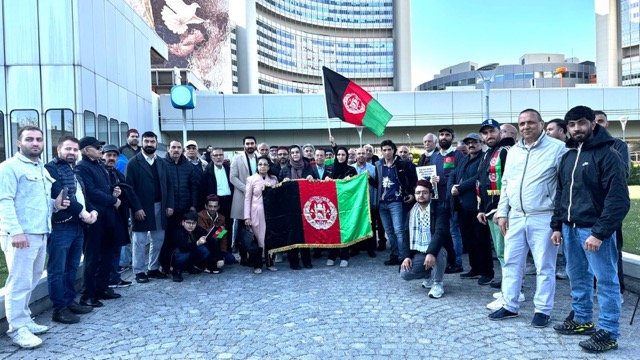
On 11 April 2026, members of the Afghan diaspora gathered in front of the UN Office in Vienna to denounce Pakistan’s military actions in Afghanistan. Photo: @Ali Ahmad for ADN
On 11 April, nearly one hundred members of the Afghan diaspora gathered outside the United Nations Office in Vienna to protest escalating attacks across the Durand Line into Afghanistan. The crowd included Pashtun Tahafuz Movement (PTM) supporters, civil society members, and diaspora activists from across Austria.
Protesters carried the tricolor flag of the former Afghan republic and banners such as “No to Pakistani Aggression!” and “Afghans Are Victims, Not Creators of Terrorism.” Some recited poems written for the event, blending political expression with cultural identity.
Speakers said the world’s attention is fixed on the confrontation involving the United States, Israel, and Iran, while another crisis is unfolding quietly between Pakistan and Afghanistan. They argued that this lack of visibility has deepened the humanitarian toll.
Civilian Harm and Refugees
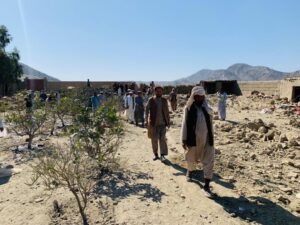
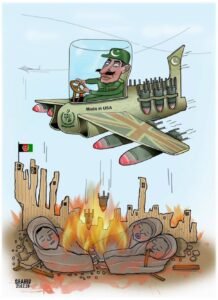
Speakers referenced Afghan authorities who allege that recent Pakistani air and ground operations struck civilian areas, including a drug rehabilitation hospital in Kabul on 16 March. Afghan officials claim hundreds were killed and scores were injured.
Fazel Rahman, one of the co-organizers of the demonstration, speaking to the crowd, said Afghanistan has endured “more than four decades of war, interference, and pain.” He described the current escalation as part of a long‑term pattern that has repeatedly placed civilians at risk. “People who needed help were killed. Patients were hit. Entire families were affected,” he said.
Rahman questioned the muted international response. “How can the world remain silent when civilian areas are struck?” he asked, urging global institutions to take the situation seriously.
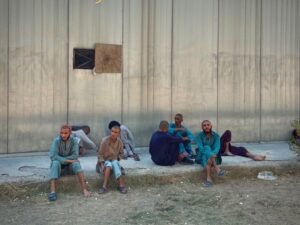
The treatment of Afghan refugees in Pakistan was another central theme. Speakers said many refugees face deportation, harassment, and the loss of property. These concerns echo findings from human rights organizations documenting forced returns and discrimination.
Stoorai Khan, another co-organizer, addressed the crowd in Urdu with a similar message. “Afghans who fled for safety are now facing pressure, uncertainty, and fear,” he said. “Refugees should not be treated as criminals. They deserve protection and dignity.”
Khan also questioned Pakistan’s diplomatic positioning. “Pakistan says it is helping facilitate peace between Iran and the United States,” Khan said, “but it should first look at the conflicts within its own borders, especially in Balochistan and Khyber Pakhtunkhwa. A country facing internal unrest cannot present itself as a neutral peace broker.”
The protest’s resolution highlighted four key demands.
First, it condemned continued air and ground attacks on Afghan territory as violations of sovereignty.
Second, it called for an immediate ceasefire and urged international bodies to publicly denounce the escalation.
Third, it requested an independent investigation into recent airstrikes and civilian casualties.
Fourth, it demanded protection for Afghan refugees under UNHCR and Geneva Convention standards.
The resolution also expressed solidarity with victims of war, displaced persons, and ethnic groups facing repression, including Pashtuns and Baloch across the Durand Line.
Geopolitics and Unity
Speakers questioned Pakistan’s role as a mediator in talks between Iran and the United States. They argued that a state engaged in conflict with its neighbor — and simultaneously confronting internal unrest — cannot credibly present itself as a peace facilitator.
Rahman said the region is experiencing “multiple overlapping crises,” and that Afghanistan’s situation should not be overshadowed. He argued that instability in one part of the region often fuels instability elsewhere. “These conflicts are not isolated,” he said. “They are connected through politics, security, and the lives of ordinary people.”
Analysts often note that Afghanistan and Pakistan share a deeply intertwined security environment shaped by porous borders and shifting alliances. Protesters, however, insisted that civilian protection must remain the priority.
A recurring theme was unity among Afghans. Speakers called on Pashtuns, Tajiks, Hazaras, Uzbeks, and others to stand together against violence and external interference. “Our strength is our solidarity,” Rahman said. “Afghans must speak with one voice when it comes to protecting their people.”
The resolution echoed this message, affirming that Afghanistan belongs to its people and that no external force has the right to interfere in its internal affairs. It urged unity across ethnic and political lines to safeguard national sovereignty.
Khan also emphasized unity. “Afghans everywhere — inside the country and abroad — need to support each other,” he said. “This is not about one group. It is about the future of all Afghans.”
As the demonstration concluded, speakers called for immediate international engagement. They urged the United Nations, the European Union, and human rights organizations to investigate alleged violations, protect refugees, and support accountability mechanisms.
“Afghanistan will not remain silent,” one speaker said. “Our voices are stronger when we stand together.”
For the Afghan diaspora in Vienna, the protest was both a response to recent events and a broader assertion of agency. In a global landscape where Afghanistan is often discussed but rarely heard, demonstrators sought to reclaim space for Afghan perspectives and emphasize the urgency of protecting civilians.