How Islamabad Shia Mosque Bombing Exposed Pakistan’s Failure to Protect Religious Spaces
Photo by @AADIL for ADN
By Shinwari
Sectarian violence has long been a defining and deeply destabilising feature of Pakistan’s internal security landscape, rooted in hostility toward religious identities and expressed through sustained attacks on both people and sacred spaces.
Over decades, this violence has claimed thousands of lives, with minority Muslim sects bearing a disproportionate share of the bloodshed.
Estimates cited by Human Rights Watch indicate that around 4,000 Shia Muslims were killed in sectarian attacks between 1987 and 2007, a toll that continued to rise as Salafi extremist groups intensified assaults from 2008 to 2014.
The impact has not been confined to one community alone. Sunni groups, particularly Sufis and Barelvis, have also been targeted, with deadly attacks on shrines reflecting ideological fault lines within Sunni Islam itself, where shrine veneration is denounced as un-Islamic by more orthodox factions.
Alongside these intra-Muslim conflicts, Pakistan’s non-Muslim minorities—including Hindus, Ahmadis and Christians—have endured what rights groups have described as periods of unprecedented insecurity and persecution.
A recurring and chilling pattern in this violence has been the deliberate targeting of places of worship during prayers or religious gatherings, a tactic designed to maximise casualties while underscoring the sectarian intent behind the attacks.
Capital shaken during prayer
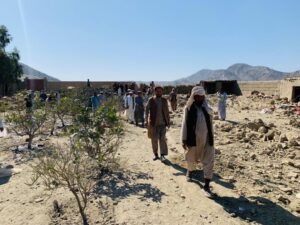
On February 6, a suicide bomber detonated explosives inside the Khadija Tul Kubra Shia mosque in the Tarlai Kalan area of Pakistan’s capital, Islamabad, killing at least 31 worshippers and injuring more than 160 others during Friday prayers.
The blast tore through what should have been one of the safest environments in the country’s most heavily guarded city. Bloodied bodies lay amid shattered glass and debris, while ambulances ferried victims to overwhelmed hospitals.
The scale of the carnage, unfolding in the federal capital, punctured official claims that major urban centres remain insulated from sectarian violence.
Authorities said the attacker was intercepted by mosque guards before opening fire and detonating his device among worshippers. Within hours, the so-called Islamic State claimed responsibility via its Telegram channel, continuing a pattern of attacks by its regional affiliates against Pakistan’s Shia minority.
The claim, while consistent with previous incidents, did little to ease the deeper question raised by the attack — how did a suicide bomber penetrate a place of worship in a city synonymous with security checkpoints, intelligence agencies, and layered policing?
Condemnations without accountability
Pakistan’s senior leadership responded swiftly with statements of grief and condemnation.
Prime Minister Shehbaz Sharif called the bombing a crime against humanity and ordered an investigation. President Asif Ali Zardari echoed similar language, while Defence Minister Khawaja Asif alleged that the attacker had travelled to and from Afghanistan.
Such assertions were made before any public release of investigative findings, reinforcing a familiar pattern in which external blame is invoked even as domestic security lapses remain insufficiently examined.
International reactions followed. The United Kingdom’s ambassador, Jane Marriott, described the violence as abhorrent, while the European Union delegation in Pakistan condemned the attack and offered condolences.
These responses underscored the global shock that a massacre of worshippers could occur in the heart of Pakistan’s capital.
A predictable target, a familiar failure
For Pakistan’s Shia community, the Islamabad bombing was not an aberration but part of a grim continuum. Over the past two decades, Shia mosques, processions, buses, hospitals, and shrines have repeatedly been targeted across the country.
From Peshawar and Quetta to Parachinar and Karachi, attacks have followed a disturbingly consistent script — intelligence warnings, inadequate preventive measures, post-attack condemnations, and little visible accountability.
The federal capital was long portrayed as an exception, a zone where the state’s coercive capacity would deter such violence.
That assumption collapsed on February 6.
The bombing demonstrated that sectarian militants could strike even where surveillance density is highest, raising serious doubts about threat assessment, intelligence coordination, and on-ground protection of vulnerable religious sites.
Security architecture under scrutiny
Pakistan maintains one of South Asia’s most expansive security establishments. Islamabad alone hosts multiple intelligence agencies, elite police units, and paramilitary forces.
Yet the presence of institutions has not translated into effective protection for religious minorities.
The Khadija Tul Kubra mosque was not an obscure location; it was a known Shia place of worship with predictable Friday congregations. In such contexts, the absence of robust, visible security measures becomes difficult to justify.
Officials reported that 169 injured people were transported to hospitals, including the Pakistan Institute of Medical Sciences, where scenes of chaos unfolded as victims arrived in private vehicles and even car boots.
The scale of the emergency response highlighted not preparedness but improvisation, reinforcing concerns that contingency planning for attacks on religious sites remains inadequate.
Sectarian violence as a structural reality
Pakistan is home to an estimated 40 million Shia Muslims, roughly one-fifth of its population. Despite this demographic reality, sectarian violence has persisted with alarming regularity.
Human rights groups and independent researchers estimate that thousands of Shias have been killed in targeted attacks over the past two decades. These are not random casualties of instability; they are victims of sustained ideological hostility.
On November 21, 2024, a Shia religious procession commemorating the death of Hazrat Fatima, daughter of the Prophet Muhammad, was ambushed by unidentified gunmen in Parachinar, the administrative centre of Kurram District in Khyber Pakhtunkhwa.
The attack left at least 44 civilians dead, among them women and children.
The town, where Shias constitute nearly half the population, has long been a flashpoint for sectarian strife and has witnessed repeated massacres, including the 2017 twin bombings that killed more than 100 people.
Such incidents are part of a wider and persistent pattern. Over the years, sectarian violence in Pakistan has taken many forms, from large-scale bombings to precision-targeted shootings.
At times, the spark has been seemingly unrelated disputes. In July 2024, a land disagreement escalated into armed clashes between Sunni and Shia tribes, resulting in 43 deaths.
In other cases, prominent and economically successful Shia individuals have been singled out and assassinated, reinforcing a climate of fear and vulnerability.
In Karachi, the heavily guarded Wadi-e-Hussain graveyard bears silent testimony to this history of targeted killings.
Behind its tall iron gates lie hundreds of Shia victims, including entire families wiped out in attacks such as the 2013 Abbas Town bombing, which killed more than 45 people, among them a mother and her young child.
The cemetery has become a stark symbol of how deeply sectarian violence has penetrated everyday life.
Processions and religious commemorations have frequently been targeted. In 2012, a suicide attack on a Shia procession in Rawalpindi killed at least 20 people during Muharram, one of several assaults on gatherings held in the sacred month.
In Quetta, the Hazara Shia community—marginalised both for its sectarian identity and ethnicity—has endured some of the deadliest attacks, including the 2013 twin bombings that killed over 200 people. Responsibility for those attacks was claimed by Lashkar-e-Jhangvi — a militant offshoot of Sipah-i-Sahaba Pakistan, a Deobandi and anti-Shia group that emerged in the mid-1980s.
In 2015, during Friday prayers, a suicide bomber struck a Shia mosque in Shikarpur, in Sindh, killing 61 worshippers.
The attack reinforced a grim reality for Shia Muslims in Pakistan: the threat of violence extends even into spaces meant to offer safety, faith, and refuge.
As per reports, in Pakistan, militant groups espousing anti-Shia doctrines have operated openly at various points, organising rallies and mobilising supporters with limited interference.
While some organisations have been formally banned, their networks, aliases, and street power have often endured. This environment has normalised the targeting of Shias to an extent that attacks, while shocking, no longer provoke sustained institutional reform.
The capital as a symbolic failure
That such an attack occurred in Islamabad carries symbolic weight. The city represents the Pakistani state in its most concentrated form — ministries, embassies, military headquarters, and intelligence offices are clustered within its boundaries.
When a suicide bomber can breach a mosque here, it signals not merely a local lapse but a systemic failure of deterrence.
Top Shia leaders were explicit in their criticism. Raja Nasir Abbas Jafri described the bombing as a serious failure to protect human lives and questioned the performance of law enforcement agencies. His remarks echoed a broader sentiment within the community that official assurances of protection ring hollow when measured against repeated bloodshed.
Media silence and public distrust
The immediate aftermath of the attack also exposed another fault line — information control.
As images and videos circulated rapidly on social media, several mainstream television channels were slow to report the incident, prompting public backlash.
Journalists and citizens questioned why news of a mass-casualty attack in the capital initially spread through unofficial channels rather than established media outlets.
This delay fed into a wider erosion of trust.
In a country where sectarian violence has become tragically routine, the perception that information is managed or downplayed compounds public cynicism about the state’s willingness to confront the problem honestly.
A pattern that refuses to break
The February 2026 bombing joins a long list of attacks that should have prompted structural change but did not.
From the Marriott Hotel bombing in 2008 to the Islamabad judicial complex attack in 2025, inquiries have been announced, reports compiled, and recommendations shelved.
Each new incident is framed as an isolated tragedy rather than evidence of an unresolved security crisis.
What distinguishes the Khadija Tul Kubra attack is not only its brutality but its location. If Islamabad cannot guarantee the safety of worshippers inside a mosque during Friday prayers, claims of progress against militancy ring increasingly hollow.
Measure of state responsibility
Protecting places of worship is a basic obligation of any state, particularly one that defines itself through religious identity.
The failure to safeguard Shia mosques, repeatedly and predictably, reflects more than operational shortcomings. It points to a deeper reluctance to confront sectarian extremism as a central national security threat rather than a peripheral issue.
The Islamabad bombing did not occur in a vacuum. It emerged from years of tolerated hate speech, inconsistent enforcement, and a security paradigm that has prioritised some threats while downplaying others.
Author chooses a single pseudonym. Shinwari is a freelance journalist based in Peshawar, Pakistan.
Note: The contents of the article are of sole responsibility of the author. Afghan Diaspora Network will not be responsible for any inaccurate or incorrect statement in the articles.